Source Credit : Portfolio Prints
Background
U.S. asset manager Nuveen agreed to acquire the British investment-management firm Schroders plc in a transaction valued at approximately £9.9 billion ($13.5 billion). The deal — structured as an all-cash takeover offer — will create one of the largest global active asset managers, with a combined nearly $2.5 trillion in assets under management (AUM) across institutional, wealth-management, and retail channels.
The Deal in Detail
- Nuveen, a major U.S. asset manager owned by the Teachers Insurance and Annuity Association of America (TIAA), will acquire 100% of Schroders’ share capital for an offer of 612p per share — consisting of 590p in cash plus up to 22p in permitted dividends.
- This price represents a premium of roughly 29–34% over Schroders’ share price before the deal was announced.
- The bid is recommended by Schroders’ board and has received irrevocable undertakings from key shareholders, including the Schroder family and associated trusts owning a significant stake.
- Completion is expected in Q4 2026, subject to shareholder and regulatory approvals.
| Aspect |
Detail |
| Buyer |
Nuveen |
| Deal Value |
£9.9 billion (~$13.5 bn) |
| Combined AUM |
~$2.5 trillion |
| Structure |
All-cash offer at 612p/share |
| Premium |
~29–34% |
Strategic Rationale and Market Dynamics
Scale and Global Footprint
The merger brings together two established firms:
- Nuveen, with roughly $1.4 trillion AUM and deep distribution networks in the U.S.
- Schroders, a legacy European manager with around $1.1 trillion AUM and strong presence in the U.K., Europe, and Asia.
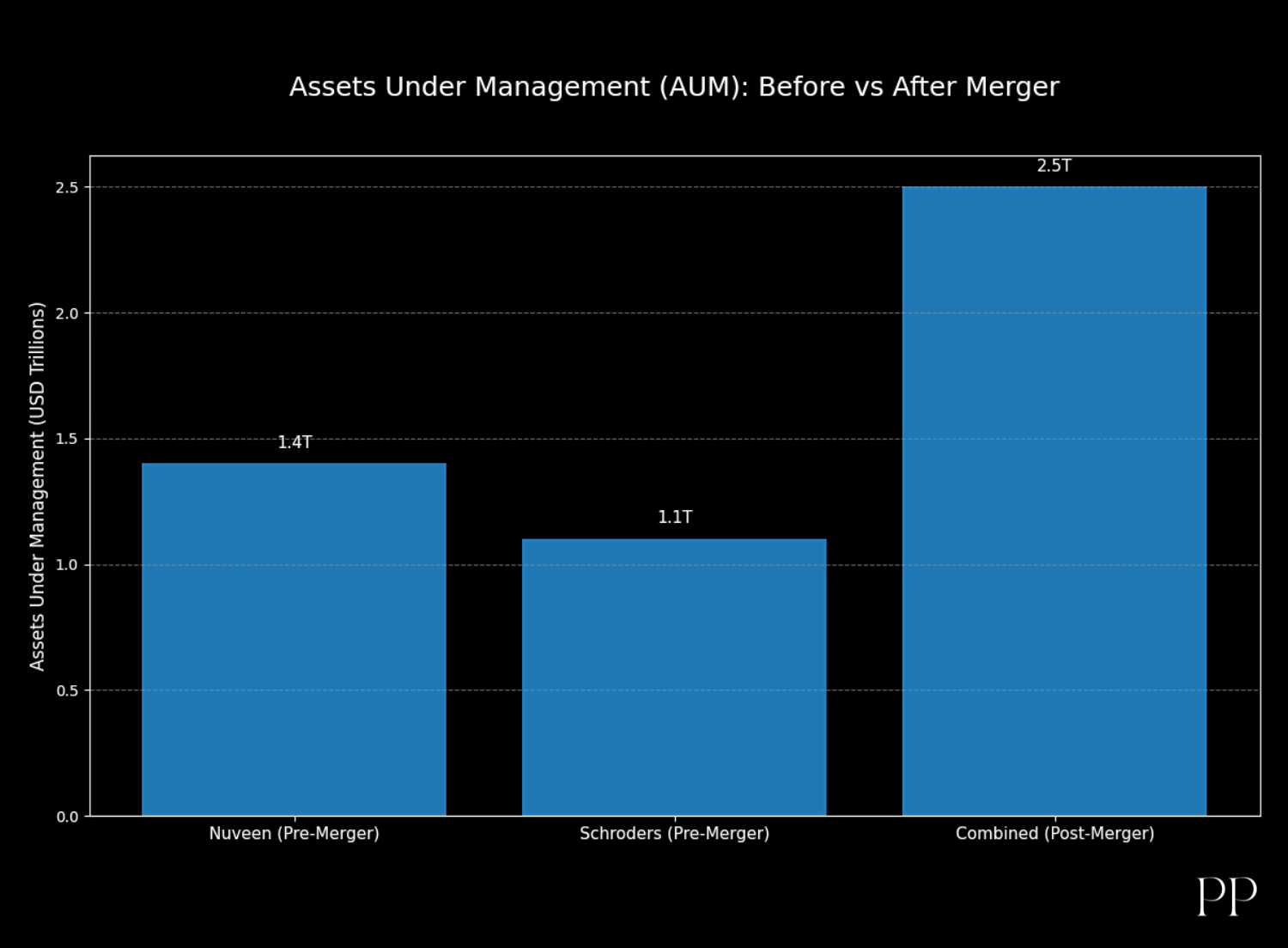 Together, the combined platform will operate across more than 40 markets worldwide, giving the firm greater scale to compete with industry giants like BlackRock and Vanguard and achieve efficiencies in global distribution, research, and product development.
Accelerating Growth Against Competitive Pressures
Traditional active asset management has faced persistent pressure from fee-lowering passive products, ETFs, and rising operational costs driven by technology and compliance demands. Scale — in both client assets and product capabilities — has increasingly become a strategic asset, allowing firms to maintain profitability and invest in growth areas such as private markets and alternatives.
Schroders’ leadership, under CEO Richard Oldfield, has framed the transaction as a way to accelerate growth and expand capabilities, especially in public-to-private investment platforms and emerging markets where larger networks and balance sheet strength are competitive advantages.
Complementary Strengths
Industry analysts note that Nuveen’s strong U.S. base and retirement-focused distribution network, combined with Schroders’ European and Asian reach, could create meaningful cross-selling opportunities. The merger also positions the firm to grow in private assets, infrastructure investing, fixed income, and high-net-worth advisory services.
Historical and Symbolic Significance
Schroders was founded in 1804 by Johann Schröder and has been a fixture of the City of London for more than two centuries. The sale marks the end of effective family control of one of the oldest independent British asset managers — an event seen by many in global finance as symbolic of broader consolidation trends in the industry.
Despite the change in ownership, the Schroders brand will be retained, and London will remain the combined group’s largest office and non-U.S. headquarters, employing around 3,100 staff.
Financial and Shareholder Impact
Shareholders of Schroders will gain immediate liquidity and value uplift from the premium offer — roughly £4 billion for the Schroder family’s stake alone. Markets responded positively: Schroders’ share price jumped more than 25–29% on the news.
For Nuveen investors, the acquisition signals a strategic shift toward greater scale and diversification, which could enhance long-term earnings potential and resilience.
Regulatory and Closing Outlook
The transaction still needs clearances from:
- Schroders’ shareholders
- Competition and antitrust regulators in key jurisdictions.
- Financial authorities overseeing cross-border financial consolidation.
Industry Implications
Consolidation Trends
This deal is part of a larger trend of consolidation in the global asset-management industry, driven by:
- Fee compression in traditional active management.
- Increasing costs of technology and regulatory compliance.
- Competitive pressures from passive and quant-driven strategies.
- Investor demand for diversified and alternative strategies.
Smaller managers increasingly find scale essential to remain competitive, and larger firms benefit from broader distribution and structural cost advantages.
Summary
Nuveen’s $13.5 billion acquisition of Schroders marks one of the most significant asset-management mergers in recent years, creating a combined firm overseeing nearly $2.5 trillion in assets under management. The deal reflects accelerating consolidation across the global investment industry, where scale, diversification, and access to private markets are becoming critical competitive advantages.
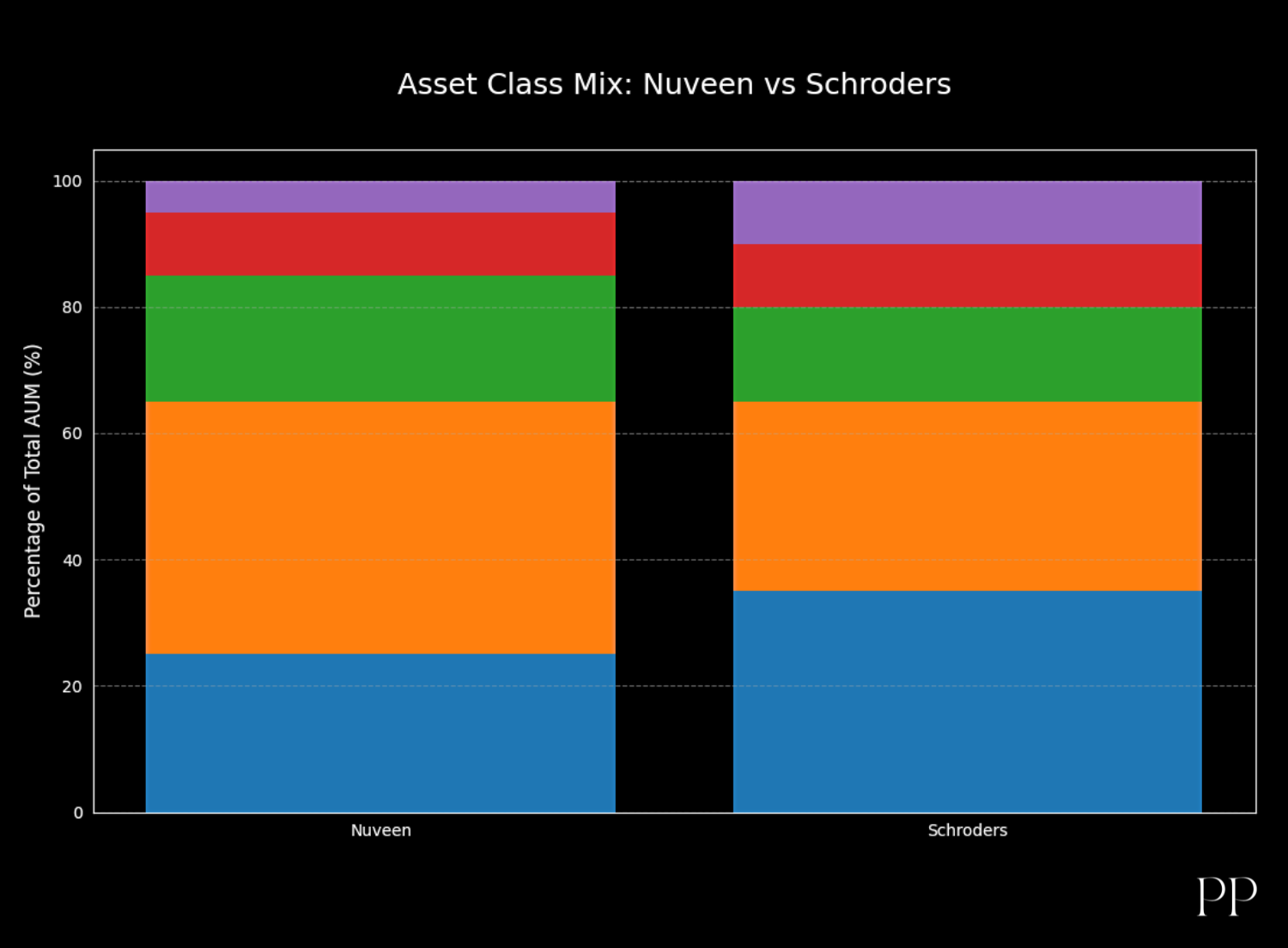
Strategically, the merger brings together Nuveen’s strength in fixed income and alternatives with Schroders’ global equity franchise and international distribution network. The combined platform enhances geographic reach across the U.S., Europe, and Asia while broadening capabilities in private markets, infrastructure, and institutional investing.
Beyond scale, the transaction signals a structural shift in asset management. Fee compression, rising operational costs, and the growing dominance of passive strategies are pushing firms toward consolidation to preserve margins and expand growth opportunities. For Schroders, the deal ends more than two centuries of family control; for Nuveen, it represents a bold step toward becoming one of the world’s leading active asset managers.