Intel forecasts second-quarter revenue above estimates
Image Credit : Reuters
Source Credit : Portfolio Prints
Intel forecast second-quarter revenue above Wall Street expectations on Thursday, signaling a resurgence driven by surging demand for its server processors powering artificial intelligence workloads in data centers.
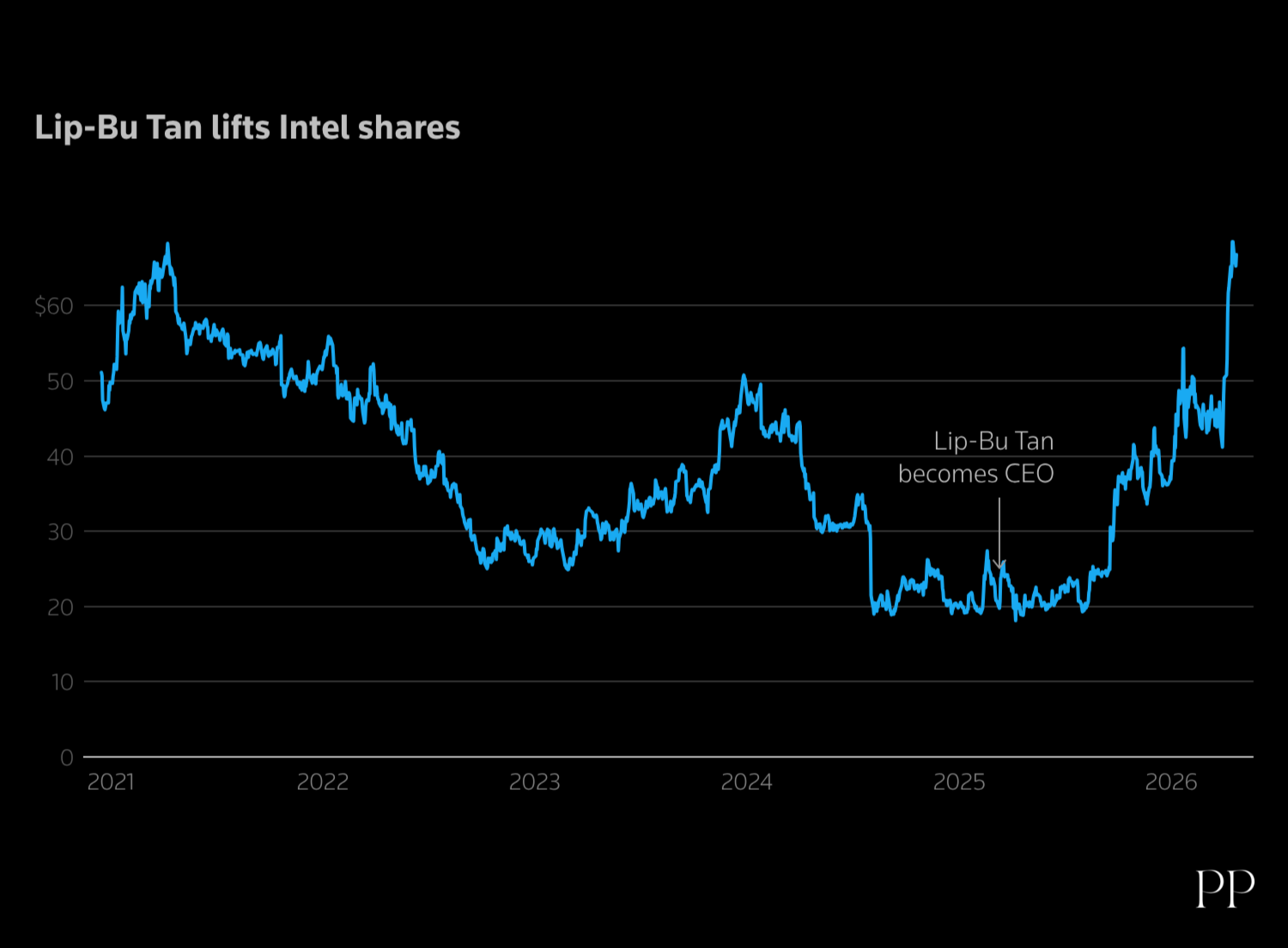
Shares of Intel jumped 19% in extended trading, adding roughly $64 billion in market value and extending an 81% rally so far this year. Nasdaq futures rose 0.3%, indicating broader optimism in tech stocks heading into Friday’s session.
The company projected revenue in the range of $13.8 billion to $14.8 billion, comfortably above the $13.07 billion consensus estimate compiled by LSEG. Adjusted earnings guidance of 20 cents per share also outpaced expectations of 9 cents, reinforcing confidence in the company’s near-term momentum.
After years of strategic missteps left it sidelined during the early AI boom, CEO Lip-Bu Tan has initiated an aggressive turnaround strategy focused on cost discipline, asset divestitures, and workforce reductions to stabilize the balance sheet.
Tan has also secured key partnerships and capital inflows, including backing from SoftBank and collaborations with Nvidia, alongside support from the U.S. government. These moves are aimed at revitalizing Intel’s manufacturing capabilities and restoring investor confidence in its long-term growth trajectory.
While Intel was late to capitalize on the initial AI wave dominated by GPUs, a new opportunity is emerging as cloud providers shift from model training to deployment. This transition is boosting demand for advanced CPUs, which are better suited for inference workloads and autonomous AI agents.
 “This is not just wishful thinking—it’s what we’re hearing directly from customers and seeing reflected in demand,” Tan said during a call with analysts.
Unlike GPUs, which excel at large-scale parallel computations, CPUs are increasingly critical for handling real-time decision-making and reasoning tasks in AI systems—an area where Intel is positioning itself to regain relevance.
Part of the company’s bullish outlook also stems from pricing power. CFO David Zinsner noted that Intel has raised chip prices to offset higher production costs, contributing to improved revenue expectations.
However, execution remains a key risk. Intel’s ability to meet demand hinges on scaling its manufacturing operations efficiently while avoiding supply chain bottlenecks.
In a significant boost to its foundry ambitions, Intel recently secured Tesla as a major customer for its next-generation 14A process under the Terafab project—an advanced AI chip manufacturing initiative linked to Elon Musk in Austin, Texas.
Zinsner declined to disclose financial details, noting that the partnership structure is still evolving. “The specifics are still being worked out between Lip-Bu and Elon,” he said.
Despite these wins, analysts caution that Intel’s transformation remains a high-stakes bet. The long-term trajectory depends on whether Intel can evolve from a legacy giant into a competitive foundry player capable of challenging TSMC by 2030. Success in capturing demand from robotics and agentic AI could make current valuations appear attractive in hindsight.
Intel’s foundry business generated $5.4 billion in first-quarter revenue, though the majority came from internal demand, with less than $200 million attributed to external customers—primarily legacy wafer contracts.
Meanwhile, its custom chip (ASIC) segment is on track to exceed $1 billion in revenue this year, underscoring growing traction in specialized silicon.
The company has also deepened its AI ecosystem partnerships, expanding collaboration with Google and participating in initiatives involving SpaceX and Tesla.
First-quarter revenue came in at $13.58 billion, beating expectations of $12.42 billion. Notably, some of that performance was driven by clearing older or previously unsellable inventory. “We identified opportunities to monetize finished goods we didn’t expect to move,” Zinsner said.
Intel’s data center and AI segment generated $5.1 billion in revenue, surpassing estimates of $4.41 billion and highlighting strengthening demand in its core growth market.
Competition remains intense, with Nvidia, AMD, and Arm all aggressively targeting AI-driven compute markets.
The company reported a first-quarter loss of 73 cents per share, weighed down by more than $4 billion in restructuring charges. On an adjusted basis, however, earnings came in at 29 cents per share—well above expectations of just 1 cent—suggesting early signs of operational recovery.
“This is not just wishful thinking—it’s what we’re hearing directly from customers and seeing reflected in demand,” Tan said during a call with analysts.
Unlike GPUs, which excel at large-scale parallel computations, CPUs are increasingly critical for handling real-time decision-making and reasoning tasks in AI systems—an area where Intel is positioning itself to regain relevance.
Part of the company’s bullish outlook also stems from pricing power. CFO David Zinsner noted that Intel has raised chip prices to offset higher production costs, contributing to improved revenue expectations.
However, execution remains a key risk. Intel’s ability to meet demand hinges on scaling its manufacturing operations efficiently while avoiding supply chain bottlenecks.
In a significant boost to its foundry ambitions, Intel recently secured Tesla as a major customer for its next-generation 14A process under the Terafab project—an advanced AI chip manufacturing initiative linked to Elon Musk in Austin, Texas.
Zinsner declined to disclose financial details, noting that the partnership structure is still evolving. “The specifics are still being worked out between Lip-Bu and Elon,” he said.
Despite these wins, analysts caution that Intel’s transformation remains a high-stakes bet. The long-term trajectory depends on whether Intel can evolve from a legacy giant into a competitive foundry player capable of challenging TSMC by 2030. Success in capturing demand from robotics and agentic AI could make current valuations appear attractive in hindsight.
Intel’s foundry business generated $5.4 billion in first-quarter revenue, though the majority came from internal demand, with less than $200 million attributed to external customers—primarily legacy wafer contracts.
Meanwhile, its custom chip (ASIC) segment is on track to exceed $1 billion in revenue this year, underscoring growing traction in specialized silicon.
The company has also deepened its AI ecosystem partnerships, expanding collaboration with Google and participating in initiatives involving SpaceX and Tesla.
First-quarter revenue came in at $13.58 billion, beating expectations of $12.42 billion. Notably, some of that performance was driven by clearing older or previously unsellable inventory. “We identified opportunities to monetize finished goods we didn’t expect to move,” Zinsner said.
Intel’s data center and AI segment generated $5.1 billion in revenue, surpassing estimates of $4.41 billion and highlighting strengthening demand in its core growth market.
Competition remains intense, with Nvidia, AMD, and Arm all aggressively targeting AI-driven compute markets.
The company reported a first-quarter loss of 73 cents per share, weighed down by more than $4 billion in restructuring charges. On an adjusted basis, however, earnings came in at 29 cents per share—well above expectations of just 1 cent—suggesting early signs of operational recovery.