Nvidia bets on new data center chips for growth
Image Credit : Bloomberg
Source Credit : Portfolio Prints
Nvidia CEO Jensen Huang sought to reassure investors on Wednesday that the world’s most valuable company can sustain its explosive growth trajectory, driven by a widening customer base and a new generation of products expected to push AI chip sales beyond the company’s projected $1 trillion mark.
Despite forecasting second-quarter revenue above Wall Street expectations and unveiling an $80 billion share buyback program, Nvidia shares fell 1.6% in extended trading, suggesting investors remain concerned about intensifying competition in the AI semiconductor market.
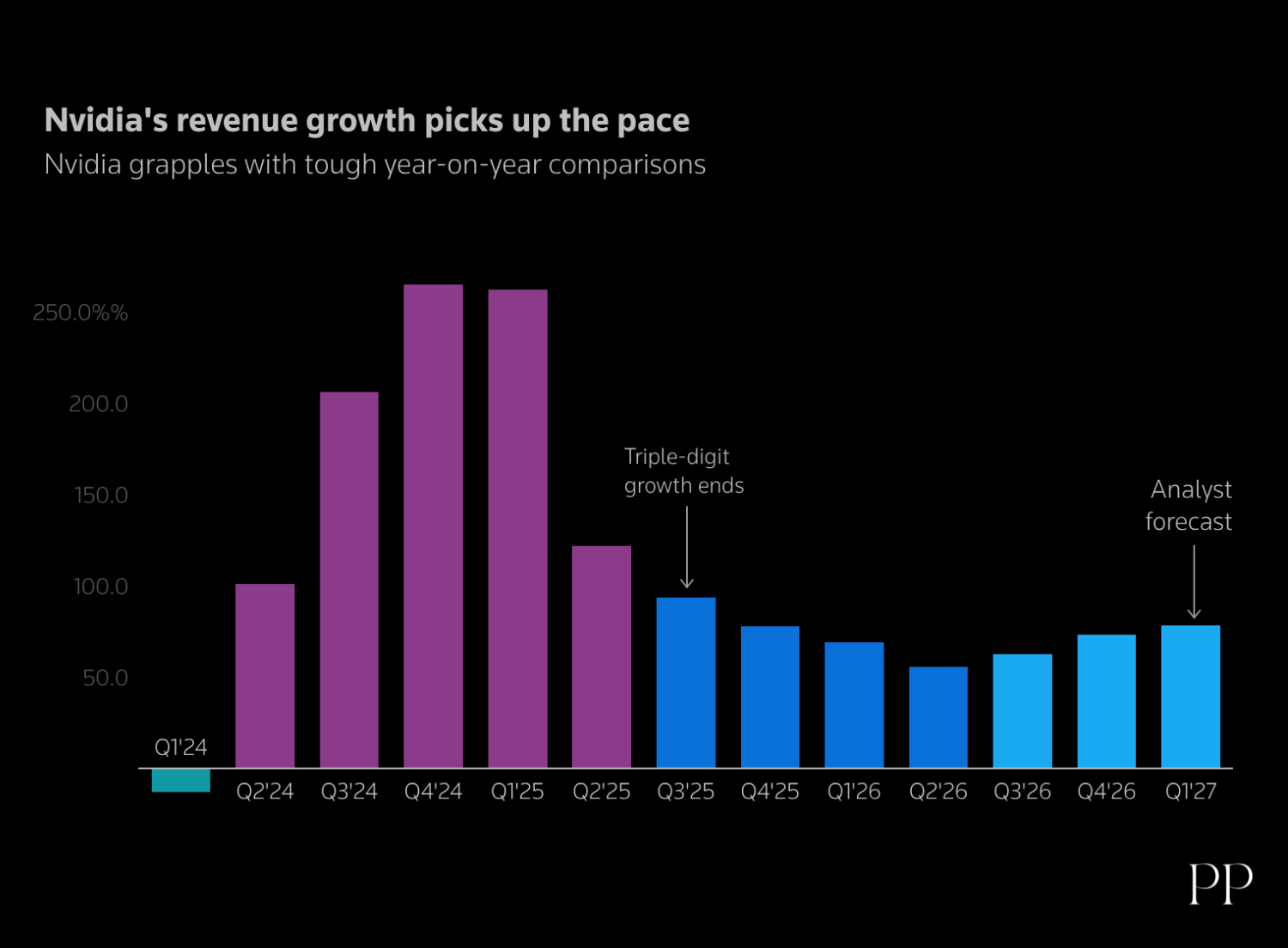
Nvidia projected second-quarter revenue of $91 billion, plus or minus 2%, comfortably ahead of analysts’ estimates of $86.84 billion, according to LSEG data.
 The company’s earnings are widely viewed as a bellwether for the broader artificial intelligence industry, as Nvidia chips power nearly every major AI data center globally and underpin many of the world’s most advanced AI models.
“Nvidia delivered another beat, but at this point that’s essentially priced in as it keeps beating quarter after quarter,” said Jacob Bourne, analyst at eMarketer. “The lingering question is whether it can convince investors that the AI buildout has durability into 2027 and 2028, especially as the narrative shifts toward inference workloads and competing silicon from Google, Amazon, AMD, and Intel.”
The company also announced plans to raise its quarterly cash dividend to 25 cents per share from 1 cent.
Investment in AI infrastructure continues to surge, with U.S. technology giants including Alphabet, Amazon and Microsoft expected to spend more than $700 billion on AI this year, up sharply from roughly $400 billion in 2025.
Huang told analysts during a conference call that Nvidia expects to outpace spending growth by hyperscale cloud companies, pointing to rapidly expanding demand from a newer segment of AI-focused cloud providers. Revenue from those customers was roughly equal to sales generated from major cloud giants, but grew faster sequentially.
“We should be growing faster than hyperscale capex,” Huang said.
Even as Nvidia’s largest customers continue to rely heavily on its premium AI processors, many are simultaneously investing billions of dollars into developing custom in-house chips, threatening Nvidia’s long-standing dominance in the semiconductor industry.
The company is also facing mounting competition from rivals including Intel and AMD, both of which are aggressively targeting the growing inference computing market.
To strengthen its position, Nvidia in March unveiled a new central processor and AI system based on technology from Groq, a startup focused on inference chips.
During the earnings call, Huang said Nvidia’s new “Vera” processors open access to a $200 billion market opportunity. The company expects Vera-related sales to generate $20 billion in revenue by the end of the fiscal year. Huang clarified that those projections were not included in Nvidia’s previously announced estimate of $1 trillion in cumulative sales from its “Blackwell” and “Rubin” AI chip platforms between 2025 and 2027.
“I expect Vera to be the second-largest contributor beyond Blackwell and Rubin,” Huang said. “All of our customers are quite excited about Vera.”
However, Huang acknowledged that Nvidia could remain supply-constrained throughout the lifespan of the Vera Rubin platform, which combines CPUs and GPUs and is scheduled to launch later this year.
The company is ramping up spending to avoid supply-chain bottlenecks amid a global memory-chip shortage. Nvidia said supply commitments rose to $119 billion in the fiscal first quarter, up from $95.2 billion in the previous quarter.
Nvidia reported first-quarter revenue of $81.62 billion, beating analysts’ estimates of $78.86 billion, according to LSEG data.
Data center revenue reached $75.2 billion during the quarter, ahead of analysts’ average estimate of $72.8 billion.
On an adjusted basis, Nvidia earned $1.87 per share, surpassing market expectations of $1.76.
The company also disclosed $30 billion in cloud-computing agreements, up from $27 billion in the prior quarter, which it said would support research and development efforts.
Jay Goldberg, analyst at Seaport Research Partners, said in a research note last year that such commitments likely act as “backstops,” under which Nvidia compensates cloud providers that purchase its hardware for unused capacity tied to Nvidia-powered systems.
The company’s earnings are widely viewed as a bellwether for the broader artificial intelligence industry, as Nvidia chips power nearly every major AI data center globally and underpin many of the world’s most advanced AI models.
“Nvidia delivered another beat, but at this point that’s essentially priced in as it keeps beating quarter after quarter,” said Jacob Bourne, analyst at eMarketer. “The lingering question is whether it can convince investors that the AI buildout has durability into 2027 and 2028, especially as the narrative shifts toward inference workloads and competing silicon from Google, Amazon, AMD, and Intel.”
The company also announced plans to raise its quarterly cash dividend to 25 cents per share from 1 cent.
Investment in AI infrastructure continues to surge, with U.S. technology giants including Alphabet, Amazon and Microsoft expected to spend more than $700 billion on AI this year, up sharply from roughly $400 billion in 2025.
Huang told analysts during a conference call that Nvidia expects to outpace spending growth by hyperscale cloud companies, pointing to rapidly expanding demand from a newer segment of AI-focused cloud providers. Revenue from those customers was roughly equal to sales generated from major cloud giants, but grew faster sequentially.
“We should be growing faster than hyperscale capex,” Huang said.
Even as Nvidia’s largest customers continue to rely heavily on its premium AI processors, many are simultaneously investing billions of dollars into developing custom in-house chips, threatening Nvidia’s long-standing dominance in the semiconductor industry.
The company is also facing mounting competition from rivals including Intel and AMD, both of which are aggressively targeting the growing inference computing market.
To strengthen its position, Nvidia in March unveiled a new central processor and AI system based on technology from Groq, a startup focused on inference chips.
During the earnings call, Huang said Nvidia’s new “Vera” processors open access to a $200 billion market opportunity. The company expects Vera-related sales to generate $20 billion in revenue by the end of the fiscal year. Huang clarified that those projections were not included in Nvidia’s previously announced estimate of $1 trillion in cumulative sales from its “Blackwell” and “Rubin” AI chip platforms between 2025 and 2027.
“I expect Vera to be the second-largest contributor beyond Blackwell and Rubin,” Huang said. “All of our customers are quite excited about Vera.”
However, Huang acknowledged that Nvidia could remain supply-constrained throughout the lifespan of the Vera Rubin platform, which combines CPUs and GPUs and is scheduled to launch later this year.
The company is ramping up spending to avoid supply-chain bottlenecks amid a global memory-chip shortage. Nvidia said supply commitments rose to $119 billion in the fiscal first quarter, up from $95.2 billion in the previous quarter.
Nvidia reported first-quarter revenue of $81.62 billion, beating analysts’ estimates of $78.86 billion, according to LSEG data.
Data center revenue reached $75.2 billion during the quarter, ahead of analysts’ average estimate of $72.8 billion.
On an adjusted basis, Nvidia earned $1.87 per share, surpassing market expectations of $1.76.
The company also disclosed $30 billion in cloud-computing agreements, up from $27 billion in the prior quarter, which it said would support research and development efforts.
Jay Goldberg, analyst at Seaport Research Partners, said in a research note last year that such commitments likely act as “backstops,” under which Nvidia compensates cloud providers that purchase its hardware for unused capacity tied to Nvidia-powered systems.