SK Hynix and Micron Joins 1 Trillion Dollar Club
Image Credit : Bloomberg
Source Credit : Portfolio Prints
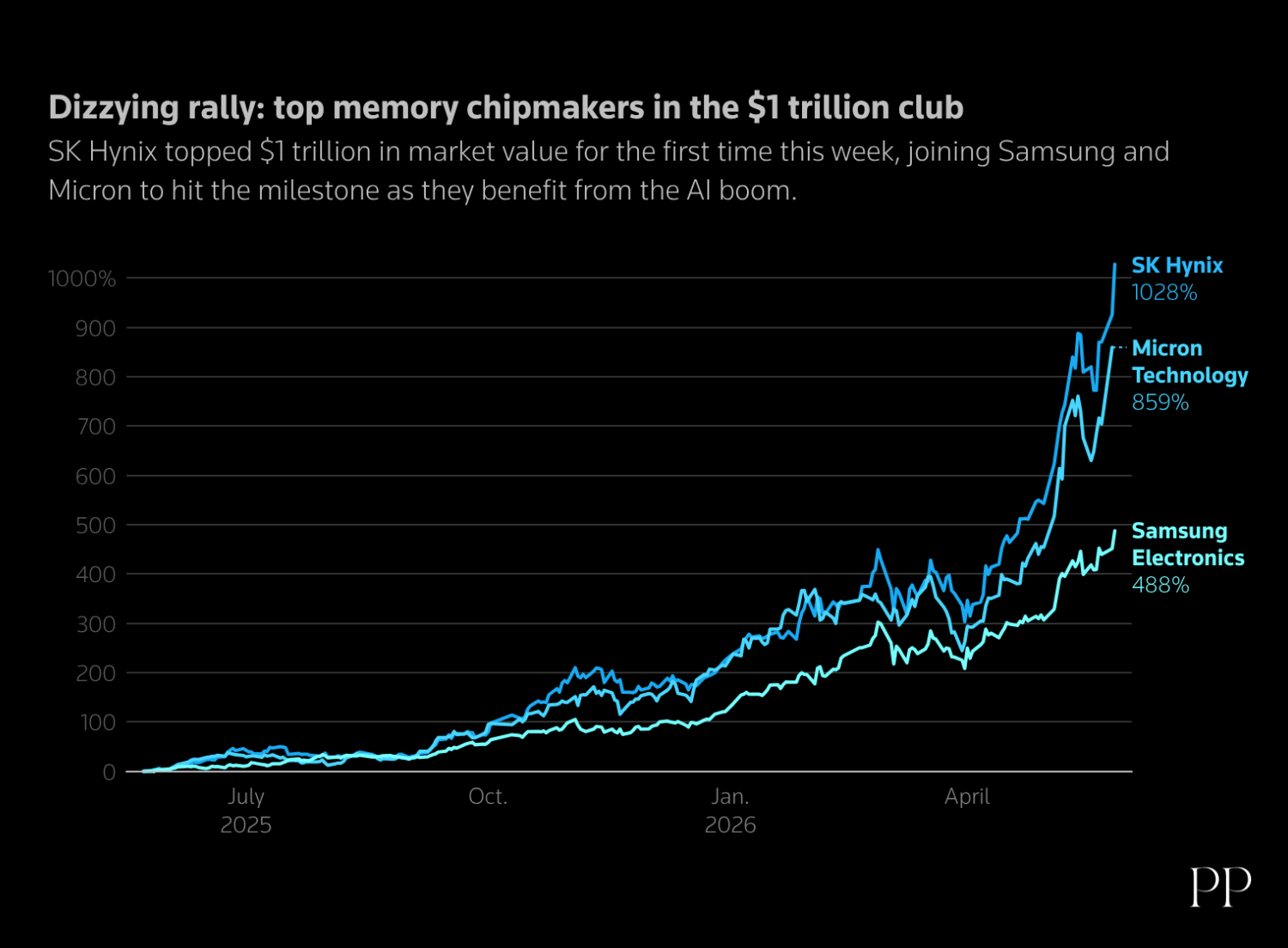
South Korean chipmaker SK Hynix crossed the $1 trillion market value threshold for the first time on Wednesday, joining rivals Samsung Electronics and Micron Technology as investors continued to pour into artificial intelligence-linked semiconductor stocks.
SK Hynix shares closed 9.3% higher after surging as much as 14.9% during the session, lifting the company’s market capitalisation to a record 1,680 trillion won ($1.12 trillion). The rally also pushed South Korea’s benchmark KOSPI to an all-time high.
Samsung Electronics crossed the $1 trillion valuation mark earlier this month, while U.S.-listed Micron reached the milestone on Tuesday, underscoring the global investor frenzy surrounding AI infrastructure and semiconductor demand.
The rally has been fuelled by soaring demand for high-bandwidth memory chips used in advanced AI processors such as those developed by NVIDIA. Tight supply conditions and rapidly rising prices have delivered windfall gains for the world’s largest memory chipmakers.
Memory chip prices doubled in the first quarter from the previous three months and are expected to rise by as much as 63% in the current quarter, driven by explosive demand from AI data centres. The surge has constrained supply for smartphones, laptops and automobiles, helping major semiconductor companies post record earnings.
Only three Asian companies — including Taiwan Semiconductor Manufacturing Company — have ever surpassed the $1 trillion valuation milestone. South Korea has now become the first country outside the United States to have more than one company achieve that mark.
Driven by massive gains in Samsung and SK Hynix, the KOSPI index climbed 2.3% to close at 8,229.70 after earlier jumping as much as 5.1% to a record intraday high of 8,457.09. The sharp rally briefly triggered a “sidecar” trading curb, temporarily halting algorithmic futures trading to cool market volatility.
 Following Wednesday’s surge, Samsung and SK Hynix together accounted for roughly half of the KOSPI’s total market capitalisation. South Korea’s stock market has emerged as one of the world’s top performers during the AI boom, with the KOSPI up 95% so far this year after gaining 76% in 2025.
“We expect memory chip demand to continue exceeding supply through 2028, keeping prices elevated,” said Kim Young-gun, an analyst at Mirae Asset Securities.
Kim raised his target price for SK Hynix by 18.8% to 3.8 million won per share and increased Samsung’s target price by 14.6% to 550,000 won.
SK Hynix shares ended Wednesday’s session at 2.243 million won, while Samsung shares rose as much as 8% before closing 2.7% higher at a record 307,000 won.
Samsung also benefited from easing labour concerns after unionised workers approved a tentative wage agreement, avoiding a strike that had threatened to disrupt global semiconductor supply chains.
Analysts at UBS said this week they had more than tripled their target price for Micron, citing “structural changes AI has driven across the entire memory ecosystem.”
Investor returns in semiconductor stocks have been staggering. Samsung shares have surged 149% this year, while SK Hynix has jumped 215% and Micron has soared 245%.
Retail investors in the United States have also poured billions of dollars into exchange-traded funds offering exposure to Samsung and SK Hynix, further amplifying momentum in semiconductor shares.
South Korea’s first single-stock leveraged ETFs tied to Samsung and SK Hynix debuted on Wednesday and immediately posted double-digit gains as investors rushed into AI-linked assets.
“Leveraged ETF buying drives futures purchases, which lifts futures prices and widens the premium over spot prices, encouraging additional spot buying,” said Kang Jin-hyuk, analyst at Shinhan Securities.
Kang added that the KOSPI pared some gains late in the session as the ETF-driven momentum cooled.
Financial investment firms bought a net 1.3 trillion won worth of KOSPI shares, supported by strong retail demand for leveraged ETFs. Individual investors purchased an additional 403 billion won, while foreign investors were net sellers.
The frenzy was so intense that the Korea Financial Investment Association website — which hosts mandatory online courses for retail investors seeking access to leveraged ETFs — briefly crashed as users rushed to sign up, according to local media reports.
Despite the record-setting rally, market breadth remained weak. Of the 918 stocks traded on the KOSPI, only 75 advanced while 826 declined, highlighting how heavily the market’s gains were concentrated in a handful of AI-driven semiconductor giants.
Following Wednesday’s surge, Samsung and SK Hynix together accounted for roughly half of the KOSPI’s total market capitalisation. South Korea’s stock market has emerged as one of the world’s top performers during the AI boom, with the KOSPI up 95% so far this year after gaining 76% in 2025.
“We expect memory chip demand to continue exceeding supply through 2028, keeping prices elevated,” said Kim Young-gun, an analyst at Mirae Asset Securities.
Kim raised his target price for SK Hynix by 18.8% to 3.8 million won per share and increased Samsung’s target price by 14.6% to 550,000 won.
SK Hynix shares ended Wednesday’s session at 2.243 million won, while Samsung shares rose as much as 8% before closing 2.7% higher at a record 307,000 won.
Samsung also benefited from easing labour concerns after unionised workers approved a tentative wage agreement, avoiding a strike that had threatened to disrupt global semiconductor supply chains.
Analysts at UBS said this week they had more than tripled their target price for Micron, citing “structural changes AI has driven across the entire memory ecosystem.”
Investor returns in semiconductor stocks have been staggering. Samsung shares have surged 149% this year, while SK Hynix has jumped 215% and Micron has soared 245%.
Retail investors in the United States have also poured billions of dollars into exchange-traded funds offering exposure to Samsung and SK Hynix, further amplifying momentum in semiconductor shares.
South Korea’s first single-stock leveraged ETFs tied to Samsung and SK Hynix debuted on Wednesday and immediately posted double-digit gains as investors rushed into AI-linked assets.
“Leveraged ETF buying drives futures purchases, which lifts futures prices and widens the premium over spot prices, encouraging additional spot buying,” said Kang Jin-hyuk, analyst at Shinhan Securities.
Kang added that the KOSPI pared some gains late in the session as the ETF-driven momentum cooled.
Financial investment firms bought a net 1.3 trillion won worth of KOSPI shares, supported by strong retail demand for leveraged ETFs. Individual investors purchased an additional 403 billion won, while foreign investors were net sellers.
The frenzy was so intense that the Korea Financial Investment Association website — which hosts mandatory online courses for retail investors seeking access to leveraged ETFs — briefly crashed as users rushed to sign up, according to local media reports.
Despite the record-setting rally, market breadth remained weak. Of the 918 stocks traded on the KOSPI, only 75 advanced while 826 declined, highlighting how heavily the market’s gains were concentrated in a handful of AI-driven semiconductor giants.