SpaceX targets $135 IPO price at valuation of $1.77t
Image Credit : Reuters
Source Credit : Portfolio Prints
SpaceX stunned Wall Street on Wednesday by publicly setting a $135 per-share price for its upcoming initial public offering, bypassing one of the most fundamental traditions of the IPO process and reinforcing Elon Musk's reputation for rewriting financial rules on his own terms.
The move marks a dramatic departure from the conventional price-discovery process that has long defined major public offerings. By announcing a share price a full week before meeting investors on its official roadshow, SpaceX has effectively upended the standard practice in which investment banks gauge demand and negotiate valuation expectations before final pricing.
Few, if any, major U.S. IPOs have followed a similar path, highlighting Musk's unique position in global capital markets. While critics question the company's extraordinary valuation, supporters argue that SpaceX has earned the ability to challenge traditional norms after transforming multiple industries and becoming one of the world's most influential private companies.
The updated IPO filing confirms that SpaceX intends to raise approximately $75 billion, making it the largest initial public offering in history. At the proposed share price, the company would be valued at roughly $1.75 trillion, immediately placing it among the ten most valuable publicly traded companies in the United States.
The company is scheduled to begin its investor roadshow on Thursday, with final pricing expected on June 11. Shares are anticipated to begin trading on the Nasdaq the following day.
The early pricing announcement is only one of several unconventional decisions shaping the SpaceX offering.
Musk has reportedly pushed for a significantly larger allocation of shares to retail investors, sought accelerated inclusion in major stock indexes, and maintained a governance structure designed to preserve substantial founder control after the company becomes public.
"Nothing about this IPO is normal in any course or sense," said one investor planning to participate in the offering. "But then again, this is the largest IPO in history, so perhaps that shouldn't be surprising."
Wall Street firms have raced to secure a role in the transaction, attracted by both the prestige of participating in a landmark deal and the potential for millions of dollars in underwriting fees. Yet behind the enthusiasm lies growing debate over whether SpaceX's valuation can be justified by traditional financial metrics.
 The same investor described an atmosphere in which major institutions appear eager to demonstrate their proximity to Musk and the company.
"There is definitely a sense of firms wanting to say they got in early," the investor said, reflecting the leverage Musk continues to exert over global investors.
Valuing SpaceX presents a challenge even for seasoned analysts.
Unlike most technology companies, SpaceX operates across multiple sectors, including aerospace, satellite communications, defense technology, launch services, and space infrastructure. The limited number of comparable publicly traded companies makes conventional valuation methods difficult to apply.
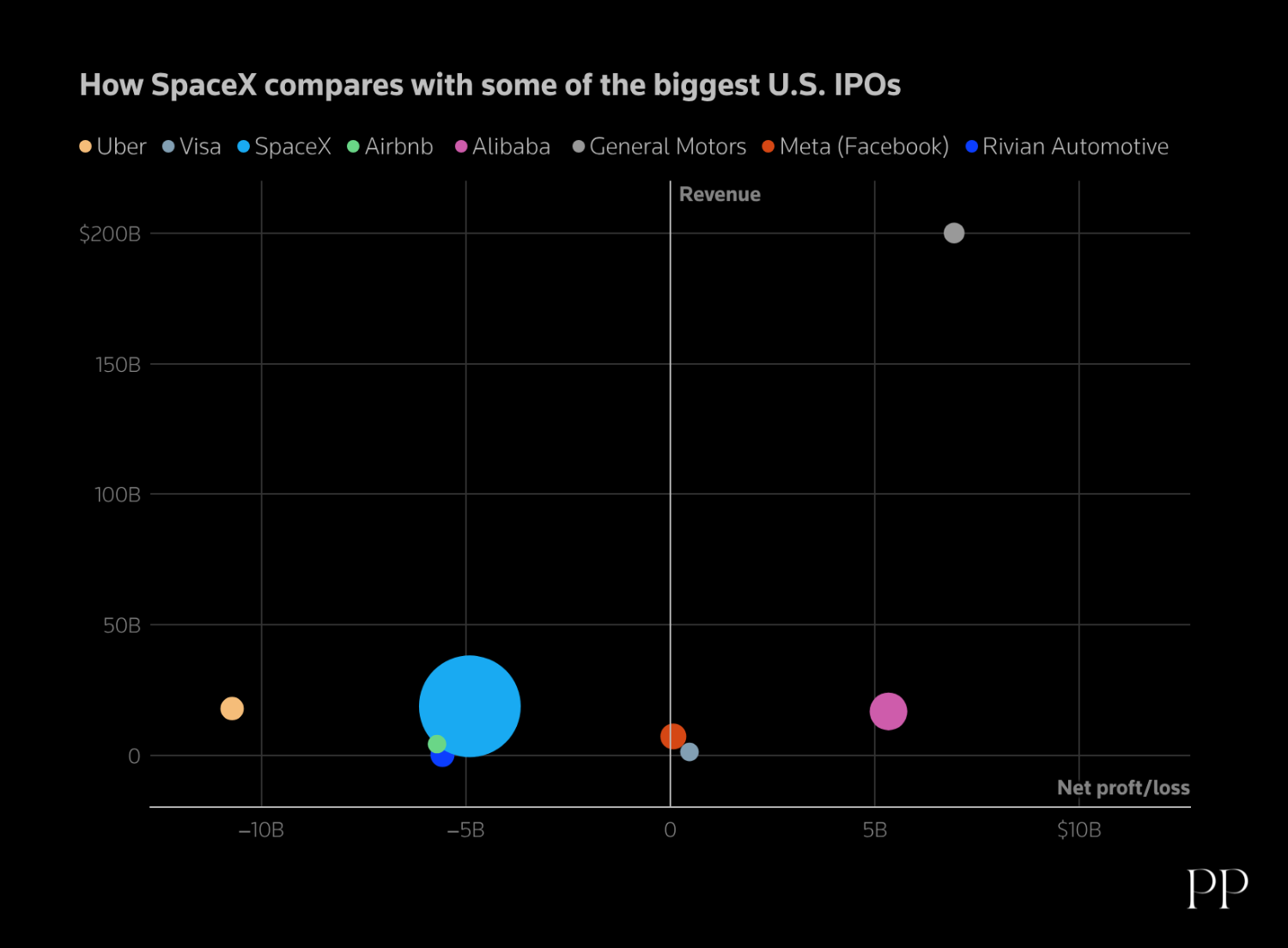
The company reported a net loss of $4.94 billion in 2025 despite generating revenue of $18.67 billion, representing annual growth of 33%.
At the proposed valuation, SpaceX would trade at more than 90 times annual revenue—a level that would be considered exceptionally expensive by traditional standards.
"On the face of it, a revenue multiple above 90 times is extremely high by any measure," said Tim Hatt, Head of Research and Consulting at GSMA Intelligence. "But SpaceX is not a traditional company, and there are no true public-market comparisons."
That dilemma has become a central theme among institutional investors evaluating the offering. Many acknowledge the valuation appears stretched when viewed through conventional financial frameworks, yet they also recognize that SpaceX's market position, technological leadership, and long-term ambitions are unlike those of almost any company that has previously gone public.
Prior to launching the roadshow, SpaceX conducted a series of investor meetings to gauge interest and valuation expectations.
During those discussions, the company reportedly signaled that it was targeting a valuation near $1.75 trillion, while some institutional investors argued that a valuation closer to $1.5 trillion would be more reasonable.
Even so, demand appears exceptionally strong.
One institutional investor who works with Goldman Sachs said he attempted to secure an allocation in the IPO but was told that SpaceX share allotments had become a "David Solomon-level decision," a reference to Goldman Sachs' chief executive. According to the investor, his banker ultimately suggested purchasing shares after the company begins public trading.
The anecdote underscores the extraordinary demand surrounding the offering and the limited availability of shares relative to investor interest.
Another defining feature of the SpaceX IPO is its unusually large focus on individual investors.
Major international banks, including Mizuho, Deutsche Bank, UBS, and Barclays, have reportedly been encouraged to identify wealthy individual clients in overseas markets as potential buyers.
Historically, IPO marketing efforts have focused primarily on large institutional investors such as mutual funds, pension funds, and hedge funds. Retail investors have often received only modest allocations.
SpaceX is taking a different approach.
The company is reportedly considering allocating as much as 30% of the offering to individual investors—an unusually large retail portion for a transaction of this size.
The strategy reflects Musk's belief that individual investors should play a larger role in public markets, while also capitalizing on the enormous personal following he has cultivated over the years.
Supporters argue the move could democratize access to one of the world's most sought-after private companies. Critics counter that retail investors may be assuming significant valuation risk by buying into a company already priced for extraordinary future growth.
For many investors, the decision to buy SpaceX shares extends beyond financial analysis.
The company's leadership remains one of its most powerful selling points.
"Why would you own it?" asked Robert Pavlik, Senior Portfolio Manager at Dakota Wealth. "Because of the cachet that Elon Musk brings."
Pavlik added that while he has no plans to invest, he views the offering as one of the most fascinating events in modern financial markets.
That sentiment captures the broader challenge facing investors. SpaceX is not merely being evaluated as an aerospace company or a telecommunications provider. Instead, it is being priced as a transformative platform with ambitions that extend from Earth orbit to interplanetary transportation.
Whether that vision ultimately justifies a $1.75 trillion valuation remains one of the most important questions surrounding the largest IPO in history.
For now, however, investor demand suggests that many are willing to place a premium not only on SpaceX's future, but also on Elon Musk's ability to continue defying expectations.
The same investor described an atmosphere in which major institutions appear eager to demonstrate their proximity to Musk and the company.
"There is definitely a sense of firms wanting to say they got in early," the investor said, reflecting the leverage Musk continues to exert over global investors.
Valuing SpaceX presents a challenge even for seasoned analysts.
Unlike most technology companies, SpaceX operates across multiple sectors, including aerospace, satellite communications, defense technology, launch services, and space infrastructure. The limited number of comparable publicly traded companies makes conventional valuation methods difficult to apply.
The company reported a net loss of $4.94 billion in 2025 despite generating revenue of $18.67 billion, representing annual growth of 33%.
At the proposed valuation, SpaceX would trade at more than 90 times annual revenue—a level that would be considered exceptionally expensive by traditional standards.
"On the face of it, a revenue multiple above 90 times is extremely high by any measure," said Tim Hatt, Head of Research and Consulting at GSMA Intelligence. "But SpaceX is not a traditional company, and there are no true public-market comparisons."
That dilemma has become a central theme among institutional investors evaluating the offering. Many acknowledge the valuation appears stretched when viewed through conventional financial frameworks, yet they also recognize that SpaceX's market position, technological leadership, and long-term ambitions are unlike those of almost any company that has previously gone public.
Prior to launching the roadshow, SpaceX conducted a series of investor meetings to gauge interest and valuation expectations.
During those discussions, the company reportedly signaled that it was targeting a valuation near $1.75 trillion, while some institutional investors argued that a valuation closer to $1.5 trillion would be more reasonable.
Even so, demand appears exceptionally strong.
One institutional investor who works with Goldman Sachs said he attempted to secure an allocation in the IPO but was told that SpaceX share allotments had become a "David Solomon-level decision," a reference to Goldman Sachs' chief executive. According to the investor, his banker ultimately suggested purchasing shares after the company begins public trading.
The anecdote underscores the extraordinary demand surrounding the offering and the limited availability of shares relative to investor interest.
Another defining feature of the SpaceX IPO is its unusually large focus on individual investors.
Major international banks, including Mizuho, Deutsche Bank, UBS, and Barclays, have reportedly been encouraged to identify wealthy individual clients in overseas markets as potential buyers.
Historically, IPO marketing efforts have focused primarily on large institutional investors such as mutual funds, pension funds, and hedge funds. Retail investors have often received only modest allocations.
SpaceX is taking a different approach.
The company is reportedly considering allocating as much as 30% of the offering to individual investors—an unusually large retail portion for a transaction of this size.
The strategy reflects Musk's belief that individual investors should play a larger role in public markets, while also capitalizing on the enormous personal following he has cultivated over the years.
Supporters argue the move could democratize access to one of the world's most sought-after private companies. Critics counter that retail investors may be assuming significant valuation risk by buying into a company already priced for extraordinary future growth.
For many investors, the decision to buy SpaceX shares extends beyond financial analysis.
The company's leadership remains one of its most powerful selling points.
"Why would you own it?" asked Robert Pavlik, Senior Portfolio Manager at Dakota Wealth. "Because of the cachet that Elon Musk brings."
Pavlik added that while he has no plans to invest, he views the offering as one of the most fascinating events in modern financial markets.
That sentiment captures the broader challenge facing investors. SpaceX is not merely being evaluated as an aerospace company or a telecommunications provider. Instead, it is being priced as a transformative platform with ambitions that extend from Earth orbit to interplanetary transportation.
Whether that vision ultimately justifies a $1.75 trillion valuation remains one of the most important questions surrounding the largest IPO in history.
For now, however, investor demand suggests that many are willing to place a premium not only on SpaceX's future, but also on Elon Musk's ability to continue defying expectations.