CXMT Becomes Most Valuable Listed Firm in China
Image Credit : South China Morning Post
Source Credit : Portfolio Prints
Shares of CXMT Corp surged more than 500% in their Shanghai trading debut on Monday following Asia’s largest IPO of the year, propelling the memory-chip maker to the top of China’s stock market by valuation despite a recent pullback in global technology stocks.
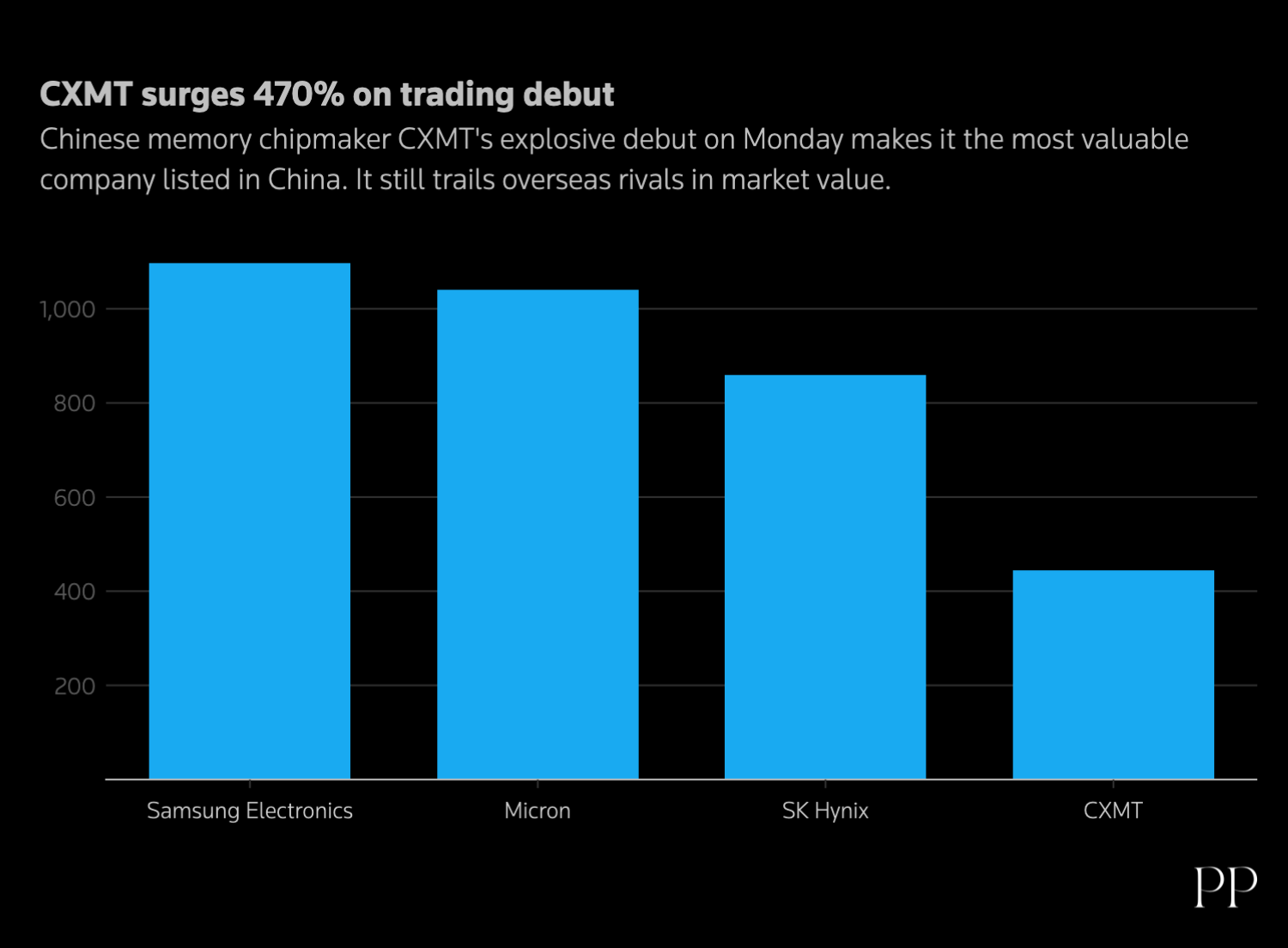
The stock climbed to 54.65 yuan in morning trading, compared with its IPO price of 8.66 yuan per share. The rally boosted CXMT’s market capitalisation to 3.65 trillion yuan ($539.2 billion), up sharply from roughly $85.5 billion at the time of the offering.
The explosive debut made CXMT the most valuable company listed in mainland China, surpassing Industrial and Commercial Bank of China (ICBC), long regarded as the market’s heavyweight.
 As U.S. export restrictions intensify competition in advanced technologies, CXMT has emerged as a central pillar of China’s efforts to strengthen its semiconductor supply chain and reduce reliance on foreign suppliers in strategic sectors such as artificial intelligence.
The first-day surge comfortably exceeded the gains recorded by China Resources New Energy, whose shares more than doubled after its $3.6 billion IPO earlier this month.
The listing offers a fresh measure of investor appetite for a flagship Chinese chipmaker at a time when markets are reassessing lofty valuations across the AI sector following a recent global technology selloff.
More than 122 billion yuan worth of CXMT shares changed hands during the morning session. According to local media, the company became the first A-share stock to surpass 100 billion yuan in single-day turnover.
Chinese semiconductor stocks broadly declined on Monday as investors and fund managers rotated capital into CXMT, reflecting the stock’s outsized influence on the sector.
The company’s extraordinary valuation—equivalent to nearly half that of U.S. memory-chip giant Micron—has fuelled concerns that speculative enthusiasm may be running ahead of fundamentals. CXMT’s growing dominance in China’s memory market has already strengthened its pricing power with major customers, including Huawei.
“At such a price, I don’t dare hold or buy the stock,” said Wu Zhou, a fund manager at Shenzhen Deyuan Investment, who participated in the IPO and sold all of his shares shortly after trading began.
AI-related stocks, particularly semiconductor companies, have been among the strongest performers in global equity markets this year. However, concerns over stretched valuations and uncertainty about whether massive AI-related capital expenditure will translate into earnings growth quickly enough have recently tempered investor optimism.
“The stock is too expensive and smells of speculation,” said Yuan Yuwei, a hedge fund manager at Trinity Synergy Investments. “It’s hard to say the optimism is sustainable.”
Elsewhere in Asia, technology-heavy benchmarks reflected a more cautious mood. South Korea’s KOSPI and Taiwan’s stock market both fell more than 1% on Monday, while MSCI’s Asia-Pacific Information Technology Index excluding Japan declined 0.5%.
Only 6.73% of CXMT’s enlarged share capital was freely tradable at listing, with the majority of shares subject to lock-up restrictions. The limited free float is likely to amplify price volatility and contribute to unusually high trading volumes.
Formerly known as ChangXin Memory Technologies, CXMT raised 57.92 billion yuan ($8.6 billion) in its IPO, making it the largest semiconductor listing ever completed in mainland China. The offering surpassed SMIC’s $7.5 billion Shanghai share sale in 2020 and could expand to 66.61 billion yuan if the over-allotment option is exercised in full.
The company’s debut comes amid a broader boom in AI-related investment. Asian chipmakers, data-centre operators and infrastructure providers have benefited from hundreds of billions of dollars in spending by major technology companies seeking to expand AI capabilities. Earnings reports from global hyperscalers later this week are expected to provide a key test of sentiment towards the AI investment cycle.
“The memory market remains tight, with price increases expected to continue through the end of 2027,” said Ellie Wong, an analyst at technology research firm TrendForce.
“Persistent supply shortages are encouraging customers to diversify their memory suppliers, which should create significant opportunities for CXMT and support further business growth.”
Morningstar analyst Jing Jie said the company was well positioned to benefit from rising domestic demand for AI hardware, although its technological gap with global leaders could limit its ability to capture a larger share of the market for high-end AI memory chips.
In its IPO prospectus, CXMT said the recent upturn in the memory-chip market had been driven largely by AI demand. However, it cautioned that industry conditions could weaken if investment in AI infrastructure slowed or if competitors significantly increased supply.
The company expects first-half revenue to increase more than sevenfold to between 110 billion yuan and 120 billion yuan. Net profit is forecast at 66 billion yuan to 75 billion yuan, representing a dramatic turnaround from a loss in the same period a year earlier.
As U.S. export restrictions intensify competition in advanced technologies, CXMT has emerged as a central pillar of China’s efforts to strengthen its semiconductor supply chain and reduce reliance on foreign suppliers in strategic sectors such as artificial intelligence.
The first-day surge comfortably exceeded the gains recorded by China Resources New Energy, whose shares more than doubled after its $3.6 billion IPO earlier this month.
The listing offers a fresh measure of investor appetite for a flagship Chinese chipmaker at a time when markets are reassessing lofty valuations across the AI sector following a recent global technology selloff.
More than 122 billion yuan worth of CXMT shares changed hands during the morning session. According to local media, the company became the first A-share stock to surpass 100 billion yuan in single-day turnover.
Chinese semiconductor stocks broadly declined on Monday as investors and fund managers rotated capital into CXMT, reflecting the stock’s outsized influence on the sector.
The company’s extraordinary valuation—equivalent to nearly half that of U.S. memory-chip giant Micron—has fuelled concerns that speculative enthusiasm may be running ahead of fundamentals. CXMT’s growing dominance in China’s memory market has already strengthened its pricing power with major customers, including Huawei.
“At such a price, I don’t dare hold or buy the stock,” said Wu Zhou, a fund manager at Shenzhen Deyuan Investment, who participated in the IPO and sold all of his shares shortly after trading began.
AI-related stocks, particularly semiconductor companies, have been among the strongest performers in global equity markets this year. However, concerns over stretched valuations and uncertainty about whether massive AI-related capital expenditure will translate into earnings growth quickly enough have recently tempered investor optimism.
“The stock is too expensive and smells of speculation,” said Yuan Yuwei, a hedge fund manager at Trinity Synergy Investments. “It’s hard to say the optimism is sustainable.”
Elsewhere in Asia, technology-heavy benchmarks reflected a more cautious mood. South Korea’s KOSPI and Taiwan’s stock market both fell more than 1% on Monday, while MSCI’s Asia-Pacific Information Technology Index excluding Japan declined 0.5%.
Only 6.73% of CXMT’s enlarged share capital was freely tradable at listing, with the majority of shares subject to lock-up restrictions. The limited free float is likely to amplify price volatility and contribute to unusually high trading volumes.
Formerly known as ChangXin Memory Technologies, CXMT raised 57.92 billion yuan ($8.6 billion) in its IPO, making it the largest semiconductor listing ever completed in mainland China. The offering surpassed SMIC’s $7.5 billion Shanghai share sale in 2020 and could expand to 66.61 billion yuan if the over-allotment option is exercised in full.
The company’s debut comes amid a broader boom in AI-related investment. Asian chipmakers, data-centre operators and infrastructure providers have benefited from hundreds of billions of dollars in spending by major technology companies seeking to expand AI capabilities. Earnings reports from global hyperscalers later this week are expected to provide a key test of sentiment towards the AI investment cycle.
“The memory market remains tight, with price increases expected to continue through the end of 2027,” said Ellie Wong, an analyst at technology research firm TrendForce.
“Persistent supply shortages are encouraging customers to diversify their memory suppliers, which should create significant opportunities for CXMT and support further business growth.”
Morningstar analyst Jing Jie said the company was well positioned to benefit from rising domestic demand for AI hardware, although its technological gap with global leaders could limit its ability to capture a larger share of the market for high-end AI memory chips.
In its IPO prospectus, CXMT said the recent upturn in the memory-chip market had been driven largely by AI demand. However, it cautioned that industry conditions could weaken if investment in AI infrastructure slowed or if competitors significantly increased supply.
The company expects first-half revenue to increase more than sevenfold to between 110 billion yuan and 120 billion yuan. Net profit is forecast at 66 billion yuan to 75 billion yuan, representing a dramatic turnaround from a loss in the same period a year earlier.