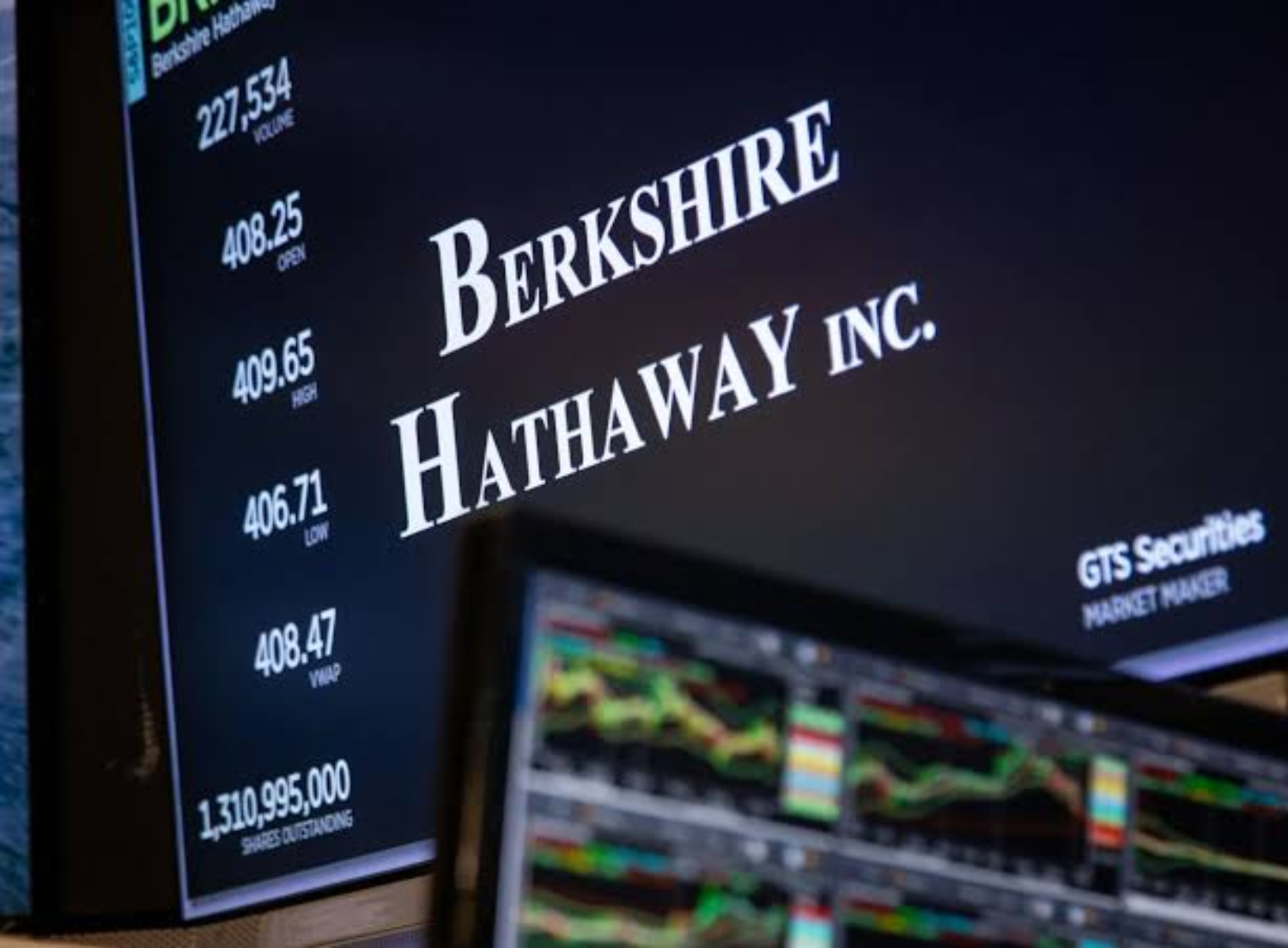
Source Credit : Portfolio Prints
Berkshire Hathaway began deploying part of its enormous cash stockpile in the second quarter, investing billions of dollars in stocks including Alphabet and stepping up purchases of its own shares as the conglomerate reported better-than-expected quarterly profit.
The company said on Saturday that it repurchased $4.5 billion of its own stock between April and June, followed by more than $3.3 billion in additional buybacks in July. The purchases marked an acceleration of a repurchase program that resumed in March after a nearly two-year pause.
Berkshire also bought nearly $20 billion more in stocks than it sold during the quarter, ending 14 consecutive quarters in which it had been a net seller of equities.
Among its largest purchases was a roughly $10 billion investment in Alphabet, the parent company of Google and YouTube. The purchase significantly increased Berkshire’s existing stake and made Alphabet one of its largest stock holdings.
The conglomerate’s quarterly operating profit rose 16% to $12.98 billion, beating analyst expectations. Stronger results at BNSF Railway and service businesses, including private-jet operator NetJets and electronic-components distributor TTI, helped offset weaker performance at auto insurer Geico.
Net income more than doubled to $25.67 billion, boosted in part by unrealized gains and losses on Berkshire’s stock investments. The company has long advised investors to focus on operating earnings rather than the often-volatile changes in the value of its equity portfolio.
Revenue, which had been largely stagnant in recent quarters, increased 10% to $101.81 billion.
Despite the stronger results, Berkshire warned that "considerable uncertainty" remains surrounding macroeconomic and geopolitical conditions, including tariffs and ongoing wars.
The company also pointed to weaker demand across several consumer businesses, including its network of 103 automobile and truck dealerships, Fruit of the Loom apparel and Forest River recreational vehicles. Berkshire attributed the slowdown partly to changes in consumer confidence.
The quarter was the second since Greg Abel became Berkshire’s chief executive, succeeding Warren Buffett, who remains chairman.
"It's a pretty healthy beat, and investors will be encouraged," said Cathy Seifert, an analyst at CFRA Research who has a "neutral" rating on Berkshire. "Slowly, gradually and subtly we're seeing Greg assert himself as the new leader."
Investors and analysts have been closely watching how Abel’s approach to capital allocation compares with Buffett’s. Buffett, who led Berkshire for about six decades, faced increasing difficulty finding sufficiently attractive investments for the company’s huge cash reserves toward the end of his tenure.
Berkshire ended June with $364.7 billion in cash, down from a record $380.2 billion three months earlier. The company’s cash balance nevertheless remains one of the largest corporate liquidity reserves in the world.
Berkshire’s policy permits share repurchases when management believes the stock is trading below its intrinsic value, which Abel determines conservatively after consulting with Buffett.
Buffett, who turns 96 on August 30, said last month that he remains involved in Berkshire’s decision-making. He also said that neither he nor Abel was taking actions that the other did not approve of.
Berkshire’s market capitalization currently stands at roughly 1.5 times its book value, which represents the value of its assets minus liabilities.
The latest pace of share repurchases is comparable with Berkshire’s most aggressive buyback periods under Buffett earlier this decade. The company’s biggest year for buybacks was 2021, when it repurchased approximately $27 billion of its own shares.
"Warren and Greg are terrific investors, and their repurchasing shares gives me confidence in the present value of Berkshire's shares and growth of intrinsic value going forward," said Macrae Sykes of Gabelli Funds, who manages the Gabelli Financial Services Opportunities ETF, where Berkshire is the largest holding.
Berkshire’s reported cash balance also reflects $6.8 billion spent in late July to acquire homebuilder Taylor Morrison.
Operating profit of $12.98 billion was equivalent to roughly $9,068 per Class A share, compared with $11.16 billion a year earlier.
Net income of $25.67 billion amounted to about $17,928 per Class A share, up from $12.37 billion in the year-ago period.
Berkshire’s Class A shares have gained about 3% this year, significantly underperforming the S&P 500’s 13% advance. The shares have also lagged the benchmark by roughly 40 percentage points since Buffett announced in May 2025 that he would step down as chief executive.
Geico was one of the biggest weak spots in the quarter. The auto insurer’s pretax underwriting profit fell 45% as accident claims increased and marketing expenses rose.
Geico has increased advertising spending as it attempts to rebuild its customer base after a multiyear effort to improve underwriting quality and reduce operating costs.
Seifert described Geico’s results as "absolutely abysmal" and said they raised "red flags," particularly as competitors such as Allstate and Progressive have reported stronger performances.
"The question is, was Geico late to the party to raise rates, and is it getting whipsawed by persistently higher claims frequencies," Seifert said. "It is spending a boatload on advertising, but at some point it may have to pull the plug because it hurts the bottom line."
Overall profit from Berkshire’s insurance and reinsurance operations declined 11%. Lower-than-expected property losses and stronger results from some insurance businesses partially offset the weakness at Geico.
Profit at BNSF Railway rose 6% to $1.56 billion as the railroad transported greater volumes of consumer, agricultural and energy products and benefited from higher fuel-related charges.
Berkshire Hathaway Energy posted a 27% increase in profit to $891 million, helped by stronger utility margins and tax credits.