Source Credit : Portfolio Prints
Introduction
On 1 February 2026, Finance Minister Nirmala Sitharaman presented India’s Union Budget for FY 2026–27 in the Lok Sabha. This marks her ninth full budget and reflects the government’s strategic priorities — boosting growth, strengthening infrastructure, fostering technology-led development, empowering small businesses and farmers, and positioning India for long-term competitive advantage.
The Budget outlines total expenditures of about ₹53.5 lakh crore, with revenues of around ₹36.5 lakh crore, while maintaining fiscal discipline with a deficit target of 4.3% of GDP.
Major Strategic Themes
Infrastructure-Led Growth
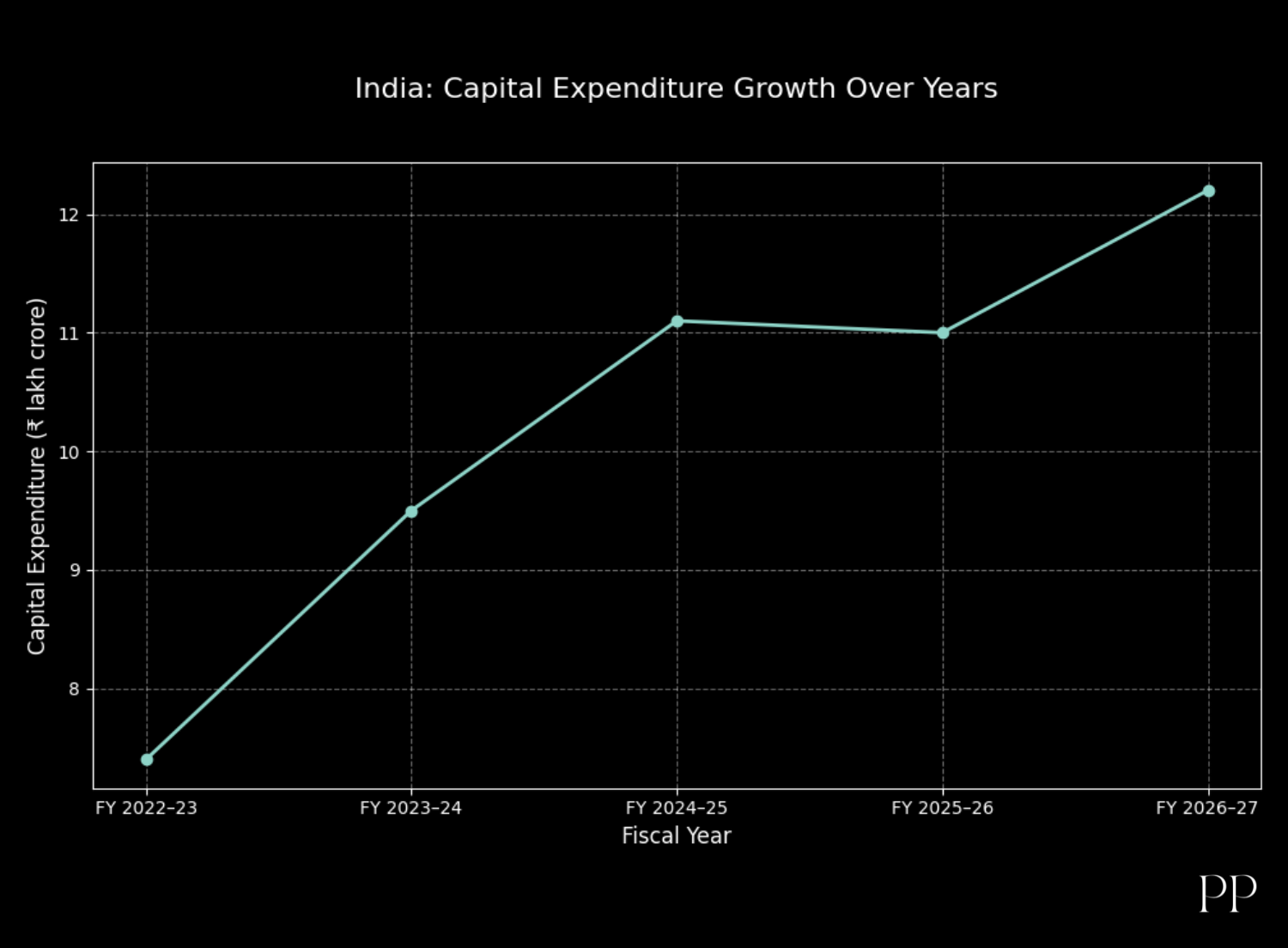
- Capital Expenditure Boost: The government allocated ₹12.2 lakh crore for capital spending in FY 2026–27 — a clear push toward building roads, railways, waterways and urban development across the country.
- High-Speed Rail: Seven new high-speed rail corridors were announced, linking key economic and population centres to enhance connectivity and reduce travel times.
- Freight and Waterways: A dedicated freight corridor from Dankuni to Surat and the operationalisation of 20 National Waterways are aimed at unclogging logistics and lowering transport costs.
- Regional Infrastructure Grants: States will receive enhanced grants (₹1.4 lakh crore) for disaster management and infrastructure.
Manufacturing and Technology Push
BioPharma SHAKTI
A new scheme with an outlay of ₹10,000 crore over 5 years to make India a global hub for biopharma manufacturing — including new research networks and expanded clinical trial sites.
India Semiconductor Mission (ISM) 2.0
This phase expands beyond chip assembly to end-to-end semiconductor design, materials and equipment — aiming to reduce import dependence.
- ₹40,000 crore push for Electronic Component Manufacturing Scheme — strengthening supply chains for gadgets, EVs and consumer electronics.
AI & Agriculture: Bharat-VISTAAR
A multilingual AI tool designed to give farmers location-specific advisories on weather, soil, pests and crop care — integrating AgriStack data.
Battery & EV Support
Customs duty relief on lithium-ion battery manufacturing capital goods until March 2028 and expanded duty exemptions to promote domestic EV supply chains.
| Key Area |
New Initiative |
Expected Impact |
| Infrastructure |
₹12.2 lakh crore capex; 7 new high-speed rail lines |
Growth, jobs, regional connectivity |
| Technology & Manufacturing |
ISM 2.0, biopharma push, AI in agriculture |
Global competitiveness |
| Tax Reform |
New Income Tax Act, TCS rationalisation |
Simplified tax compliance |
| Agriculture |
Productivity-led investment |
Farmer welfare |
| Social Sector |
Women-led enterprises, education expansion |
Inclusive growth |
| Defence |
Record funding |
Security and modernisation |
Tax and Fiscal Reforms
Contrary to speculation, no major income-tax rate cuts were announced, but there are significant policy changes:
- A new Income Tax Act will come into force from April 2026 to simplify tax provisions and return processes.
- Tax holidays till 2047 for foreign cloud service companies operating Indian data centres are proposed, encouraging digital infrastructure investments.
- TCS (Tax Collected at Source) reductions: Overseas travel, education and health payments via LRS have seen TCS rates cut to 2%.
Fiscal Deficit Trend
India’s fiscal deficit has been on a steady downward trajectory, reflecting the government’s focus on restoring fiscal discipline after the pandemic-induced spike in borrowing. From 6.7% of GDP in FY 2021–22, the deficit has gradually narrowed as economic activity recovered and revenues improved.
In Budget 2026, the government reaffirmed its commitment to consolidation, targeting a fiscal deficit of around 4.3% of GDP by FY 2026–27. This reduction has been achieved while continuing high capital expenditure, indicating a shift from consumption-led spending to investment-driven growth.
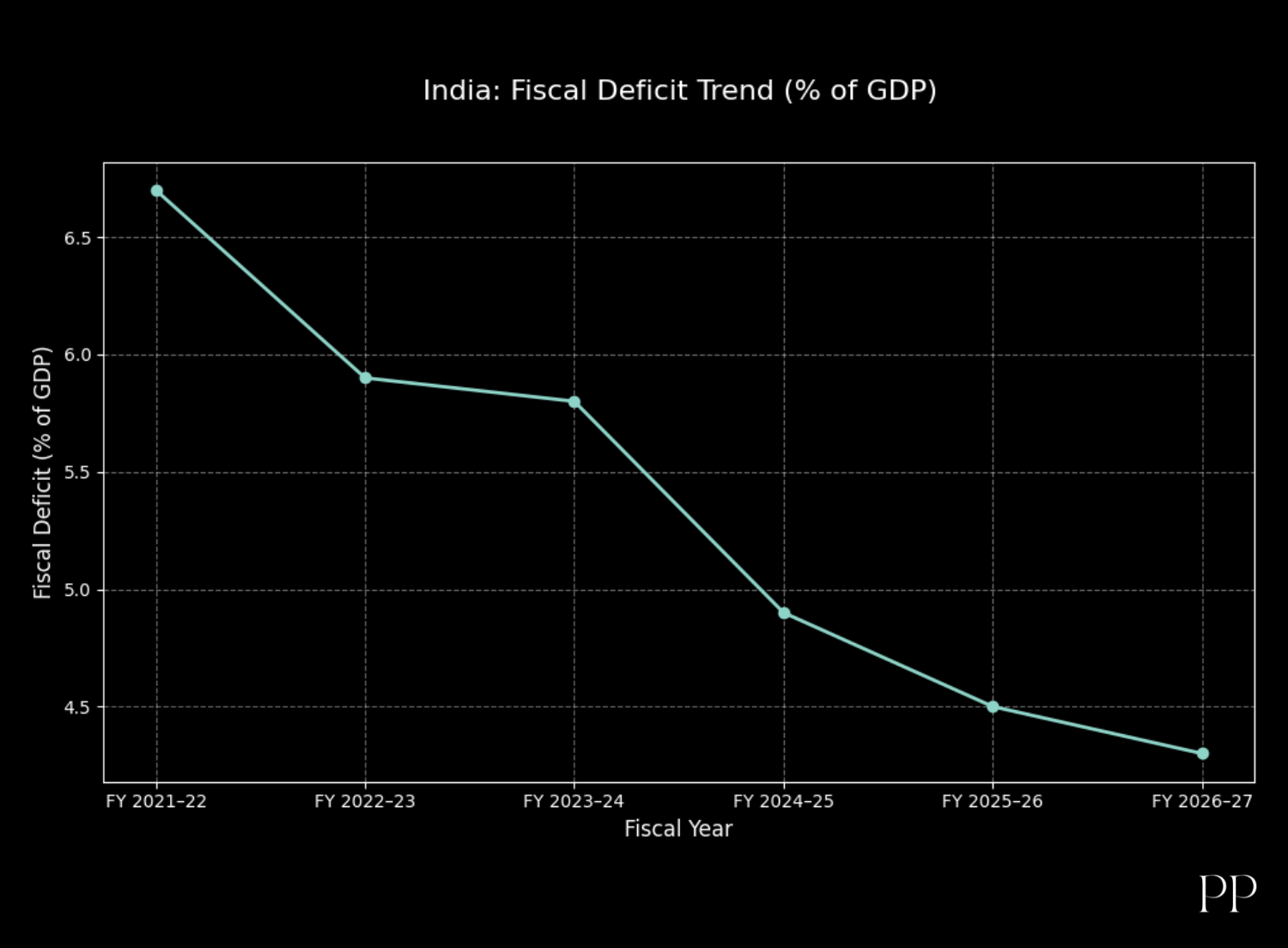 The declining fiscal deficit trend is significant as it helps contain public debt, stabilise inflation expectations, and improve investor confidence, both domestic and global. At the same time, maintaining lower deficits provides the government with greater flexibility to respond to future economic shocks without compromising long-term stability.
Sectoral Highlights
Agriculture and Rural Economy
- ₹1.63 lakh crore allocated to agriculture and rural development.
- Focus shifted from subsidies to productivity hubs, high-value crops (coconut, cashew, cocoa), fisheries and livestock, plus rural job creation.
Healthcare
- Health research funding increased by ~24%, supporting stronger public health systems and innovation.
- AIIMS funding boosted to meet rising patient demand and expand facilities.
Education & Innovation
- New university townships and expansion of education institutions, including a new National Institute of Design (NID), aimed at broadening access to quality education.
- Emphasis on innovation, employability and skill development to prepare youth for future tech and creative industries.
Defence & Security
- Record allocations to defence spending and modernisation of armed forces — including capital equipment and technology upgrades.
- Enhanced funding for intelligence agencies reflects focus on national security.
Summary
India’s Union Budget 2026–27 focuses on long-term growth, technology leadership, and infrastructure expansion while maintaining fiscal discipline. The government increased capital expenditure to around ₹12.2 lakh crore, prioritising roads, railways, logistics, and urban infrastructure to boost jobs and private investment.
The budget strongly backs manufacturing and technology, with initiatives like Semiconductor Mission 2.0, support for EV batteries, biopharma manufacturing, and wider use of AI in agriculture. Agriculture and rural development receive continued support, with an emphasis on productivity and high-value crops rather than subsidies alone.
On the tax front, there are no major income-tax rate changes, but the announcement of a new simplified Income Tax Act from April 2026 and rationalisation of TCS aim to ease compliance. Social sectors such as education, healthcare, women-led enterprises, and defence modernisation also see higher allocations.