India's GDP beats estimates to grow at 7.7% in FY26
Image Credit : Bloomberg
Source Credit : Portfolio Prints
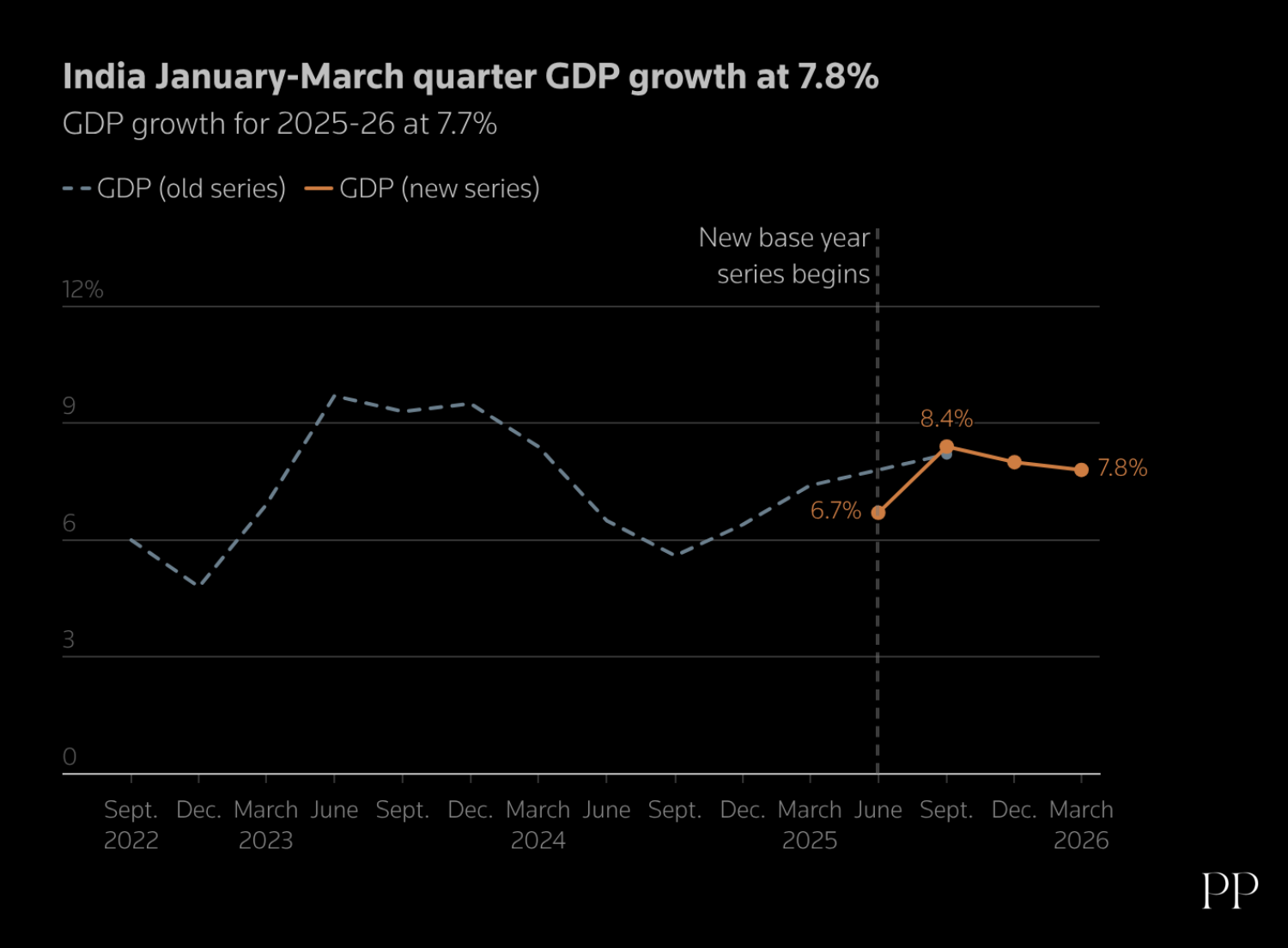
India's economy expanded by a stronger-than-expected 7.8% year-on-year during the January–March quarter, government data released on Friday showed, as robust private investment, higher agricultural output, and sustained construction activity helped cushion the economy from the initial effects of the escalating Middle East conflict.
The growth figure, which marks the second release under India's revised national accounts series featuring an updated base year and broader economic coverage, comfortably exceeded economists' expectations of 7.2% in a Reuters poll.
Despite the impressive performance, growth eased slightly from the previous quarter. The government revised October–December GDP growth upward to 8.0% from the previously reported 7.8%, highlighting the economy's strong momentum heading into 2026.
“The disruption caused by the West Asia conflict in March appears to have had only a limited impact on economic activity,” said Sakshi Gupta, Principal Economist at HDFC Bank. However, she cautioned that growth is likely to moderate from the April–June quarter onward as external risks intensify.
Gross Value Added (GVA)—widely viewed as a more accurate measure of underlying economic activity because it excludes the volatility of taxes and subsidies—rose 7.9% during the quarter, underscoring the broad-based strength of the economy.
For the fiscal year ending March 2026, the National Statistics Office estimated GDP growth at 7.7%, slightly above its earlier forecast of 7.6%, reinforcing India's position as one of the world's fastest-growing major economies.
 Before the outbreak of the latest Middle East conflict, Chief Economic Adviser V. Anantha Nageswaran had projected economic growth for the current fiscal year in the range of 7.0% to 7.4%.
However, the prolonged conflict involving Iran and the United States has emerged as a major external risk. With the war entering its fourth month and no immediate diplomatic breakthrough in sight, India faces mounting challenges due to its heavy dependence on Middle Eastern energy supplies. As the world's third-largest importer and consumer of crude oil, the country remains particularly vulnerable to disruptions in global energy markets.
The Reserve Bank of India earlier on Friday warned that the ongoing conflict could slow economic growth to 6.6% during the current fiscal year. While keeping benchmark interest rates unchanged, the central bank signaled a potentially more hawkish policy stance amid rising inflation risks, elevated oil prices, and continued pressure on the rupee.
Higher energy costs are expected to fuel domestic inflation while widening both fiscal and current account deficits, creating additional headwinds for the economy and weighing on investor sentiment.
Another concern is the outlook for agriculture, as India is experiencing its weakest monsoon rainfall in more than a decade. A prolonged rainfall deficit could affect rural incomes, food production, and overall economic growth in the coming quarters.
Sector-wise data revealed a mixed picture. Manufacturing output expanded 7.3% year-on-year during the January–March quarter, slowing from the revised 12.8% growth recorded in the previous quarter. In contrast, construction activity accelerated to 8.4%, up from 6.7%, supported by strong infrastructure spending and real estate demand.
Agriculture and allied activities showed notable improvement, with farm output growing 3.6% compared with a revised 1.7% expansion in the preceding quarter. The sector remains critical to the economy, employing more than 40% of India's workforce and supporting rural consumption.
Private consumption, which accounts for approximately 57% of India's GDP, grew 7.1% during the quarter. While still healthy, the pace slowed from the revised 8.2% growth recorded in the previous three months, suggesting some moderation in household spending.
Government expenditure increased 4.9%, slightly higher than the 4.6% growth seen in the preceding quarter, providing continued support to economic activity.
Private investment emerged as one of the strongest pillars of growth, surging 10.8% year-on-year compared with a revised 8.2% increase in the previous quarter. Under the revised GDP series, this marks the fastest pace of private-sector investment growth in three years, reflecting improving corporate confidence and expanding capital expenditure.
“A notable slowdown in private consumption was more than offset by stronger investment activity,” said Alexandra Hermann Prasad, Lead Economist at Oxford Economics.
Despite the strong headline figures, economists remain cautious about the outlook. “We believe economic activity has already begun to lose some momentum and is likely to remain relatively soft over the coming quarters,” Prasad said, pointing to global uncertainties, higher commodity prices, and domestic inflationary pressures.
Overall, the latest data highlights the resilience of India's economy amid a challenging global environment. Strong investment, improving agricultural performance, and sustained infrastructure activity continue to support growth, although rising geopolitical tensions, energy costs, and weather-related risks could test that resilience in the months ahead.
Before the outbreak of the latest Middle East conflict, Chief Economic Adviser V. Anantha Nageswaran had projected economic growth for the current fiscal year in the range of 7.0% to 7.4%.
However, the prolonged conflict involving Iran and the United States has emerged as a major external risk. With the war entering its fourth month and no immediate diplomatic breakthrough in sight, India faces mounting challenges due to its heavy dependence on Middle Eastern energy supplies. As the world's third-largest importer and consumer of crude oil, the country remains particularly vulnerable to disruptions in global energy markets.
The Reserve Bank of India earlier on Friday warned that the ongoing conflict could slow economic growth to 6.6% during the current fiscal year. While keeping benchmark interest rates unchanged, the central bank signaled a potentially more hawkish policy stance amid rising inflation risks, elevated oil prices, and continued pressure on the rupee.
Higher energy costs are expected to fuel domestic inflation while widening both fiscal and current account deficits, creating additional headwinds for the economy and weighing on investor sentiment.
Another concern is the outlook for agriculture, as India is experiencing its weakest monsoon rainfall in more than a decade. A prolonged rainfall deficit could affect rural incomes, food production, and overall economic growth in the coming quarters.
Sector-wise data revealed a mixed picture. Manufacturing output expanded 7.3% year-on-year during the January–March quarter, slowing from the revised 12.8% growth recorded in the previous quarter. In contrast, construction activity accelerated to 8.4%, up from 6.7%, supported by strong infrastructure spending and real estate demand.
Agriculture and allied activities showed notable improvement, with farm output growing 3.6% compared with a revised 1.7% expansion in the preceding quarter. The sector remains critical to the economy, employing more than 40% of India's workforce and supporting rural consumption.
Private consumption, which accounts for approximately 57% of India's GDP, grew 7.1% during the quarter. While still healthy, the pace slowed from the revised 8.2% growth recorded in the previous three months, suggesting some moderation in household spending.
Government expenditure increased 4.9%, slightly higher than the 4.6% growth seen in the preceding quarter, providing continued support to economic activity.
Private investment emerged as one of the strongest pillars of growth, surging 10.8% year-on-year compared with a revised 8.2% increase in the previous quarter. Under the revised GDP series, this marks the fastest pace of private-sector investment growth in three years, reflecting improving corporate confidence and expanding capital expenditure.
“A notable slowdown in private consumption was more than offset by stronger investment activity,” said Alexandra Hermann Prasad, Lead Economist at Oxford Economics.
Despite the strong headline figures, economists remain cautious about the outlook. “We believe economic activity has already begun to lose some momentum and is likely to remain relatively soft over the coming quarters,” Prasad said, pointing to global uncertainties, higher commodity prices, and domestic inflationary pressures.
Overall, the latest data highlights the resilience of India's economy amid a challenging global environment. Strong investment, improving agricultural performance, and sustained infrastructure activity continue to support growth, although rising geopolitical tensions, energy costs, and weather-related risks could test that resilience in the months ahead.