India’s consumer price inflation rose to 4.38% in June
Image Credit : Reuters
Source Credit : Portfolio Prints
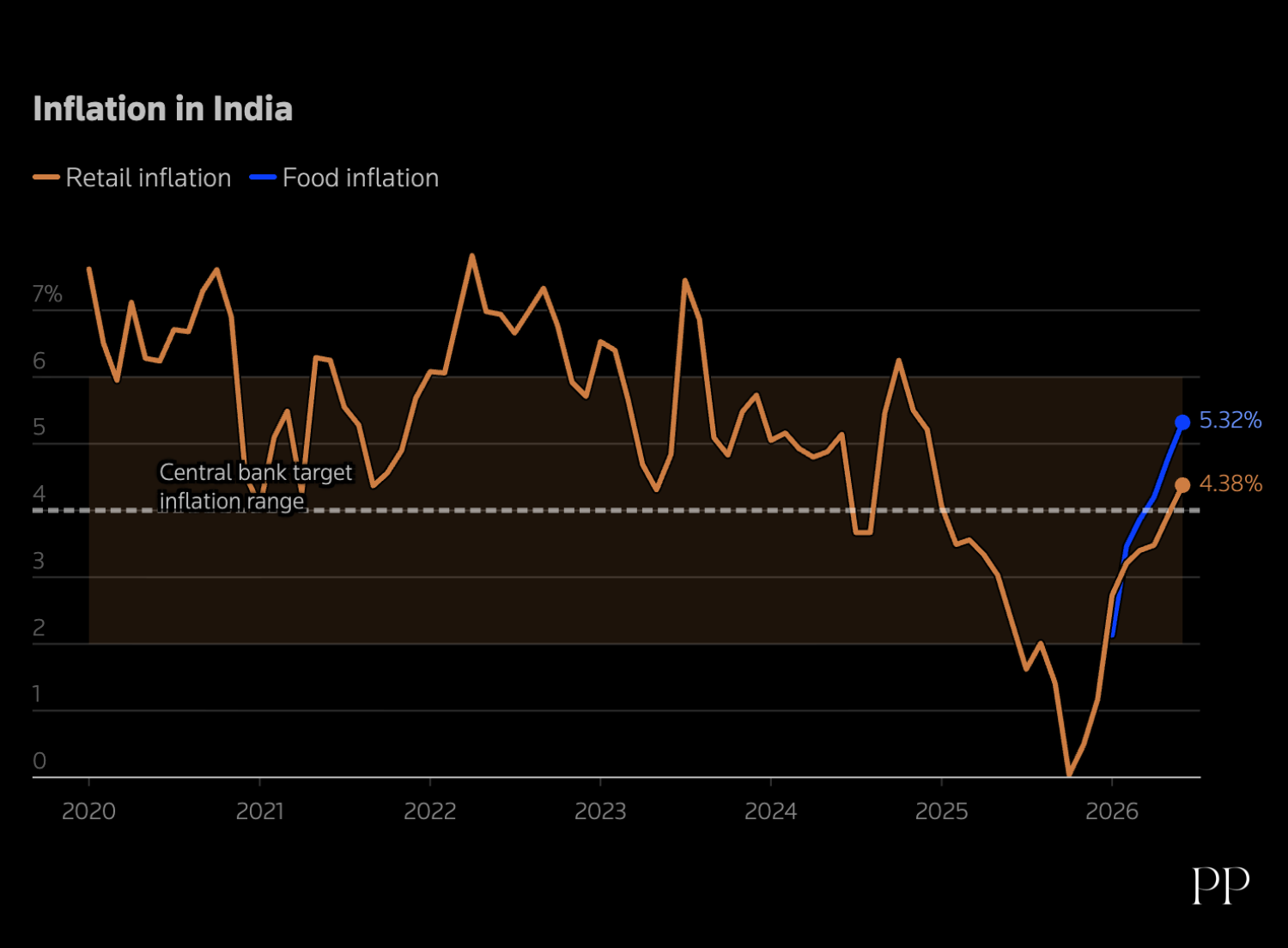
India’s consumer price inflation accelerated to 4.38% in June from 3.93% in May, driven by rising food and fuel costs amid renewed geopolitical tensions in the Middle East and concerns over an uneven monsoon season. The increase adds to mounting cost pressures across the economy and signals a potential resurgence in inflationary risks.
The headline inflation reading exceeded economists’ expectations of 4.30%, according to a Reuters poll, highlighting the persistence of price pressures despite recent efforts to stabilize inflation.
Data released Monday by the Ministry of Statistics and Programme Implementation showed that annual inflation based on the All India Consumer Food Price Index (CFPI) climbed to 5.32% in June. Transportation costs also accelerated sharply, with transport inflation rising 4.3% year-over-year compared with 1.75% in May, reflecting the impact of higher energy prices on household and business expenses.
 The latest figures come just weeks after the Reserve Bank of India (RBI) left interest rates unchanged while warning that inflation could rise further and economic growth may moderate during the financial year ending March 2027.
The central bank expects headline inflation to increase to around 5.1% over the coming year as consumers face elevated fuel costs and agricultural output remains vulnerable to weather disruptions associated with El Niño. Core inflation, which excludes volatile food and fuel prices, is projected at 4.7%.
Geopolitical developments have emerged as a key inflationary risk. Although a temporary ceasefire between the United States and Iran briefly eased tensions in June, hostilities resumed last week, reigniting concerns about disruptions to global energy markets.
Oil prices have climbed as the United States and Iran continue to contest influence over the Strait of Hormuz, a strategic maritime chokepoint through which a significant share of the world’s energy supplies passes. Any disruption to shipping through the corridor could have far-reaching consequences for global oil and gas markets.
India, the world’s fastest-growing major economy, remains particularly exposed to such disruptions. The country imports nearly 85% of its crude oil requirements and depends on the Strait of Hormuz for roughly half of its crude imports, 60% of its liquefied natural gas imports, and almost all of its liquefied petroleum gas supplies. As a result, sustained increases in energy prices could significantly raise inflation and widen import costs.
At the same time, weather-related risks continue to cloud the inflation outlook. Despite heavy rainfall and flooding in several regions over the past two weeks, India still faces the possibility of a weaker-than-normal monsoon due to the developing El Niño weather pattern.
According to a report released Friday by Crisil, the S&P Global-owned research and ratings firm, the monsoon recovered significantly after a dry start to the season. Following a parched June, rainfall accelerated rapidly, reducing the nationwide rainfall deficit from 40% to 15% as of July 8.
However, the India Meteorological Department (IMD) has forecast that rainfall during July will remain approximately 6% below the long-period average, suggesting that weather conditions could remain unpredictable during the crucial agricultural season.
Economists warn that sharp swings between rainfall deficits and excessive precipitation can be just as damaging to agriculture as an outright weak monsoon. Such volatility affects sowing patterns, crop yields, farm productivity, and ultimately rural incomes, creating uncertainty for both food production and consumer prices.
The RBI has repeatedly emphasized the importance of monitoring core inflation, viewing it as a more reliable indicator of underlying price trends. While core inflation remains relatively contained for now, persistently elevated food and energy costs could gradually filter through the broader economy by increasing transportation, manufacturing, and operational expenses. If sustained, these pressures may eventually push core inflation higher, complicating the central bank’s efforts to maintain price stability while supporting economic growth.
The latest figures come just weeks after the Reserve Bank of India (RBI) left interest rates unchanged while warning that inflation could rise further and economic growth may moderate during the financial year ending March 2027.
The central bank expects headline inflation to increase to around 5.1% over the coming year as consumers face elevated fuel costs and agricultural output remains vulnerable to weather disruptions associated with El Niño. Core inflation, which excludes volatile food and fuel prices, is projected at 4.7%.
Geopolitical developments have emerged as a key inflationary risk. Although a temporary ceasefire between the United States and Iran briefly eased tensions in June, hostilities resumed last week, reigniting concerns about disruptions to global energy markets.
Oil prices have climbed as the United States and Iran continue to contest influence over the Strait of Hormuz, a strategic maritime chokepoint through which a significant share of the world’s energy supplies passes. Any disruption to shipping through the corridor could have far-reaching consequences for global oil and gas markets.
India, the world’s fastest-growing major economy, remains particularly exposed to such disruptions. The country imports nearly 85% of its crude oil requirements and depends on the Strait of Hormuz for roughly half of its crude imports, 60% of its liquefied natural gas imports, and almost all of its liquefied petroleum gas supplies. As a result, sustained increases in energy prices could significantly raise inflation and widen import costs.
At the same time, weather-related risks continue to cloud the inflation outlook. Despite heavy rainfall and flooding in several regions over the past two weeks, India still faces the possibility of a weaker-than-normal monsoon due to the developing El Niño weather pattern.
According to a report released Friday by Crisil, the S&P Global-owned research and ratings firm, the monsoon recovered significantly after a dry start to the season. Following a parched June, rainfall accelerated rapidly, reducing the nationwide rainfall deficit from 40% to 15% as of July 8.
However, the India Meteorological Department (IMD) has forecast that rainfall during July will remain approximately 6% below the long-period average, suggesting that weather conditions could remain unpredictable during the crucial agricultural season.
Economists warn that sharp swings between rainfall deficits and excessive precipitation can be just as damaging to agriculture as an outright weak monsoon. Such volatility affects sowing patterns, crop yields, farm productivity, and ultimately rural incomes, creating uncertainty for both food production and consumer prices.
The RBI has repeatedly emphasized the importance of monitoring core inflation, viewing it as a more reliable indicator of underlying price trends. While core inflation remains relatively contained for now, persistently elevated food and energy costs could gradually filter through the broader economy by increasing transportation, manufacturing, and operational expenses. If sustained, these pressures may eventually push core inflation higher, complicating the central bank’s efforts to maintain price stability while supporting economic growth.