India's forex reserves hit record $729 billion
Image Credit : Reuters
Source Credit : Portfolio Prints
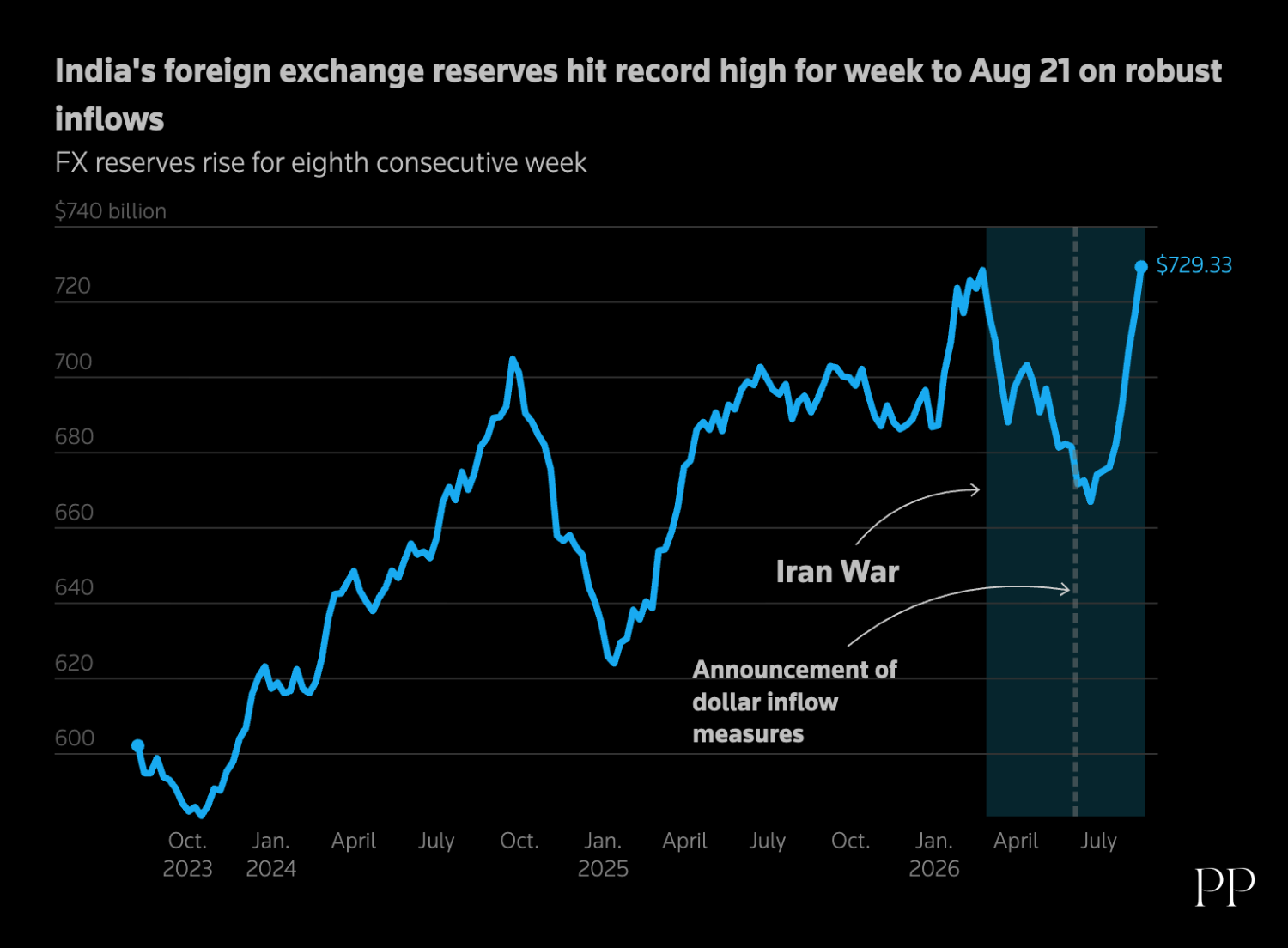
India’s foreign exchange reserves climbed to a record $729.33 billion in the week ended August 21, according to data released by the Reserve Bank of India (RBI). The increase was driven by sustained dollar inflows following a series of measures introduced by the central bank to strengthen India’s balance of payments and encourage foreign-currency deposits.
India’s reserves have now risen for eight consecutive weeks, adding around $63 billion during the period and surpassing the previous record reached in February.
The recent surge follows a package of measures announced by the RBI in June to encourage foreign-currency inflows. These included discounted hedging facilities for overseas borrowings by state-owned companies and banks, along with a zero-cost hedging facility for banks seeking to raise foreign-exchange deposits from overseas markets.
 The measures generated a substantial response. Between June 5 and August 21, the RBI received nearly $73 billion through these schemes, including around $65 billion from non-resident Indian deposits. The scale of the inflows prompted the central bank to bring forward the closure of its deposit hedging facility by one month, with the window scheduled to close at the end of August.
Economists say the latest increase in reserves reflects a combination of RBI dollar purchases and valuation gains on existing reserve assets. Gaura Sen Gupta, Chief Economist at IDFC FIRST Bank, said the rise was partly driven by the RBI purchasing dollars through the FCNR-B swap window as banks pushed to attract deposits before the facility closed. The remainder came from valuation gains on the central bank’s reserve assets.
For the week ended August 21 alone, India’s reserves increased by $12.4 billion from the previous week. Foreign currency assets rose by around $9.5 billion, while the value of the RBI’s gold holdings increased by approximately $2.8 billion.
The record accumulation also comes as the RBI continues to intervene in the foreign-exchange market to manage volatility in the rupee. Bankers believe these interventions have absorbed part of the additional dollar inflows, preventing them from translating into a much sharper appreciation of the rupee.
The increase in reserves therefore reflects not only strong foreign-currency inflows but also the RBI’s efforts to manage the exchange rate. By purchasing foreign currency from the market, the central bank can add to its reserves while limiting excessive movements in the rupee.
It is also important to note that changes in foreign currency assets do not necessarily represent direct dollar purchases. The RBI holds a range of foreign currencies and international assets, so changes in their value against the U.S. dollar can generate valuation gains or losses when reserves are reported in dollar terms.
India’s foreign-exchange reserves include foreign currency assets, gold, Special Drawing Rights (SDRs), and the country’s reserve tranche position with the International Monetary Fund (IMF). At $729.33 billion, the record reserve stock provides India with a substantial external financial cushion, strengthens confidence in its ability to meet international obligations, and gives the RBI greater capacity to respond to future pressure on the rupee.
The measures generated a substantial response. Between June 5 and August 21, the RBI received nearly $73 billion through these schemes, including around $65 billion from non-resident Indian deposits. The scale of the inflows prompted the central bank to bring forward the closure of its deposit hedging facility by one month, with the window scheduled to close at the end of August.
Economists say the latest increase in reserves reflects a combination of RBI dollar purchases and valuation gains on existing reserve assets. Gaura Sen Gupta, Chief Economist at IDFC FIRST Bank, said the rise was partly driven by the RBI purchasing dollars through the FCNR-B swap window as banks pushed to attract deposits before the facility closed. The remainder came from valuation gains on the central bank’s reserve assets.
For the week ended August 21 alone, India’s reserves increased by $12.4 billion from the previous week. Foreign currency assets rose by around $9.5 billion, while the value of the RBI’s gold holdings increased by approximately $2.8 billion.
The record accumulation also comes as the RBI continues to intervene in the foreign-exchange market to manage volatility in the rupee. Bankers believe these interventions have absorbed part of the additional dollar inflows, preventing them from translating into a much sharper appreciation of the rupee.
The increase in reserves therefore reflects not only strong foreign-currency inflows but also the RBI’s efforts to manage the exchange rate. By purchasing foreign currency from the market, the central bank can add to its reserves while limiting excessive movements in the rupee.
It is also important to note that changes in foreign currency assets do not necessarily represent direct dollar purchases. The RBI holds a range of foreign currencies and international assets, so changes in their value against the U.S. dollar can generate valuation gains or losses when reserves are reported in dollar terms.
India’s foreign-exchange reserves include foreign currency assets, gold, Special Drawing Rights (SDRs), and the country’s reserve tranche position with the International Monetary Fund (IMF). At $729.33 billion, the record reserve stock provides India with a substantial external financial cushion, strengthens confidence in its ability to meet international obligations, and gives the RBI greater capacity to respond to future pressure on the rupee.