TSMC to invest additional $100 billion in Arizona
Image Credit : Reuters
Source Credit : Portfolio Prints
Taiwan Semiconductor Manufacturing Company (TSMC), the world’s largest producer of advanced semiconductor chips and a crucial supplier to Nvidia, has delivered one of the strongest endorsements yet of the artificial intelligence investment cycle. The company announced an additional $100 billion investment in Arizona, expanding its commitment to U.S. manufacturing and bringing its total planned investment in the state to $265 billion. The announcement represents a major boost for Washington’s efforts to strengthen domestic semiconductor production and reduce reliance on overseas supply chains.
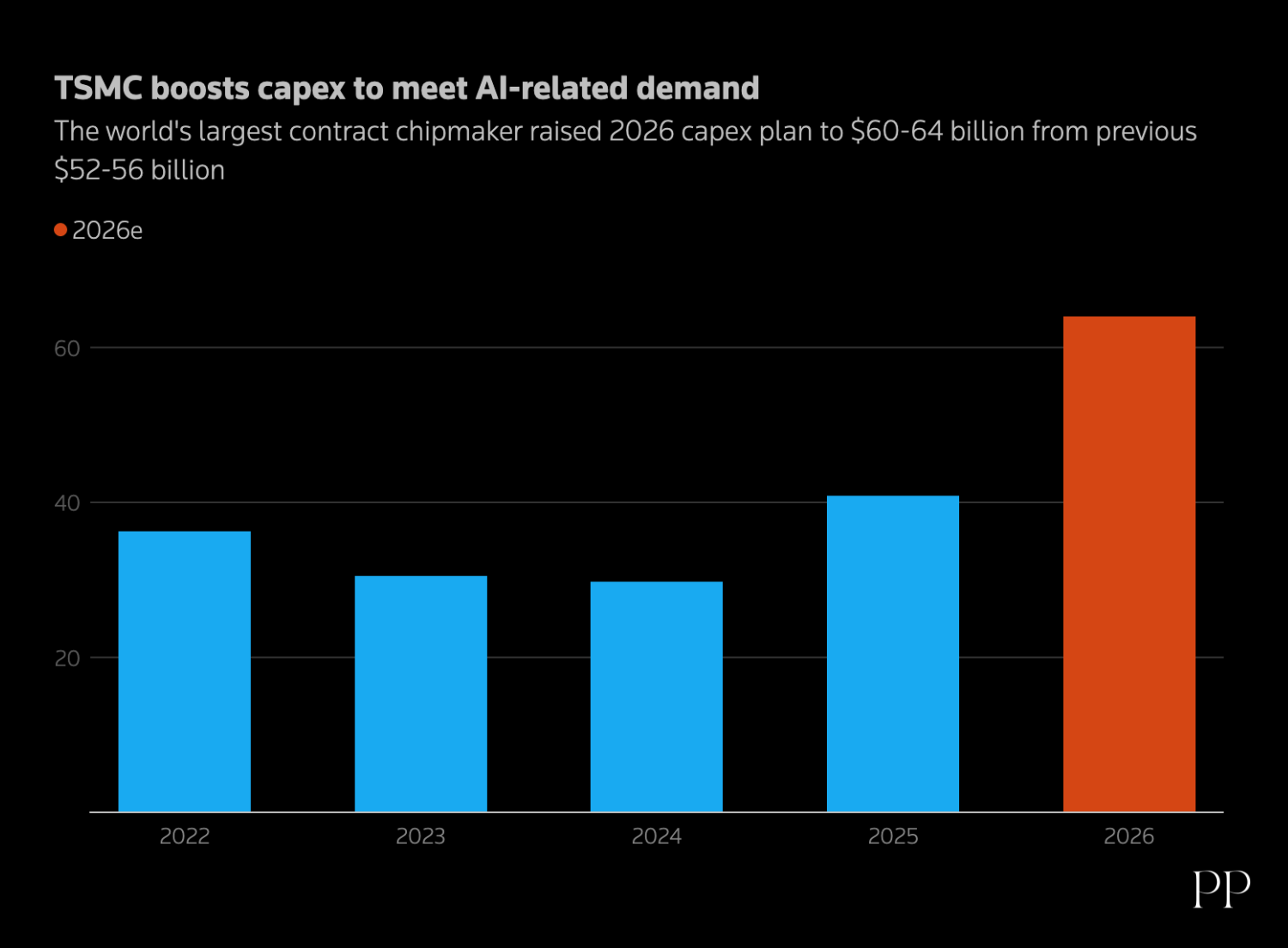
At the same time, TSMC reinforced its confidence in the long-term growth of artificial intelligence by significantly increasing its capital expenditure plans. The company now expects to spend $60–64 billion in 2026, compared with its previous guidance of $52–56 billion, while indicating that investment over the next three years will be substantially higher than during the previous three-year period. Such aggressive spending plans suggest management sees the current AI boom as a structural transformation rather than a temporary surge in demand.
Speaking during the company’s earnings call, Chief Executive Officer C.C. Wei emphasized that demand signals from major cloud computing companies remain exceptionally strong. According to Wei, hyperscale customers continue to expand AI infrastructure at an aggressive pace, reinforcing TSMC’s belief that the multi-year AI growth story remains firmly intact. While acknowledging that customer projections can sometimes be overly optimistic, he noted that TSMC conducts its own assessment of AI data-center construction, computing demand, and industry capacity requirements before making large-scale investment decisions.
 The confidence was backed by another quarter of extraordinary financial performance. TSMC reported second-quarter net profit of T$706.6 billion ($22 billion), representing a 77% increase from a year earlier and significantly exceeding market expectations of T$632.6 billion. The result marked the company’s ninth consecutive quarter of double-digit profit growth and underscored the unprecedented demand for advanced chips powering AI systems, cloud platforms, and next-generation computing applications.
Revenue growth remains equally impressive. TSMC now expects full-year revenue, measured in U.S. dollars, to increase by more than 40% in 2026, an upgrade from its previous forecast of over 30%. For the current quarter, the company projects revenue between $44.6 billion and $45.8 billion, compared with $33.1 billion during the same period a year earlier. Such guidance indicates that demand for advanced semiconductor manufacturing continues to accelerate despite concerns that the AI spending boom could eventually cool.
The Arizona expansion is expected to include approximately four additional facilities, including advanced packaging operations that are becoming increasingly important in AI chip production. These facilities would supplement the eight factories and related projects that TSMC has already announced or begun constructing in the state. The company believes the investment will strengthen the U.S. semiconductor ecosystem, improve supply-chain resilience, and support the creation of thousands of highly skilled jobs.
The announcement also arrives against a broader geopolitical backdrop. President Donald Trump has repeatedly argued that the United States should reclaim a larger share of global semiconductor manufacturing and has criticized the concentration of advanced chip production in Asia. TSMC’s latest investment commitment aligns closely with those objectives and was welcomed by the U.S. Commerce Department as evidence of growing confidence in America’s semiconductor manufacturing future.
Beyond the headline investment figures, perhaps the most important signal from TSMC is its willingness to dramatically expand capacity despite already operating at record profitability. Capital expenditure is often viewed as one of the clearest indicators of management’s confidence in future demand. Companies rarely commit tens of billions of dollars to new manufacturing facilities unless they believe demand will remain strong for many years. TSMC’s decision to raise spending forecasts while simultaneously projecting higher revenue growth suggests that it expects AI-related demand to continue outpacing supply across much of the semiconductor industry.
Another notable development is the company’s view of how artificial intelligence is reshaping computing infrastructure. Wei highlighted the growing role of agentic AI systems, which require not only powerful AI accelerators but also increasing amounts of traditional CPU processing power. This trend broadens the scope of semiconductor demand, creating growth opportunities across multiple categories of chips rather than concentrating demand solely in graphics processors and AI accelerators.
Industry analysts continue to report exceptionally strong demand for TSMC’s most advanced manufacturing technologies, including its 3-nanometer and 2-nanometer process nodes. Demand also remains robust for the company’s advanced packaging technology, known as CoWoS (Chip-on-Wafer-on-Substrate), which has become essential for assembling the high-performance AI processors used by companies such as Nvidia and AMD. Capacity constraints in advanced packaging have emerged as one of the most important bottlenecks in the AI supply chain, making TSMC’s continued investment in this area particularly significant.
The company’s dominance has translated into remarkable gains in market value. TSMC is now worth approximately $1.97 trillion, making it the most valuable company in Asia and nearly twice the size of South Korean rival Samsung Electronics by market capitalization. Earlier in the week, it also reported a 36% increase in quarterly revenue, further highlighting the extraordinary momentum created by the AI-driven semiconductor boom.
Confidence in the sustainability of AI demand is not limited to TSMC. Dutch semiconductor equipment giant ASML recently raised its own long-term sales forecasts and announced plans to expand manufacturing capacity. As the sole supplier of the extreme ultraviolet lithography systems required to produce the world’s most advanced chips, ASML occupies a critical position in the semiconductor supply chain. Its decision to increase capacity suggests that leading industry players continue to expect robust AI-related investment for years to come.
Taken together, TSMC’s record earnings, upgraded revenue outlook, sharply higher capital expenditure plans, and massive Arizona investment provide one of the clearest indications yet that the company views artificial intelligence as a long-term technological and economic transformation rather than a speculative bubble. As the central manufacturing partner behind many of the world’s most advanced AI chips, TSMC’s willingness to commit hundreds of billions of dollars to new capacity serves as a powerful vote of confidence in the future trajectory of the global AI economy.
The confidence was backed by another quarter of extraordinary financial performance. TSMC reported second-quarter net profit of T$706.6 billion ($22 billion), representing a 77% increase from a year earlier and significantly exceeding market expectations of T$632.6 billion. The result marked the company’s ninth consecutive quarter of double-digit profit growth and underscored the unprecedented demand for advanced chips powering AI systems, cloud platforms, and next-generation computing applications.
Revenue growth remains equally impressive. TSMC now expects full-year revenue, measured in U.S. dollars, to increase by more than 40% in 2026, an upgrade from its previous forecast of over 30%. For the current quarter, the company projects revenue between $44.6 billion and $45.8 billion, compared with $33.1 billion during the same period a year earlier. Such guidance indicates that demand for advanced semiconductor manufacturing continues to accelerate despite concerns that the AI spending boom could eventually cool.
The Arizona expansion is expected to include approximately four additional facilities, including advanced packaging operations that are becoming increasingly important in AI chip production. These facilities would supplement the eight factories and related projects that TSMC has already announced or begun constructing in the state. The company believes the investment will strengthen the U.S. semiconductor ecosystem, improve supply-chain resilience, and support the creation of thousands of highly skilled jobs.
The announcement also arrives against a broader geopolitical backdrop. President Donald Trump has repeatedly argued that the United States should reclaim a larger share of global semiconductor manufacturing and has criticized the concentration of advanced chip production in Asia. TSMC’s latest investment commitment aligns closely with those objectives and was welcomed by the U.S. Commerce Department as evidence of growing confidence in America’s semiconductor manufacturing future.
Beyond the headline investment figures, perhaps the most important signal from TSMC is its willingness to dramatically expand capacity despite already operating at record profitability. Capital expenditure is often viewed as one of the clearest indicators of management’s confidence in future demand. Companies rarely commit tens of billions of dollars to new manufacturing facilities unless they believe demand will remain strong for many years. TSMC’s decision to raise spending forecasts while simultaneously projecting higher revenue growth suggests that it expects AI-related demand to continue outpacing supply across much of the semiconductor industry.
Another notable development is the company’s view of how artificial intelligence is reshaping computing infrastructure. Wei highlighted the growing role of agentic AI systems, which require not only powerful AI accelerators but also increasing amounts of traditional CPU processing power. This trend broadens the scope of semiconductor demand, creating growth opportunities across multiple categories of chips rather than concentrating demand solely in graphics processors and AI accelerators.
Industry analysts continue to report exceptionally strong demand for TSMC’s most advanced manufacturing technologies, including its 3-nanometer and 2-nanometer process nodes. Demand also remains robust for the company’s advanced packaging technology, known as CoWoS (Chip-on-Wafer-on-Substrate), which has become essential for assembling the high-performance AI processors used by companies such as Nvidia and AMD. Capacity constraints in advanced packaging have emerged as one of the most important bottlenecks in the AI supply chain, making TSMC’s continued investment in this area particularly significant.
The company’s dominance has translated into remarkable gains in market value. TSMC is now worth approximately $1.97 trillion, making it the most valuable company in Asia and nearly twice the size of South Korean rival Samsung Electronics by market capitalization. Earlier in the week, it also reported a 36% increase in quarterly revenue, further highlighting the extraordinary momentum created by the AI-driven semiconductor boom.
Confidence in the sustainability of AI demand is not limited to TSMC. Dutch semiconductor equipment giant ASML recently raised its own long-term sales forecasts and announced plans to expand manufacturing capacity. As the sole supplier of the extreme ultraviolet lithography systems required to produce the world’s most advanced chips, ASML occupies a critical position in the semiconductor supply chain. Its decision to increase capacity suggests that leading industry players continue to expect robust AI-related investment for years to come.
Taken together, TSMC’s record earnings, upgraded revenue outlook, sharply higher capital expenditure plans, and massive Arizona investment provide one of the clearest indications yet that the company views artificial intelligence as a long-term technological and economic transformation rather than a speculative bubble. As the central manufacturing partner behind many of the world’s most advanced AI chips, TSMC’s willingness to commit hundreds of billions of dollars to new capacity serves as a powerful vote of confidence in the future trajectory of the global AI economy.