China’s factory activity returns to growth in March
Image Credit : Bloomberg
Source Credit : Portfolio Prints
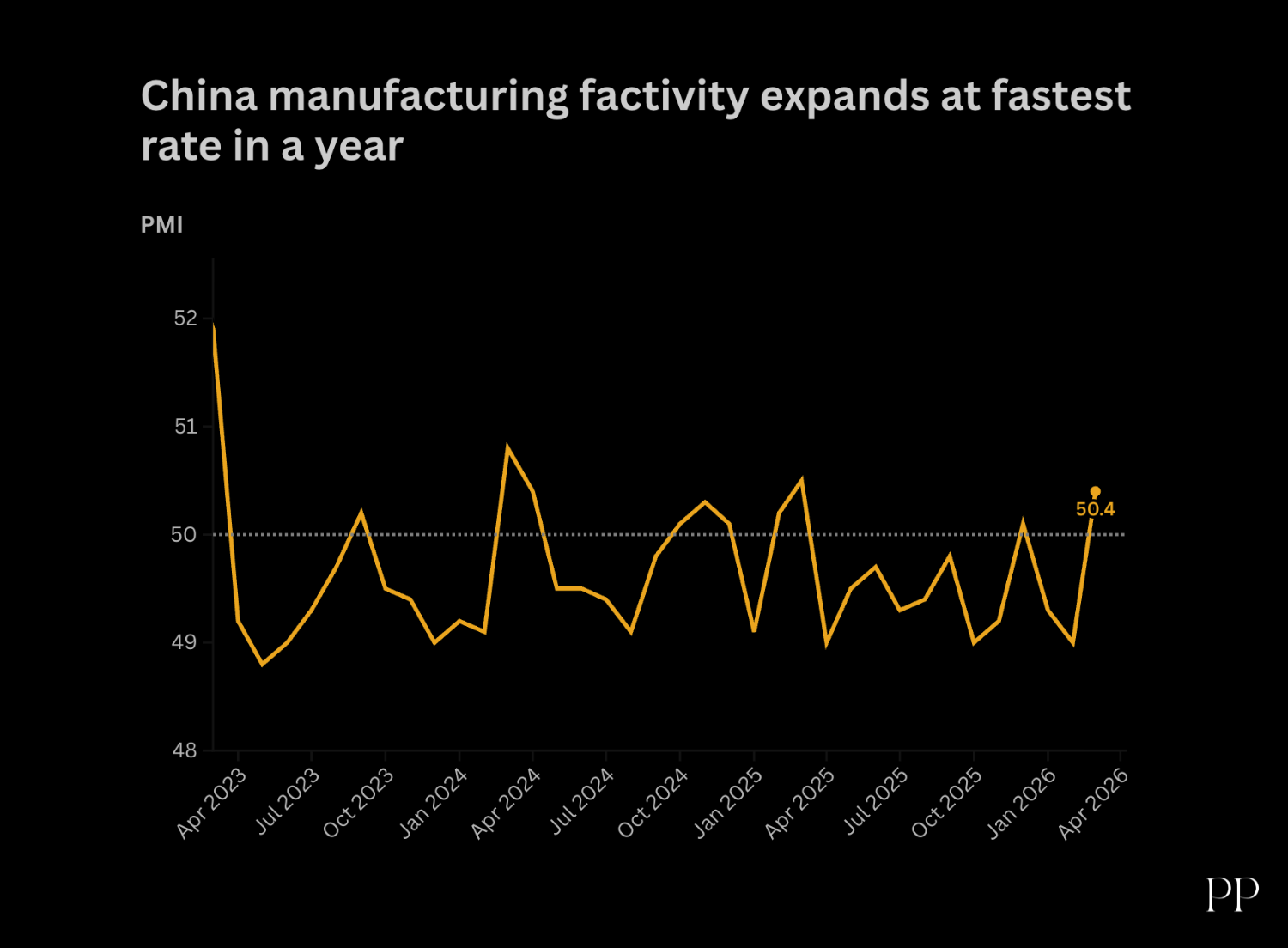
China’s official gauge of manufacturing activity rose more than expected in March, reaching its strongest level in a year and snapping a two-month streak of declines, as export orders gained momentum.
The Manufacturing Purchasing Managers’ Index (PMI) climbed to 50.4 in March, according to data released Tuesday by the National Bureau of Statistics, exceeding economists’ expectations of 50.1 in a Reuters poll. A reading above 50 indicates expansion, while a figure below signals contraction.
The improvement marks a solid rebound from contraction in the previous two months, when the PMI stood at 49.3 in January and 49.0 in February. By comparison, the index was slightly higher at 50.5 in March last year.
 A closer look at the data shows a mixed recovery. Sub-indexes for production and new orders moved into expansion territory, while indicators for raw material inventories, employment, and supplier delivery times remained in contraction.
According to NBS chief statistician Huo Lihui, manufacturing activity picked up pace as factories accelerated production following an extended national holiday in mid-February.
Outside manufacturing, China’s services sector also showed modest improvement. The non-manufacturing PMI, which tracks activity in industries such as tourism, rose to 50.1 in March from 49.5 in February.
However, rising costs continue to pose challenges. Higher shipping fees and increased prices for imported commodities—including crude oil and chemicals—driven by the ongoing Middle East conflict have weighed on businesses. Price indexes for raw material inputs and factory-gate prices rose to 63.9 and 55.4, respectively.
Despite these pressures, some businesses expect disruptions to be temporary. Cameron Johnson, a Shanghai-based senior partner at consulting firm Tidalwave Solutions, noted that market participants anticipate easing tensions ahead of a planned May meeting between U.S. President Donald Trump and Chinese President Xi Jinping. This suggests a limited window of elevated costs and supply constraints.
Demand from overseas markets has also strengthened. Inquiries for Chinese-made solar panels and batteries have increased in recent weeks, particularly from Europe, India, and East Africa. China’s large stockpiles have helped cushion the impact of global supply disruptions.
However, Johnson cautioned that prolonged disruptions could have significant consequences. “If these challenges persist into May, it could become a major problem,” he said.
Trade data further underscores the resilience of China’s export sector. In the first two months of the year, exports surged 21.8% year-on-year, far exceeding expectations, as strong demand from Southeast Asia and Europe offset weaker shipments to the United States.
Looking ahead, investors are awaiting a separate private-sector PMI survey from Caixin and S&P Global, due Wednesday. The index is expected to ease slightly to 51.6 in March from February’s five-year high of 52.1, according to a Reuters poll.
A closer look at the data shows a mixed recovery. Sub-indexes for production and new orders moved into expansion territory, while indicators for raw material inventories, employment, and supplier delivery times remained in contraction.
According to NBS chief statistician Huo Lihui, manufacturing activity picked up pace as factories accelerated production following an extended national holiday in mid-February.
Outside manufacturing, China’s services sector also showed modest improvement. The non-manufacturing PMI, which tracks activity in industries such as tourism, rose to 50.1 in March from 49.5 in February.
However, rising costs continue to pose challenges. Higher shipping fees and increased prices for imported commodities—including crude oil and chemicals—driven by the ongoing Middle East conflict have weighed on businesses. Price indexes for raw material inputs and factory-gate prices rose to 63.9 and 55.4, respectively.
Despite these pressures, some businesses expect disruptions to be temporary. Cameron Johnson, a Shanghai-based senior partner at consulting firm Tidalwave Solutions, noted that market participants anticipate easing tensions ahead of a planned May meeting between U.S. President Donald Trump and Chinese President Xi Jinping. This suggests a limited window of elevated costs and supply constraints.
Demand from overseas markets has also strengthened. Inquiries for Chinese-made solar panels and batteries have increased in recent weeks, particularly from Europe, India, and East Africa. China’s large stockpiles have helped cushion the impact of global supply disruptions.
However, Johnson cautioned that prolonged disruptions could have significant consequences. “If these challenges persist into May, it could become a major problem,” he said.
Trade data further underscores the resilience of China’s export sector. In the first two months of the year, exports surged 21.8% year-on-year, far exceeding expectations, as strong demand from Southeast Asia and Europe offset weaker shipments to the United States.
Looking ahead, investors are awaiting a separate private-sector PMI survey from Caixin and S&P Global, due Wednesday. The index is expected to ease slightly to 51.6 in March from February’s five-year high of 52.1, according to a Reuters poll.