China Export Growth Accelerates in May on AI Demand
Image Credit : Reuters
Source Credit : Portfolio Prints
China's export growth accelerated sharply in May, driven by surging global demand for semiconductors, automobiles and other high-tech products linked to the artificial intelligence boom, offering policymakers some relief as higher energy costs stemming from the Iran conflict weighed on broader global demand.
The rapid expansion in AI-related investment worldwide has helped the world's largest manufacturer offset much of the export slowdown that many analysts had expected from escalating Middle East tensions. However, signs are beginning to emerge that stockpiling activity triggered by rising energy costs is losing momentum, with overseas buyers gradually drawing down inventories while awaiting progress toward a ceasefire.
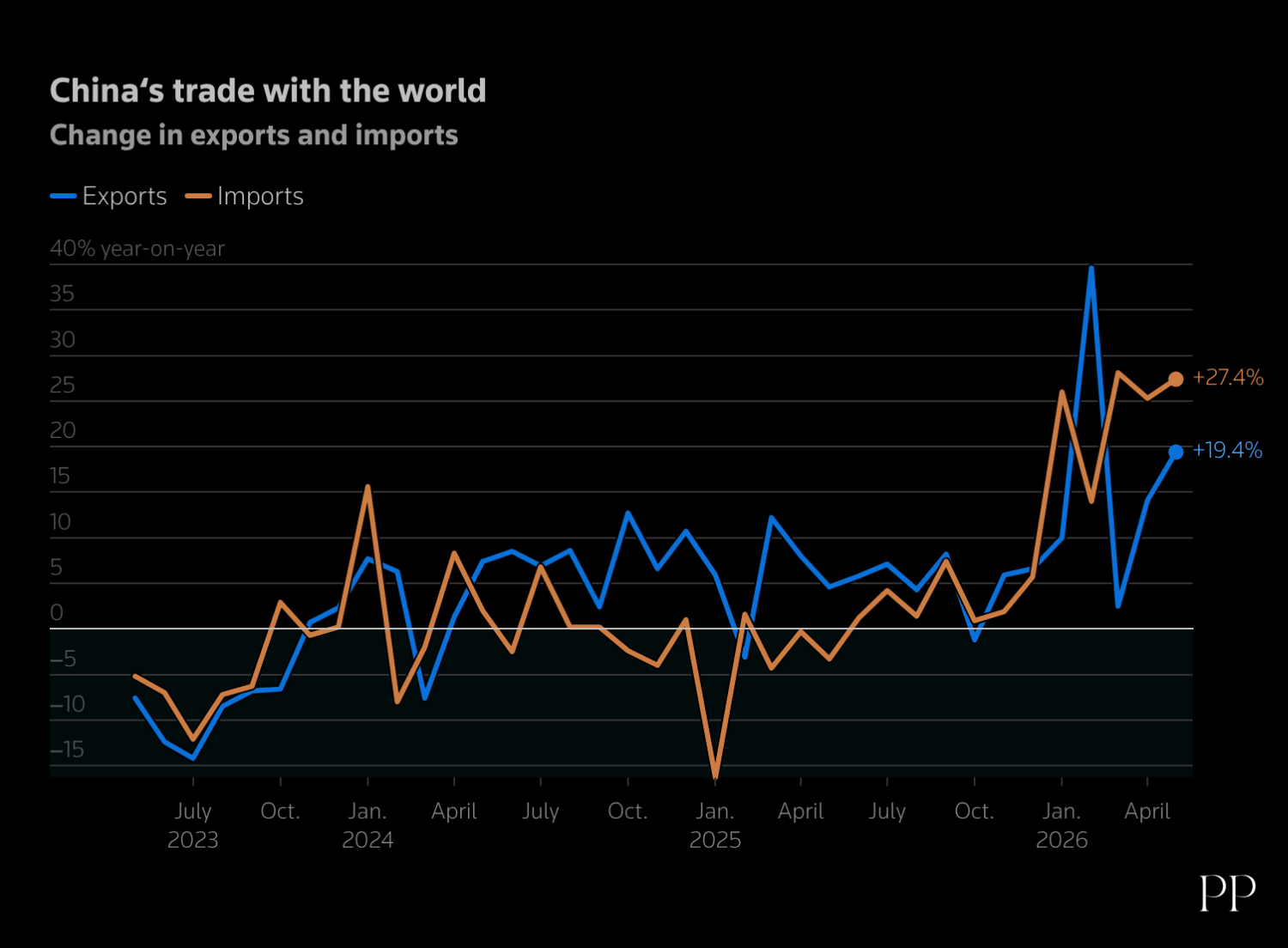
China's exports rose 19.4% year-on-year in U.S. dollar terms in May, customs data showed on Tuesday, accelerating from April's 14.1% increase and surpassing economists' expectations for a 15% gain.
Imports also posted another strong performance, climbing 27.4% from a year earlier, up from 25.3% in April and ahead of forecasts for a 25% increase.
 "Rising chip prices continue to support export growth, with memory chip prices increasing roughly 20% month-on-month and driving integrated circuit exports up 111% in May," said Xing Zhaopeng, senior China strategist at ANZ.
Exports of automated data-processing equipment surged 66.1% in value terms from a year earlier, while shipments of high-tech products rose 50.9% and automobile exports increased 39%, according to customs data.
"Looking ahead, the AI story is far from over. Semiconductors are reshaping China's trade landscape," Xing said.
The global AI boom has generated robust demand for semiconductors used in data centres and advanced electronics, reinforcing China's position as a key supplier in the technology supply chain.
Beyond AI-related industries, however, signs of weakness are emerging. Furniture exports edged up just 1.9% year-on-year in May, toy shipments declined 7%, and footwear exports fell 10.4%, suggesting that broader export momentum may be beginning to moderate.
Separate factory activity data also pointed to softer demand, showing a sharp decline in new export orders from April's two-year high, when warehouse operators reported booming business amid a rush by overseas manufacturers to secure supplies.
Strong export performance helped China's $20 trillion economy exceed expectations in the first quarter. Yet pockets of weakness within the trade sector have reinforced concerns that fragile domestic demand leaves the economy vulnerable to a slowdown in global growth and increases the likelihood of further policy support from Beijing.
At the same time, China faces growing international pressure to strengthen domestic consumption. Critics argue that the country's heavy dependence on imported components and re-exports distorts global trade patterns and squeezes other emerging economies out of higher-value manufacturing sectors.
"Close attention must be paid to the risk of escalating trade tensions between China and major trading partners, particularly Europe," said Zhiwei Zhang, chief economist at Pinpoint Asset Management.
The Organisation for Economic Co-operation and Development (OECD) echoed those concerns in a recent report, estimating that nearly 60% of Chinese firms' market-share gains could be attributed to government subsidies.
A recent paper from the U.S. Federal Reserve found that China's trade surplus, measured as a share of global GDP, has exceeded 1%—well above the peaks reached by Japan and Germany during the late twentieth century—and shows little sign of narrowing.
China's trade surplus widened to $105.43 billion in May, up from $84.8 billion in April and comfortably above economists' forecasts of $92.1 billion.
The latest trade figures suggest that industrial overcapacity may be contributing to at least part of the export surge.
Exports to Europe increased 7.6% from a year earlier in May, while shipments to the United States climbed 35.4% and exports to Southeast Asia rose 24.3%.
Imports from South Korea jumped 83.6%, reflecting strong demand from China's largest foreign supplier of semiconductors.
China's influence is also increasingly evident in global energy markets. Crude oil imports fell 29% in May to their lowest level in eight years, surprising traders and helping to moderate global oil prices. The decline partially offset the energy shock triggered by U.S. President Donald Trump's military campaign against Iran.
A closely watched meeting between Trump and Chinese President Xi Jinping last month helped ease tensions between the two powers but produced few tangible breakthroughs, either on trade disputes or cooperation regarding the Iran conflict.
Meanwhile, China's rare earth exports rose to a four-month high, with shipments reaching 5,490 metric tons. The 17-element group is critical for electric vehicles, wind turbines and defence technologies, making it another key point of friction in Beijing's trade relations with Western economies.
China's advantages in manufacturing scale, deep supply chains and industrial capacity leave it relatively well positioned to absorb trade frictions with the West, including proposed U.S. tariff increases tied to forced-labour concerns, said Sheana Yue, senior economist at Oxford Economics.
"We continue to expect exports to remain China's primary growth engine in 2026, supported by strong demand for high-tech and clean-tech products despite war-related headwinds to global demand," Yue said.
"Rising chip prices continue to support export growth, with memory chip prices increasing roughly 20% month-on-month and driving integrated circuit exports up 111% in May," said Xing Zhaopeng, senior China strategist at ANZ.
Exports of automated data-processing equipment surged 66.1% in value terms from a year earlier, while shipments of high-tech products rose 50.9% and automobile exports increased 39%, according to customs data.
"Looking ahead, the AI story is far from over. Semiconductors are reshaping China's trade landscape," Xing said.
The global AI boom has generated robust demand for semiconductors used in data centres and advanced electronics, reinforcing China's position as a key supplier in the technology supply chain.
Beyond AI-related industries, however, signs of weakness are emerging. Furniture exports edged up just 1.9% year-on-year in May, toy shipments declined 7%, and footwear exports fell 10.4%, suggesting that broader export momentum may be beginning to moderate.
Separate factory activity data also pointed to softer demand, showing a sharp decline in new export orders from April's two-year high, when warehouse operators reported booming business amid a rush by overseas manufacturers to secure supplies.
Strong export performance helped China's $20 trillion economy exceed expectations in the first quarter. Yet pockets of weakness within the trade sector have reinforced concerns that fragile domestic demand leaves the economy vulnerable to a slowdown in global growth and increases the likelihood of further policy support from Beijing.
At the same time, China faces growing international pressure to strengthen domestic consumption. Critics argue that the country's heavy dependence on imported components and re-exports distorts global trade patterns and squeezes other emerging economies out of higher-value manufacturing sectors.
"Close attention must be paid to the risk of escalating trade tensions between China and major trading partners, particularly Europe," said Zhiwei Zhang, chief economist at Pinpoint Asset Management.
The Organisation for Economic Co-operation and Development (OECD) echoed those concerns in a recent report, estimating that nearly 60% of Chinese firms' market-share gains could be attributed to government subsidies.
A recent paper from the U.S. Federal Reserve found that China's trade surplus, measured as a share of global GDP, has exceeded 1%—well above the peaks reached by Japan and Germany during the late twentieth century—and shows little sign of narrowing.
China's trade surplus widened to $105.43 billion in May, up from $84.8 billion in April and comfortably above economists' forecasts of $92.1 billion.
The latest trade figures suggest that industrial overcapacity may be contributing to at least part of the export surge.
Exports to Europe increased 7.6% from a year earlier in May, while shipments to the United States climbed 35.4% and exports to Southeast Asia rose 24.3%.
Imports from South Korea jumped 83.6%, reflecting strong demand from China's largest foreign supplier of semiconductors.
China's influence is also increasingly evident in global energy markets. Crude oil imports fell 29% in May to their lowest level in eight years, surprising traders and helping to moderate global oil prices. The decline partially offset the energy shock triggered by U.S. President Donald Trump's military campaign against Iran.
A closely watched meeting between Trump and Chinese President Xi Jinping last month helped ease tensions between the two powers but produced few tangible breakthroughs, either on trade disputes or cooperation regarding the Iran conflict.
Meanwhile, China's rare earth exports rose to a four-month high, with shipments reaching 5,490 metric tons. The 17-element group is critical for electric vehicles, wind turbines and defence technologies, making it another key point of friction in Beijing's trade relations with Western economies.
China's advantages in manufacturing scale, deep supply chains and industrial capacity leave it relatively well positioned to absorb trade frictions with the West, including proposed U.S. tariff increases tied to forced-labour concerns, said Sheana Yue, senior economist at Oxford Economics.
"We continue to expect exports to remain China's primary growth engine in 2026, supported by strong demand for high-tech and clean-tech products despite war-related headwinds to global demand," Yue said.