US Consumer prices rose 4.2% annually in May
Image Credit : Reuters
Source Credit : Portfolio Prints
U.S. consumer inflation accelerated to its fastest pace in three years in May, driven largely by soaring energy costs linked to the Middle East conflict, reinforcing expectations that the Federal Reserve will keep interest rates elevated well into 2027.
The Labor Department reported on Wednesday that the Consumer Price Index (CPI) posted a third consecutive month of strong gains, highlighting mounting financial pressure on households that are increasingly drawing down savings to sustain spending.
Rising prices continued to outpace wage growth, with inflation-adjusted earnings falling for a second straight month in May. The erosion of purchasing power threatens to weigh on broader economic activity and poses a growing political challenge for President Donald Trump and Republicans ahead of November’s midterm elections.
Trump, who returned to office promising to tame inflation, has faced declining approval ratings amid public frustration over the cost of living. Asked about the latest inflation data, Trump told reporters, “I love the inflation,” adding that prices would “come down like a rock” once the U.S.-led conflict with Iran ends.
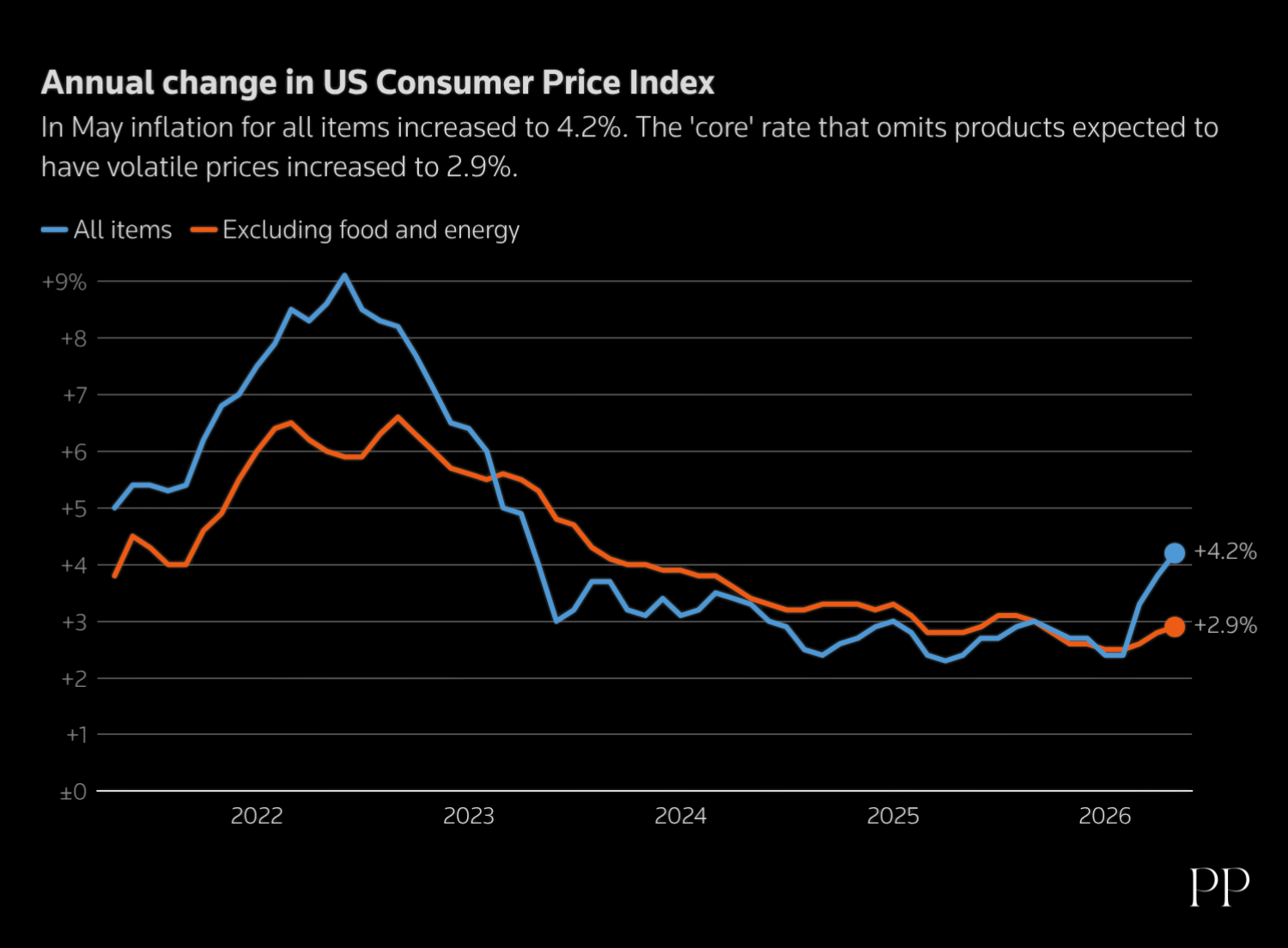
The Consumer Price Index rose 4.2% in the 12 months through May, the largest increase since April 2023, according to the Labor Department’s Bureau of Labor Statistics. That compared with annual gains of 3.8% in April and 3.3% in March. On a monthly basis, consumer prices increased 0.5% after rising 0.6% in April, matching economists’ forecasts.
 The Federal Reserve targets 2% inflation based on the Personal Consumption Expenditures (PCE) Price Index, and all major inflation measures remain well above that objective.
Real average hourly earnings fell 0.7% from a year earlier in May after declining 0.3% in April, underscoring the growing strain on household finances.
“Americans are getting squeezed financially by inflation,” said Heather Long, chief economist at Navy Federal Credit Union. “These are no longer just concerns about the economy. Households, especially middle- and lower-income families, are facing real financial stress.”
Energy costs remained the primary driver of inflation. A 3.9% increase in energy goods prices accounted for more than 60% of the monthly rise in CPI. Energy prices rose 23.5% from a year earlier, while gasoline prices climbed 7.0% over the month and surged 40.5% on an annual basis.
Although gasoline prices have eased in recent weeks as crude oil retreated from peak levels, economists cautioned that geopolitical risks remain elevated. The U.S. and Iran exchanged fresh strikes on Tuesday, with Trump saying Tehran had delayed negotiations for too long and would now “have to pay the price.”
Inflation was also supported by higher housing costs. While food-price growth moderated after accelerating in April, economists warned that rising fertilizer costs linked to the conflict could keep upward pressure on food prices in coming months.
Grocery prices edged up 0.1% in May. Higher prices for nonalcoholic beverages, cereals, bakery products, fruits and vegetables were partially offset by lower costs for meat and dairy products.
Financial markets had begun pricing in the possibility of further monetary tightening after stronger-than-expected job growth in May. However, the CPI report suggested that inflationary pressures remain concentrated in energy and transportation, with limited evidence so far of broader spillovers across the economy.
There were also signs that the inflationary effects of import tariffs were fading, reducing pressure on policymakers to respond with immediate rate increases.
Economists broadly expect the Fed to leave its benchmark interest rate unchanged in the 3.50%-3.75% range at next week’s meeting, though policymakers are increasingly likely to abandon any remaining easing bias.
Excluding the volatile food and energy categories, core CPI rose 2.9% from a year earlier in May, up from 2.8% in April.
On a monthly basis, core inflation increased 0.2%, slowing from April’s 0.4% gain. A 1.7% decline in motor vehicle insurance costs—the largest drop since October 2020—was a major factor behind the moderation.
Several economists questioned the insurance data, arguing it does not reflect the underlying trend of rising vehicle-related costs. They noted that the Federal Reserve’s preferred inflation gauge relies more heavily on producer-price data, where insurance costs remain elevated.
Meanwhile, the artificial intelligence investment boom continues to push up prices for computers, software and advanced technology equipment. Those categories carry a relatively small weighting in the CPI basket but have a larger influence on the PCE index tracked by the Fed.
Prices for household furnishings and supplies declined, while apparel costs rose modestly, suggesting that tariff-related inflation pressures are gradually easing. New vehicle prices fell, used car and truck prices edged up 0.1%, and core goods prices slipped 0.1%.
Shelter inflation remained firm. Rents increased 0.4% in May, while owners’ equivalent rent—a measure of housing costs for homeowners—rose 0.3%. Both measures cooled from April, when a one-time statistical adjustment temporarily boosted housing inflation.
Airline fares climbed 2.7% in May after increasing 2.8% in April, reflecting elevated jet-fuel costs. Airfares were up 26.7% from a year earlier. Healthcare costs increased 0.5%, led by higher prices for dental and hospital services.
Services inflation excluding energy rose 0.3% after advancing 0.5% in April, indicating that broader service-sector price pressures remain contained despite higher energy costs.
Based on the CPI data, economists estimate that the Personal Consumption Expenditures Price Index rose 0.4% in May, matching April’s monthly gain and lifting annual PCE inflation to roughly 4.0%. Core PCE inflation is projected to increase between 0.3% and 0.4% on the month and 3.3% from a year earlier.
“If we don’t see a moderation in energy prices soon, it will only be a matter of time before we see broader spillovers into other goods and services categories and into inflation expectations,” said Scott Anderson, chief U.S. economist at BMO Capital Markets. “The possibility of future rate hikes remains very much on the table.”
The Federal Reserve targets 2% inflation based on the Personal Consumption Expenditures (PCE) Price Index, and all major inflation measures remain well above that objective.
Real average hourly earnings fell 0.7% from a year earlier in May after declining 0.3% in April, underscoring the growing strain on household finances.
“Americans are getting squeezed financially by inflation,” said Heather Long, chief economist at Navy Federal Credit Union. “These are no longer just concerns about the economy. Households, especially middle- and lower-income families, are facing real financial stress.”
Energy costs remained the primary driver of inflation. A 3.9% increase in energy goods prices accounted for more than 60% of the monthly rise in CPI. Energy prices rose 23.5% from a year earlier, while gasoline prices climbed 7.0% over the month and surged 40.5% on an annual basis.
Although gasoline prices have eased in recent weeks as crude oil retreated from peak levels, economists cautioned that geopolitical risks remain elevated. The U.S. and Iran exchanged fresh strikes on Tuesday, with Trump saying Tehran had delayed negotiations for too long and would now “have to pay the price.”
Inflation was also supported by higher housing costs. While food-price growth moderated after accelerating in April, economists warned that rising fertilizer costs linked to the conflict could keep upward pressure on food prices in coming months.
Grocery prices edged up 0.1% in May. Higher prices for nonalcoholic beverages, cereals, bakery products, fruits and vegetables were partially offset by lower costs for meat and dairy products.
Financial markets had begun pricing in the possibility of further monetary tightening after stronger-than-expected job growth in May. However, the CPI report suggested that inflationary pressures remain concentrated in energy and transportation, with limited evidence so far of broader spillovers across the economy.
There were also signs that the inflationary effects of import tariffs were fading, reducing pressure on policymakers to respond with immediate rate increases.
Economists broadly expect the Fed to leave its benchmark interest rate unchanged in the 3.50%-3.75% range at next week’s meeting, though policymakers are increasingly likely to abandon any remaining easing bias.
Excluding the volatile food and energy categories, core CPI rose 2.9% from a year earlier in May, up from 2.8% in April.
On a monthly basis, core inflation increased 0.2%, slowing from April’s 0.4% gain. A 1.7% decline in motor vehicle insurance costs—the largest drop since October 2020—was a major factor behind the moderation.
Several economists questioned the insurance data, arguing it does not reflect the underlying trend of rising vehicle-related costs. They noted that the Federal Reserve’s preferred inflation gauge relies more heavily on producer-price data, where insurance costs remain elevated.
Meanwhile, the artificial intelligence investment boom continues to push up prices for computers, software and advanced technology equipment. Those categories carry a relatively small weighting in the CPI basket but have a larger influence on the PCE index tracked by the Fed.
Prices for household furnishings and supplies declined, while apparel costs rose modestly, suggesting that tariff-related inflation pressures are gradually easing. New vehicle prices fell, used car and truck prices edged up 0.1%, and core goods prices slipped 0.1%.
Shelter inflation remained firm. Rents increased 0.4% in May, while owners’ equivalent rent—a measure of housing costs for homeowners—rose 0.3%. Both measures cooled from April, when a one-time statistical adjustment temporarily boosted housing inflation.
Airline fares climbed 2.7% in May after increasing 2.8% in April, reflecting elevated jet-fuel costs. Airfares were up 26.7% from a year earlier. Healthcare costs increased 0.5%, led by higher prices for dental and hospital services.
Services inflation excluding energy rose 0.3% after advancing 0.5% in April, indicating that broader service-sector price pressures remain contained despite higher energy costs.
Based on the CPI data, economists estimate that the Personal Consumption Expenditures Price Index rose 0.4% in May, matching April’s monthly gain and lifting annual PCE inflation to roughly 4.0%. Core PCE inflation is projected to increase between 0.3% and 0.4% on the month and 3.3% from a year earlier.
“If we don’t see a moderation in energy prices soon, it will only be a matter of time before we see broader spillovers into other goods and services categories and into inflation expectations,” said Scott Anderson, chief U.S. economist at BMO Capital Markets. “The possibility of future rate hikes remains very much on the table.”