US factory activity eases off four-year high
Image Credit : Reuters
Source Credit : Portfolio Prints
U.S. manufacturing activity moderated in June after reaching a four-year high in May, as the surge in orders driven by businesses stockpiling goods to avoid supply disruptions and rising costs from the Middle East conflict began to fade. Despite the slowdown, the sector continued to expand for a sixth consecutive month, supported by strong investment in artificial intelligence (AI) and resilient domestic demand.
According to the Institute for Supply Management (ISM), the Manufacturing Purchasing Managers' Index (PMI) eased to 53.3 in June from 54.0 in May, falling slightly below economists' expectations. Although the reading declined, it remained well above the 50-point threshold that separates expansion from contraction, indicating that manufacturing activity continues to grow. The sector, which accounts for approximately 9.4% of the U.S. economy, has now remained in expansion territory for half a year.
Economists attributed much of the moderation to easing concerns over supply chain disruptions following the ceasefire between the United States and Iran. The agreement helped stabilize global energy markets, with oil prices retreating to levels seen before the conflict. Oliver Allen, Senior U.S. Economist at Pantheon Macroeconomics, noted that the rush by companies to secure supplies ahead of potential disruptions appeared to be subsiding, while emphasizing that the broader manufacturing sector remains fundamentally healthy.
A key source of resilience continues to be the rapid expansion of AI-related investment. Demand for semiconductors, electronic components, machinery, and advanced manufacturing equipment has supported factory output despite geopolitical uncertainty. Fourteen manufacturing industries reported growth during June, including electrical equipment, machinery, primary metals, textile mills, and computer and electronic products.
Survey responses also suggested that geopolitical concerns became less widespread compared with May. Around 31% of respondents cited the U.S.-Iran conflict as affecting their business operations, down from 42% a month earlier, while the proportion reporting pricing volatility declined from 57% to 50%. References to tariffs also edged lower, indicating that firms viewed these risks as somewhat less severe than earlier in the year.
 Nevertheless, several industries continued to report challenges. Chemical manufacturers said the conflict had increased raw material prices across nearly every category, while computer and electronics producers reported adopting a more cautious approach to capital spending because of geopolitical uncertainty. Food and beverage manufacturers also cited elevated input costs driven by both Middle East tensions and continued tariff uncertainty. Transportation equipment producers warned that tariffs remained a significant burden, forcing companies to raise prices and reducing profitability despite recent legal challenges to previous U.S. import duties.
Demand conditions remained broadly positive even as growth moderated. ISM's New Orders Index slipped modestly to 56.0 from 56.8, remaining comfortably in expansion territory. At the same time, order backlogs declined after increasing in May, while export demand weakened, reflecting softer overseas markets.
Supply chain conditions improved following the ceasefire, contributing to a gradual easing in production bottlenecks. The Supplier Deliveries Index declined to 57.4 from 60.6, indicating deliveries were still slower than normal but improving. Factory inventories also expanded after an extended period of contraction, suggesting businesses were rebuilding stock levels as supply conditions stabilized.
Inflationary pressures at the factory level remained elevated but showed signs of cooling. ISM's Prices Paid Index fell sharply to 73.0 from 82.1 in May, reflecting lower energy costs after oil prices retreated. However, manufacturers continued to report rising prices for aluminum, copper, electrical components, electronic parts, memory chips, semiconductors, and packaging materials. Shortages of critical AI-related components also persisted, keeping production costs elevated despite improving logistics.
Economists believe inflationary pressures remain significant enough to keep the Federal Reserve cautious. Although lower energy prices have eased some cost pressures, higher prices for industrial inputs continue to pose risks for broader inflation. Financial markets therefore expect the Federal Reserve to resume interest rate increases later this year after policymakers kept the federal funds rate unchanged at 3.50%–3.75% during their most recent meeting while signaling additional tightening in updated economic projections.
Labor market indicators within manufacturing presented a mixed picture. The ISM Manufacturing Employment Index remained in contraction territory, continuing a trend that has persisted for most of the past three years. However, hiring intentions improved noticeably, with approximately 64% of surveyed firms reporting they were adding workers, compared with 50% in May, suggesting employers remain optimistic about future demand.
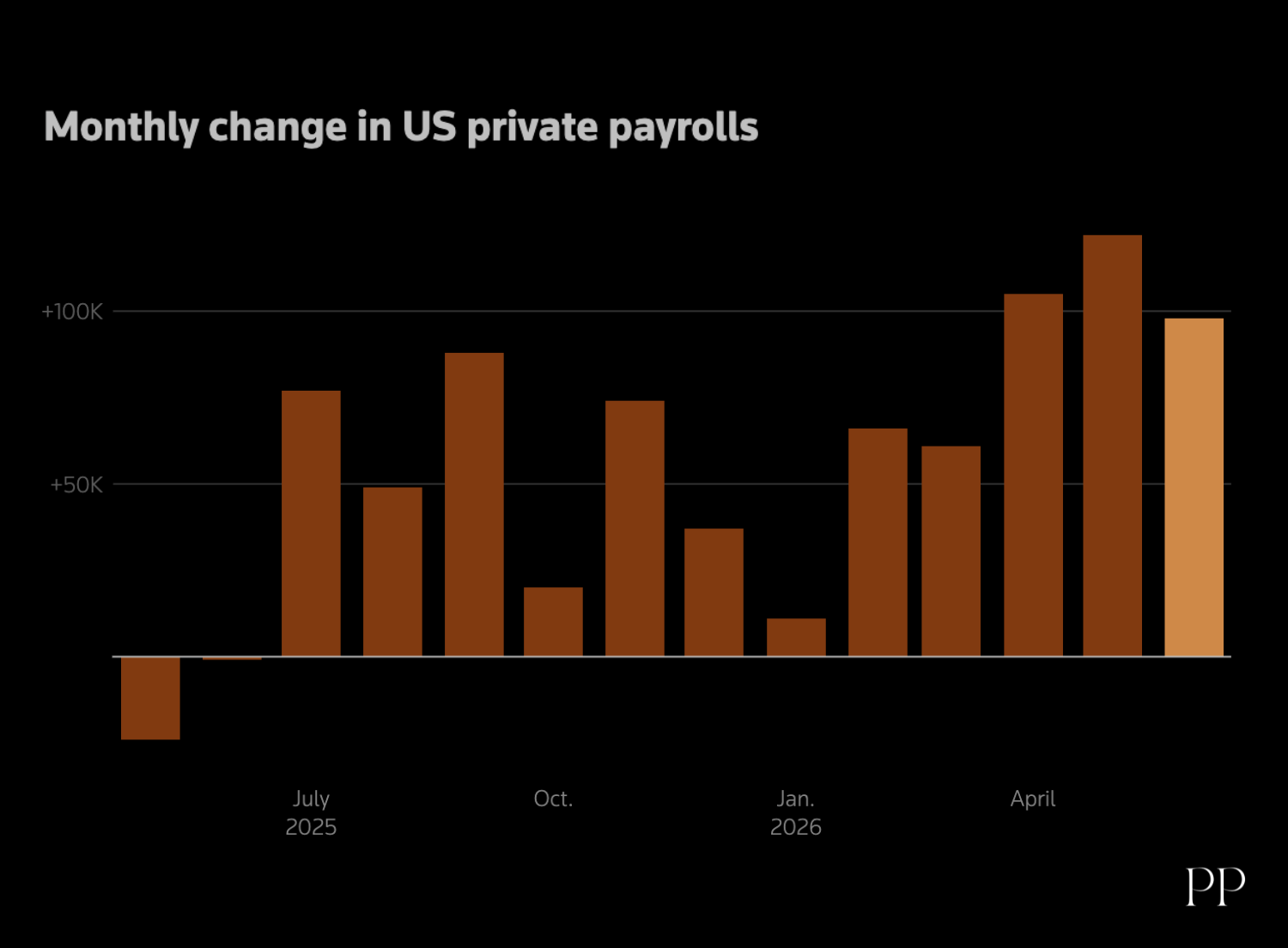
Broader labor market data also pointed to continued stability. Economists expect the government's June employment report to show a gain of approximately 110,000 nonfarm payroll jobs, following an increase of 172,000 in May, while the unemployment rate is forecast to remain unchanged at 4.3%. Supporting this outlook, the ADP National Employment Report showed private-sector payrolls increased by 98,000 jobs during June, while Challenger, Gray & Christmas reported planned layoffs fell 53% from the previous month to 45,849, with reductions continuing to be concentrated primarily within the technology sector as companies increasingly adopt AI-driven automation.
Overall, June's ISM survey indicates that U.S. manufacturing is transitioning from the rapid growth fueled by precautionary inventory building toward a more sustainable pace of expansion. While geopolitical uncertainty, tariffs, and elevated production costs continue to weigh on some industries, robust AI investment, improving supply chains, and resilient domestic demand are providing important support for the sector's continued growth.
Nevertheless, several industries continued to report challenges. Chemical manufacturers said the conflict had increased raw material prices across nearly every category, while computer and electronics producers reported adopting a more cautious approach to capital spending because of geopolitical uncertainty. Food and beverage manufacturers also cited elevated input costs driven by both Middle East tensions and continued tariff uncertainty. Transportation equipment producers warned that tariffs remained a significant burden, forcing companies to raise prices and reducing profitability despite recent legal challenges to previous U.S. import duties.
Demand conditions remained broadly positive even as growth moderated. ISM's New Orders Index slipped modestly to 56.0 from 56.8, remaining comfortably in expansion territory. At the same time, order backlogs declined after increasing in May, while export demand weakened, reflecting softer overseas markets.
Supply chain conditions improved following the ceasefire, contributing to a gradual easing in production bottlenecks. The Supplier Deliveries Index declined to 57.4 from 60.6, indicating deliveries were still slower than normal but improving. Factory inventories also expanded after an extended period of contraction, suggesting businesses were rebuilding stock levels as supply conditions stabilized.
Inflationary pressures at the factory level remained elevated but showed signs of cooling. ISM's Prices Paid Index fell sharply to 73.0 from 82.1 in May, reflecting lower energy costs after oil prices retreated. However, manufacturers continued to report rising prices for aluminum, copper, electrical components, electronic parts, memory chips, semiconductors, and packaging materials. Shortages of critical AI-related components also persisted, keeping production costs elevated despite improving logistics.
Economists believe inflationary pressures remain significant enough to keep the Federal Reserve cautious. Although lower energy prices have eased some cost pressures, higher prices for industrial inputs continue to pose risks for broader inflation. Financial markets therefore expect the Federal Reserve to resume interest rate increases later this year after policymakers kept the federal funds rate unchanged at 3.50%–3.75% during their most recent meeting while signaling additional tightening in updated economic projections.
Labor market indicators within manufacturing presented a mixed picture. The ISM Manufacturing Employment Index remained in contraction territory, continuing a trend that has persisted for most of the past three years. However, hiring intentions improved noticeably, with approximately 64% of surveyed firms reporting they were adding workers, compared with 50% in May, suggesting employers remain optimistic about future demand.
Broader labor market data also pointed to continued stability. Economists expect the government's June employment report to show a gain of approximately 110,000 nonfarm payroll jobs, following an increase of 172,000 in May, while the unemployment rate is forecast to remain unchanged at 4.3%. Supporting this outlook, the ADP National Employment Report showed private-sector payrolls increased by 98,000 jobs during June, while Challenger, Gray & Christmas reported planned layoffs fell 53% from the previous month to 45,849, with reductions continuing to be concentrated primarily within the technology sector as companies increasingly adopt AI-driven automation.
Overall, June's ISM survey indicates that U.S. manufacturing is transitioning from the rapid growth fueled by precautionary inventory building toward a more sustainable pace of expansion. While geopolitical uncertainty, tariffs, and elevated production costs continue to weigh on some industries, robust AI investment, improving supply chains, and resilient domestic demand are providing important support for the sector's continued growth.