China consumer price growth weakens in June
Image Credit : Reuters
Source Credit : Portfolio Prints
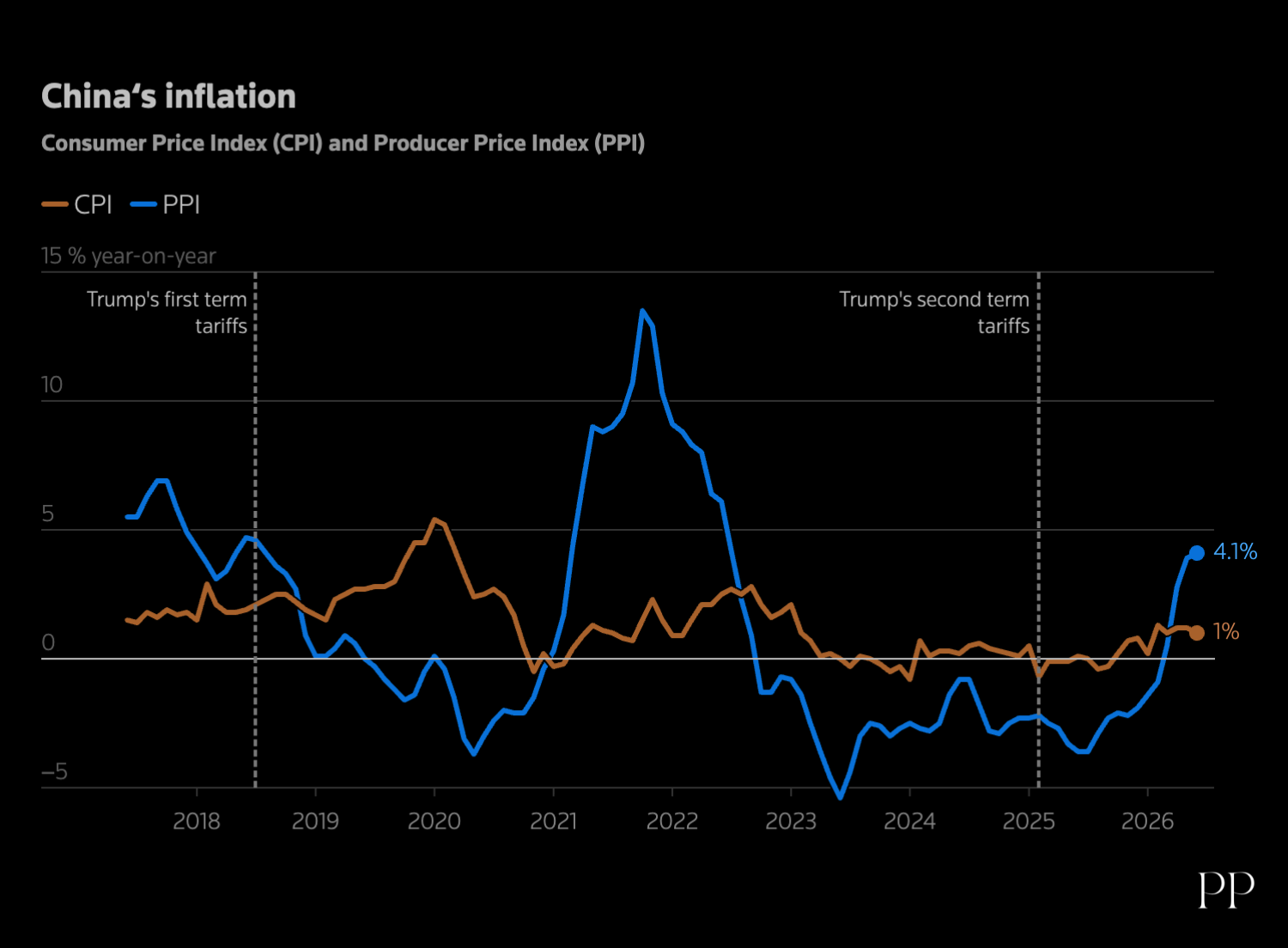
China’s producer price inflation accelerated to its fastest pace in nearly four years in June, increasing pressure on manufacturers as weak domestic demand continues to limit their ability to pass higher costs on to consumers.
The world’s second-largest economy is increasingly showing a two-speed recovery. While a global AI-driven technology boom has boosted exports and advanced manufacturing, sluggish household consumption, weak private investment, and the prolonged property sector downturn continue to weigh on domestic economic activity.
According to data released by China’s National Bureau of Statistics (NBS) on Thursday, the Producer Price Index (PPI) rose 4.1% year-over-year in June, matching market expectations and marking its strongest increase since July 2022. The reading followed a 3.9% rise in May and represented the fourth consecutive month of growth after China emerged from a prolonged period of producer-price deflation earlier this year.
 Analysts noted that part of the increase was driven by favorable base effects from weaker prices a year earlier. However, underlying demand conditions remain soft, suggesting that broader deflationary pressures have not fully disappeared.
“The latest escalation in U.S.-Iran tensions could deliver some renewed upward pressure on inflation in the near term,” said Julian Evans-Pritchard, Head of China Economics at Capital Economics. “However, the impact is likely to remain concentrated in a limited number of sectors, and inflation should return closer to zero once energy markets stabilize.”
The NBS attributed the rise in producer prices largely to higher costs in coal mining, electrical equipment manufacturing, electronics, and ferrous metals. By contrast, prices continued to decline in industries such as alcoholic beverages and automobile manufacturing, reflecting uneven demand across sectors.
On a monthly basis, producer prices fell 0.3% in June after a sharp decline in global oil prices following a ceasefire agreement between the United States and Iran. Nevertheless, several emerging industries linked to advanced technology and the green transition—including virtual reality equipment, wearable devices, and carbon-based nanomaterials—recorded monthly price increases.
Financial markets reacted only modestly to the inflation data. Chinese equities were little changed, while the yuan posted a slight gain against the U.S. dollar.
Although higher producer prices have supported profitability in certain upstream industries and technology-focused sectors, companies that depend heavily on domestic consumption continue to face challenges. Many firms remain unable to fully transfer rising costs to consumers, underscoring the difficulties policymakers face in strengthening employment and stimulating domestic demand.
Further evidence of weak consumer demand emerged from China’s automotive sector, where vehicle sales declined for a ninth consecutive month in June. The persistent slowdown has prompted manufacturers to rely increasingly on overseas markets for growth.
Separate data released alongside the producer price figures showed a moderation in consumer inflation. China’s Consumer Price Index (CPI) rose 1.0% year-over-year in June, slowing from 1.2% in May and coming in slightly below economists’ expectations. Softer price growth for industrial consumer goods, including gasoline and gold jewelry, contributed to the slowdown.
On a monthly basis, consumer prices declined 0.3%, a steeper drop than forecast and larger than May’s 0.1% decline.
Core inflation, which excludes volatile food and energy prices, increased 1.0% from a year earlier, marking its weakest pace since January. Meanwhile, food prices fell 1.6%, highlighting continued softness in household demand.
“The data suggests China is moving from a near-deflation environment toward low but positive inflation,” said Lynn Song, Chief Economist for Greater China at ING. “Current inflation levels are unlikely to prevent the People’s Bank of China from easing monetary policy if economic conditions warrant additional support.”
Meanwhile, Chinese regulators have intensified efforts to curb what officials describe as “involution-style” competition—aggressive price-cutting strategies that have contributed to deflationary pressures and shrinking profit margins across several industries.
Sectors affected by intense price competition include electric vehicles, solar panels, lithium batteries, steel, cement, and food delivery services, where excess capacity and fierce rivalry have eroded corporate earnings.
Many economists argue that stronger policy measures will be needed to address structural imbalances caused by excess industrial capacity and weak domestic consumption. So far, robust export performance has provided policymakers with room to delay more aggressive stimulus efforts.
According to Zhaopeng Xing, Senior China Strategist at ANZ, the government’s anti-competition campaign, combined with favorable base effects, could provide additional support for inflation in early 2027.
“The inflation outlook gives policymakers greater flexibility to remain patient,” Xing said, adding that the current environment supports expectations that interest rates could remain unchanged through much of 2026.
Analysts noted that part of the increase was driven by favorable base effects from weaker prices a year earlier. However, underlying demand conditions remain soft, suggesting that broader deflationary pressures have not fully disappeared.
“The latest escalation in U.S.-Iran tensions could deliver some renewed upward pressure on inflation in the near term,” said Julian Evans-Pritchard, Head of China Economics at Capital Economics. “However, the impact is likely to remain concentrated in a limited number of sectors, and inflation should return closer to zero once energy markets stabilize.”
The NBS attributed the rise in producer prices largely to higher costs in coal mining, electrical equipment manufacturing, electronics, and ferrous metals. By contrast, prices continued to decline in industries such as alcoholic beverages and automobile manufacturing, reflecting uneven demand across sectors.
On a monthly basis, producer prices fell 0.3% in June after a sharp decline in global oil prices following a ceasefire agreement between the United States and Iran. Nevertheless, several emerging industries linked to advanced technology and the green transition—including virtual reality equipment, wearable devices, and carbon-based nanomaterials—recorded monthly price increases.
Financial markets reacted only modestly to the inflation data. Chinese equities were little changed, while the yuan posted a slight gain against the U.S. dollar.
Although higher producer prices have supported profitability in certain upstream industries and technology-focused sectors, companies that depend heavily on domestic consumption continue to face challenges. Many firms remain unable to fully transfer rising costs to consumers, underscoring the difficulties policymakers face in strengthening employment and stimulating domestic demand.
Further evidence of weak consumer demand emerged from China’s automotive sector, where vehicle sales declined for a ninth consecutive month in June. The persistent slowdown has prompted manufacturers to rely increasingly on overseas markets for growth.
Separate data released alongside the producer price figures showed a moderation in consumer inflation. China’s Consumer Price Index (CPI) rose 1.0% year-over-year in June, slowing from 1.2% in May and coming in slightly below economists’ expectations. Softer price growth for industrial consumer goods, including gasoline and gold jewelry, contributed to the slowdown.
On a monthly basis, consumer prices declined 0.3%, a steeper drop than forecast and larger than May’s 0.1% decline.
Core inflation, which excludes volatile food and energy prices, increased 1.0% from a year earlier, marking its weakest pace since January. Meanwhile, food prices fell 1.6%, highlighting continued softness in household demand.
“The data suggests China is moving from a near-deflation environment toward low but positive inflation,” said Lynn Song, Chief Economist for Greater China at ING. “Current inflation levels are unlikely to prevent the People’s Bank of China from easing monetary policy if economic conditions warrant additional support.”
Meanwhile, Chinese regulators have intensified efforts to curb what officials describe as “involution-style” competition—aggressive price-cutting strategies that have contributed to deflationary pressures and shrinking profit margins across several industries.
Sectors affected by intense price competition include electric vehicles, solar panels, lithium batteries, steel, cement, and food delivery services, where excess capacity and fierce rivalry have eroded corporate earnings.
Many economists argue that stronger policy measures will be needed to address structural imbalances caused by excess industrial capacity and weak domestic consumption. So far, robust export performance has provided policymakers with room to delay more aggressive stimulus efforts.
According to Zhaopeng Xing, Senior China Strategist at ANZ, the government’s anti-competition campaign, combined with favorable base effects, could provide additional support for inflation in early 2027.
“The inflation outlook gives policymakers greater flexibility to remain patient,” Xing said, adding that the current environment supports expectations that interest rates could remain unchanged through much of 2026.