US retail sales post first decline in nine months in July
Image Credit : Reuters
Source Credit : Portfolio Prints
U.S. retail sales fell in July for the first time in nine months, signaling that the powerful boost to household spending from large tax refunds may be fading. The unexpected decline has raised concerns about the strength of consumer demand and prompted economists to lower their forecasts for U.S. economic growth in the third quarter.
The weakness in July sales was also partly linked to changes in the timing of major retail promotions. Amazon moved its Prime Day event forward from July to June, prompting other retailers to launch competing discounts at the same time. As a result, some purchases that would normally have occurred in July were brought forward into June. Lower gasoline prices also reduced revenues at service stations.
The report adds to a growing series of signals suggesting that the U.S. economy is losing some momentum. Recent data showed unexpected job losses, while inflation remained relatively subdued. Together, these developments have strengthened financial-market expectations that the Federal Reserve will leave interest rates unchanged at its September meeting, unless upcoming employment and inflation data surprise significantly to the upside.
“This points to a material slowdown in real consumer spending growth in the third quarter,” said Sal Guatieri, a senior economist at BMO Capital Markets. He added that the combination of weaker employment data and subdued core inflation increases the likelihood that the Federal Open Market Committee will remain patient in September.
Retail sales declined 0.6% in July after an unrevised 0.2% increase in June, according to the Commerce Department’s Census Bureau. It was the first monthly decline since October and the largest drop in 14 months. Economists surveyed by Reuters had expected sales to increase slightly by 0.1%.
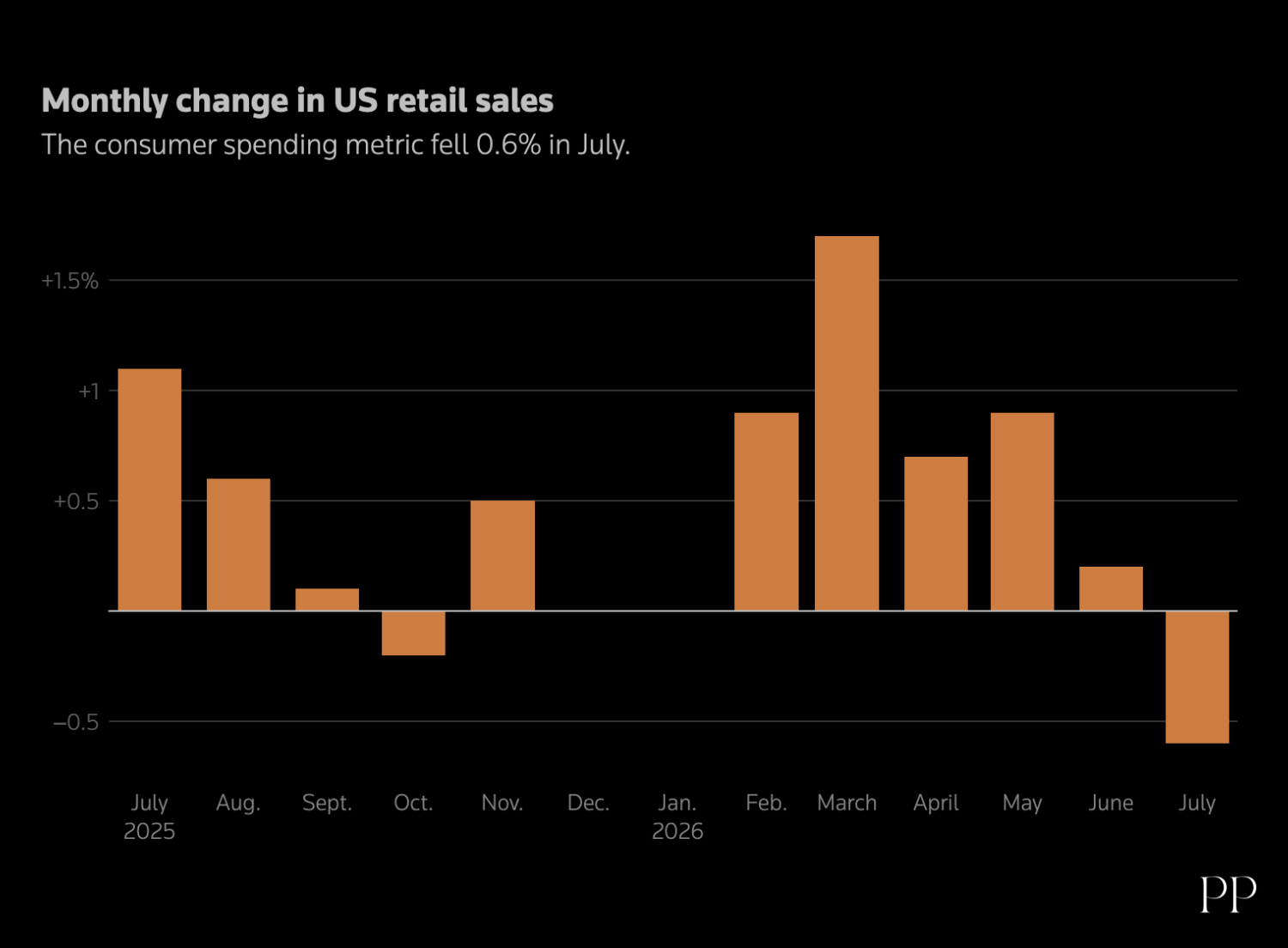 Forecasts had ranged from a 0.5% decline to a 0.7% increase, highlighting the extent of the surprise in the July figures. Despite the monthly contraction, retail sales were still 5.0% higher than a year earlier, showing that consumer spending remained above last year’s levels even as its recent momentum weakened.
Because the Consumer Price Index increased only 0.1% in July, economists said the decline in retail sales largely represented a fall in the volume of goods purchased rather than simply reflecting changes in prices. Although inflation has moderated from its recent peaks, prices remain considerably higher than they were a year ago, leaving consumers more sensitive to increases in the cost of everyday goods and services.
The decline was broad across several major categories. Sales at nonstore retailers fell 2.2%, while motor vehicle and parts dealers recorded a 1.8% decline. Electronics and appliance store sales dropped 0.5%, while receipts at service stations fell 0.9%, reflecting the decline in gasoline prices.
Gasoline prices have remained significantly higher than before the conflict in the Middle East. Average prices at U.S. pumps are hovering just above $4 a gallon, compared with roughly $4.39 earlier in the U.S.-Israeli conflict with Iran and around $2.98 before the conflict began in February. Higher fuel costs have added to household expenses and contributed to growing pressure on consumer sentiment.
Consumer confidence has also weakened. The University of Michigan’s Surveys of Consumers reported that its Consumer Sentiment Index fell to 51.0 in August from 55.2 in July, ending two consecutive months of improvement. Sentiment deteriorated across the political spectrum, with Republicans recording a particularly sharp monthly decline.
Weak consumer sentiment could become an additional drag on household spending. Carl Weinberg, chief economist at High Frequency Economics, said depressed sentiment tends to reduce consumers’ willingness to spend, noting that American households remain considerably less confident than they have been historically.
However, the retail sales report was not uniformly negative. Sales at clothing stores rebounded 1.9%, likely reflecting increased back-to-school shopping. Food services and drinking places, the only services category included in the report, also recorded a 0.5% increase after rising 0.4% in June.
Other areas of strength included furniture stores, building-material and garden-equipment retailers, miscellaneous retailers, and health and personal-care outlets. Sales at sporting-goods, hobby, musical-instrument and book stores were unchanged, suggesting that consumer demand has not weakened evenly across the economy.
Financial markets reacted cautiously to the data. U.S. stocks were mostly muted, the dollar weakened against a basket of major currencies and Treasury yields declined as investors reassessed the outlook for monetary policy and economic growth.
Markets were pricing in a roughly 69.4% probability that the Federal Reserve would keep its benchmark overnight interest rate in the 3.50%-3.75% range at its September 15-16 meeting, according to the CME FedWatch Tool. The probability of a rate hike stood at 30.6%, down from 33.9% a day earlier and 50% a month ago.
Large tax refunds earlier this year had helped cushion American households from higher gasoline prices linked to the Middle East conflict and supported strong consumer spending during the second quarter. Economists now believe much of that additional cash has been spent. Nevertheless, the strong performance of financial markets has increased household wealth, particularly among higher-income and older Americans, providing another source of support for consumption.
The S&P 500 has gained roughly 14% so far this year after rising 16.4% in 2025. Economists at PNC Financial said bank data showed growing evidence that higher-income and older households were using gains in their financial wealth to support spending, potentially limiting the risk of a sharp collapse in consumer demand.
Retail sales excluding automobiles, gasoline, building materials and food services fell 0.4% in July after a slightly downwardly revised 0.4% increase in June. Economists had expected this measure, often referred to as core retail sales, to rise 0.3%. Because it more closely corresponds with the consumer spending component of gross domestic product, the decline has important implications for third-quarter growth.
Consumer spending accounts for more than two-thirds of the U.S. economy, making the July slowdown particularly important for the broader growth outlook. Some economists now expect annualized consumer spending growth to fall below 2% in the third quarter, compared with a much stronger 3.2% pace in the April-June quarter.
The weaker retail data have already led economists to reduce their forecasts for third-quarter GDP growth. Goldman Sachs economists cut their estimate by 0.5 percentage point to a 2.2% annualized rate. The U.S. economy expanded at a 1.5% annualized pace in the previous quarter, meaning the latest projections still point to continued growth, but at a slower rate.
Slower consumer spending could, however, be partially offset by stronger business investment in inventories. Companies have reduced their inventories for five consecutive quarters, creating the possibility that businesses will need to replenish stocks, which could provide a temporary boost to economic growth.
A separate Census Bureau report showed that business inventories were unchanged in June, as declines in retailers’ inventories offset increases elsewhere. Economists believe that depleted inventories could eventually translate into stronger production and restocking activity, supporting GDP growth during the current quarter.
“Businesses have run down their inventories and need to restock,” said Bernard Yaros, lead U.S. economist at Oxford Economics. He argued that inventory investment could provide a solid boost to third-quarter GDP, although renewed instability in the Middle East remains a significant risk to that outlook.
The July retail sales figures therefore point to a U.S. consumer that is still spending but becoming more cautious. The fading impact of tax refunds, weaker consumer confidence, elevated living costs and the pull-forward of purchases into June have all contributed to the slowdown. While strong household wealth and pockets of resilient demand may prevent a sharp downturn, the data suggest that consumer spending is unlikely to provide the same powerful support to economic growth that it did earlier in the year.
Forecasts had ranged from a 0.5% decline to a 0.7% increase, highlighting the extent of the surprise in the July figures. Despite the monthly contraction, retail sales were still 5.0% higher than a year earlier, showing that consumer spending remained above last year’s levels even as its recent momentum weakened.
Because the Consumer Price Index increased only 0.1% in July, economists said the decline in retail sales largely represented a fall in the volume of goods purchased rather than simply reflecting changes in prices. Although inflation has moderated from its recent peaks, prices remain considerably higher than they were a year ago, leaving consumers more sensitive to increases in the cost of everyday goods and services.
The decline was broad across several major categories. Sales at nonstore retailers fell 2.2%, while motor vehicle and parts dealers recorded a 1.8% decline. Electronics and appliance store sales dropped 0.5%, while receipts at service stations fell 0.9%, reflecting the decline in gasoline prices.
Gasoline prices have remained significantly higher than before the conflict in the Middle East. Average prices at U.S. pumps are hovering just above $4 a gallon, compared with roughly $4.39 earlier in the U.S.-Israeli conflict with Iran and around $2.98 before the conflict began in February. Higher fuel costs have added to household expenses and contributed to growing pressure on consumer sentiment.
Consumer confidence has also weakened. The University of Michigan’s Surveys of Consumers reported that its Consumer Sentiment Index fell to 51.0 in August from 55.2 in July, ending two consecutive months of improvement. Sentiment deteriorated across the political spectrum, with Republicans recording a particularly sharp monthly decline.
Weak consumer sentiment could become an additional drag on household spending. Carl Weinberg, chief economist at High Frequency Economics, said depressed sentiment tends to reduce consumers’ willingness to spend, noting that American households remain considerably less confident than they have been historically.
However, the retail sales report was not uniformly negative. Sales at clothing stores rebounded 1.9%, likely reflecting increased back-to-school shopping. Food services and drinking places, the only services category included in the report, also recorded a 0.5% increase after rising 0.4% in June.
Other areas of strength included furniture stores, building-material and garden-equipment retailers, miscellaneous retailers, and health and personal-care outlets. Sales at sporting-goods, hobby, musical-instrument and book stores were unchanged, suggesting that consumer demand has not weakened evenly across the economy.
Financial markets reacted cautiously to the data. U.S. stocks were mostly muted, the dollar weakened against a basket of major currencies and Treasury yields declined as investors reassessed the outlook for monetary policy and economic growth.
Markets were pricing in a roughly 69.4% probability that the Federal Reserve would keep its benchmark overnight interest rate in the 3.50%-3.75% range at its September 15-16 meeting, according to the CME FedWatch Tool. The probability of a rate hike stood at 30.6%, down from 33.9% a day earlier and 50% a month ago.
Large tax refunds earlier this year had helped cushion American households from higher gasoline prices linked to the Middle East conflict and supported strong consumer spending during the second quarter. Economists now believe much of that additional cash has been spent. Nevertheless, the strong performance of financial markets has increased household wealth, particularly among higher-income and older Americans, providing another source of support for consumption.
The S&P 500 has gained roughly 14% so far this year after rising 16.4% in 2025. Economists at PNC Financial said bank data showed growing evidence that higher-income and older households were using gains in their financial wealth to support spending, potentially limiting the risk of a sharp collapse in consumer demand.
Retail sales excluding automobiles, gasoline, building materials and food services fell 0.4% in July after a slightly downwardly revised 0.4% increase in June. Economists had expected this measure, often referred to as core retail sales, to rise 0.3%. Because it more closely corresponds with the consumer spending component of gross domestic product, the decline has important implications for third-quarter growth.
Consumer spending accounts for more than two-thirds of the U.S. economy, making the July slowdown particularly important for the broader growth outlook. Some economists now expect annualized consumer spending growth to fall below 2% in the third quarter, compared with a much stronger 3.2% pace in the April-June quarter.
The weaker retail data have already led economists to reduce their forecasts for third-quarter GDP growth. Goldman Sachs economists cut their estimate by 0.5 percentage point to a 2.2% annualized rate. The U.S. economy expanded at a 1.5% annualized pace in the previous quarter, meaning the latest projections still point to continued growth, but at a slower rate.
Slower consumer spending could, however, be partially offset by stronger business investment in inventories. Companies have reduced their inventories for five consecutive quarters, creating the possibility that businesses will need to replenish stocks, which could provide a temporary boost to economic growth.
A separate Census Bureau report showed that business inventories were unchanged in June, as declines in retailers’ inventories offset increases elsewhere. Economists believe that depleted inventories could eventually translate into stronger production and restocking activity, supporting GDP growth during the current quarter.
“Businesses have run down their inventories and need to restock,” said Bernard Yaros, lead U.S. economist at Oxford Economics. He argued that inventory investment could provide a solid boost to third-quarter GDP, although renewed instability in the Middle East remains a significant risk to that outlook.
The July retail sales figures therefore point to a U.S. consumer that is still spending but becoming more cautious. The fading impact of tax refunds, weaker consumer confidence, elevated living costs and the pull-forward of purchases into June have all contributed to the slowdown. While strong household wealth and pockets of resilient demand may prevent a sharp downturn, the data suggest that consumer spending is unlikely to provide the same powerful support to economic growth that it did earlier in the year.