U.S. inflation rate held steady at 3.7 percent in July
Image Credit : Reuters
Source Credit : Portfolio Prints
U.S. inflation remained stubbornly above the Federal Reserve’s 2% target in July, adding to uncertainty over the central bank’s next interest-rate decision. At the same time, signs of resilient consumer demand, strong business investment and rising corporate profits suggest that the U.S. economy may be regaining momentum in the third quarter.
Government data showed that the Personal Consumption Expenditures (PCE) Price Index, the Federal Reserve’s preferred inflation gauge, rose 3.7% over the 12 months through July. The figure was unchanged from June and slightly above economists’ forecast of 3.6%.
On a monthly basis, PCE inflation increased 0.2% in July after falling 0.1% in June, which had been the weakest monthly reading since April 2020. Economists had expected a 0.1% increase.
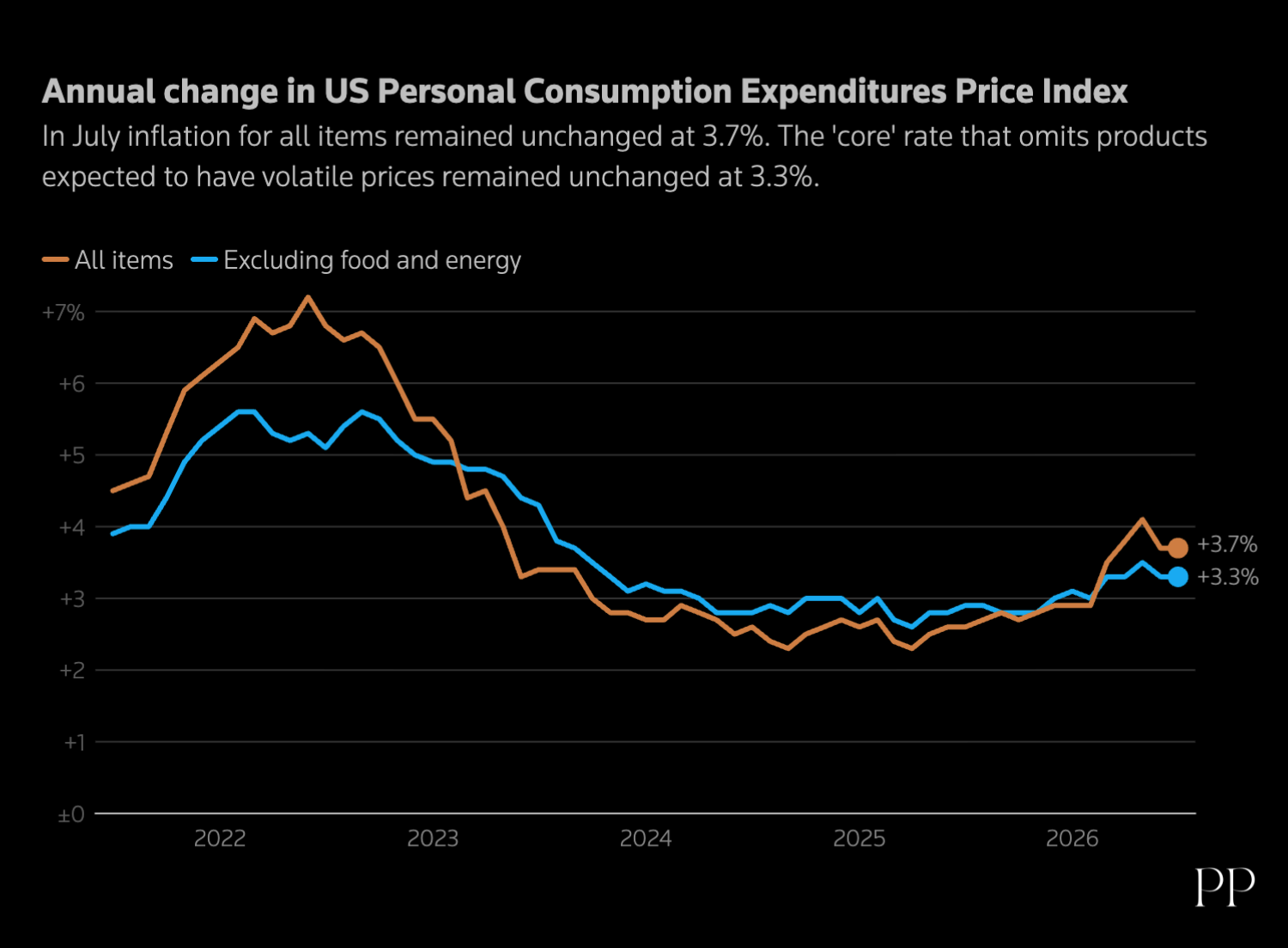 Core PCE inflation, which excludes volatile food and energy prices and is closely watched by Fed policymakers, also remained elevated. Core prices rose 3.3% from a year earlier and increased 0.2% during July, compared with a 0.1% monthly increase in June.
The figures highlight a growing challenge for the Federal Reserve. Although inflation has fallen substantially from its 7.2% peak in June 2022, the decline has slowed and inflation remains significantly above the central bank’s 2% target. The latest data suggest that the final stage of bringing inflation back to target could prove considerably more difficult.
The situation is further complicated by trade and geopolitical pressures. Higher import tariffs have pushed up the prices of a wide range of goods, while tensions involving the United States, Israel and Iran have contributed to volatility in energy markets. Although oil prices and broader inflation pressures have eased from their earlier highs, the risks of renewed price increases remain.
The stronger-than-expected inflation data also increased market expectations for a possible interest-rate hike. Fed funds futures indicated roughly a 40% probability of a rate increase at the Federal Reserve’s September 15–16 meeting, up from around 36% before the report.
The inflation figures would normally argue for maintaining restrictive monetary policy, but the Fed must also consider the strength of the wider economy. The latest data suggest that economic activity could accelerate during the third quarter.
Consumer spending increased at a slower pace in July, but incomes rose faster than inflation, potentially providing households with greater purchasing power in the months ahead. Consumer spending is particularly important because it accounts for roughly two-thirds of U.S. economic activity.
The Commerce Department also left its estimate of second-quarter annualized GDP growth unchanged at 1.5%, while revising consumer spending growth upward to 3.4% from an earlier estimate of 3.2%.
Business investment remained another important source of strength. Orders for major capital goods rebounded in July, led by transportation equipment, while shipments of durable goods excluding defense and aircraft pointed to continued investment by businesses. A significant portion of this investment continues to be linked to artificial intelligence, as companies spend heavily on data centers, computing infrastructure and other technologies required to support AI development.
Corporate profits provided another indication of economic resilience. Profits jumped by $400.9 billion in the second quarter after increasing by $74.4 billion in the first quarter. The latest increase was the second-largest on record, surpassed only by the surge recorded in the third quarter of 2020.
Economic growth also looked stronger when measured from the income side. Gross domestic income increased at a 2.2% annualized rate, compared with 1.2% in the first quarter. The average of GDP and GDI, often considered a more reliable measure of underlying economic activity, increased at a 1.8% annualized rate, compared with 1.7% previously.
Taken together, the figures point to an economy that is showing more resilience than the headline GDP growth rate alone suggests. Strong business investment, rising profits and relatively healthy household incomes could support faster growth in the third quarter.
Economists therefore expect real GDP growth in the third quarter could reach at least 3%, potentially double the unrevised 1.5% growth rate recorded in the second quarter.
This combination of persistent inflation and stronger economic activity puts the Federal Reserve in a difficult position. A weaker economy would give policymakers a stronger reason to cut interest rates, but the latest data provide little evidence of an economy that urgently needs monetary support.
Instead, inflation remains above target while demand and business investment remain relatively strong. That could encourage policymakers to keep interest rates elevated for longer or even consider another increase if price pressures intensify.
The upcoming Federal Reserve symposium in Jackson Hole is therefore likely to attract significant attention from investors. With inflation still well above the 2% target and economic growth potentially accelerating, the Fed faces a delicate balancing act: preventing inflation from becoming entrenched without imposing so much pressure on the economy that growth and employment begin to weaken sharply.
For financial markets, the key question is no longer simply whether inflation is falling. It is whether inflation is falling quickly enough for the Federal Reserve to begin easing policy. July’s data suggest that the answer remains uncertain.
Core PCE inflation, which excludes volatile food and energy prices and is closely watched by Fed policymakers, also remained elevated. Core prices rose 3.3% from a year earlier and increased 0.2% during July, compared with a 0.1% monthly increase in June.
The figures highlight a growing challenge for the Federal Reserve. Although inflation has fallen substantially from its 7.2% peak in June 2022, the decline has slowed and inflation remains significantly above the central bank’s 2% target. The latest data suggest that the final stage of bringing inflation back to target could prove considerably more difficult.
The situation is further complicated by trade and geopolitical pressures. Higher import tariffs have pushed up the prices of a wide range of goods, while tensions involving the United States, Israel and Iran have contributed to volatility in energy markets. Although oil prices and broader inflation pressures have eased from their earlier highs, the risks of renewed price increases remain.
The stronger-than-expected inflation data also increased market expectations for a possible interest-rate hike. Fed funds futures indicated roughly a 40% probability of a rate increase at the Federal Reserve’s September 15–16 meeting, up from around 36% before the report.
The inflation figures would normally argue for maintaining restrictive monetary policy, but the Fed must also consider the strength of the wider economy. The latest data suggest that economic activity could accelerate during the third quarter.
Consumer spending increased at a slower pace in July, but incomes rose faster than inflation, potentially providing households with greater purchasing power in the months ahead. Consumer spending is particularly important because it accounts for roughly two-thirds of U.S. economic activity.
The Commerce Department also left its estimate of second-quarter annualized GDP growth unchanged at 1.5%, while revising consumer spending growth upward to 3.4% from an earlier estimate of 3.2%.
Business investment remained another important source of strength. Orders for major capital goods rebounded in July, led by transportation equipment, while shipments of durable goods excluding defense and aircraft pointed to continued investment by businesses. A significant portion of this investment continues to be linked to artificial intelligence, as companies spend heavily on data centers, computing infrastructure and other technologies required to support AI development.
Corporate profits provided another indication of economic resilience. Profits jumped by $400.9 billion in the second quarter after increasing by $74.4 billion in the first quarter. The latest increase was the second-largest on record, surpassed only by the surge recorded in the third quarter of 2020.
Economic growth also looked stronger when measured from the income side. Gross domestic income increased at a 2.2% annualized rate, compared with 1.2% in the first quarter. The average of GDP and GDI, often considered a more reliable measure of underlying economic activity, increased at a 1.8% annualized rate, compared with 1.7% previously.
Taken together, the figures point to an economy that is showing more resilience than the headline GDP growth rate alone suggests. Strong business investment, rising profits and relatively healthy household incomes could support faster growth in the third quarter.
Economists therefore expect real GDP growth in the third quarter could reach at least 3%, potentially double the unrevised 1.5% growth rate recorded in the second quarter.
This combination of persistent inflation and stronger economic activity puts the Federal Reserve in a difficult position. A weaker economy would give policymakers a stronger reason to cut interest rates, but the latest data provide little evidence of an economy that urgently needs monetary support.
Instead, inflation remains above target while demand and business investment remain relatively strong. That could encourage policymakers to keep interest rates elevated for longer or even consider another increase if price pressures intensify.
The upcoming Federal Reserve symposium in Jackson Hole is therefore likely to attract significant attention from investors. With inflation still well above the 2% target and economic growth potentially accelerating, the Fed faces a delicate balancing act: preventing inflation from becoming entrenched without imposing so much pressure on the economy that growth and employment begin to weaken sharply.
For financial markets, the key question is no longer simply whether inflation is falling. It is whether inflation is falling quickly enough for the Federal Reserve to begin easing policy. July’s data suggest that the answer remains uncertain.