SoftBank profit more than triples to $12 billion
Image Credit : Bloomberg
Source Credit : Portfolio Prints
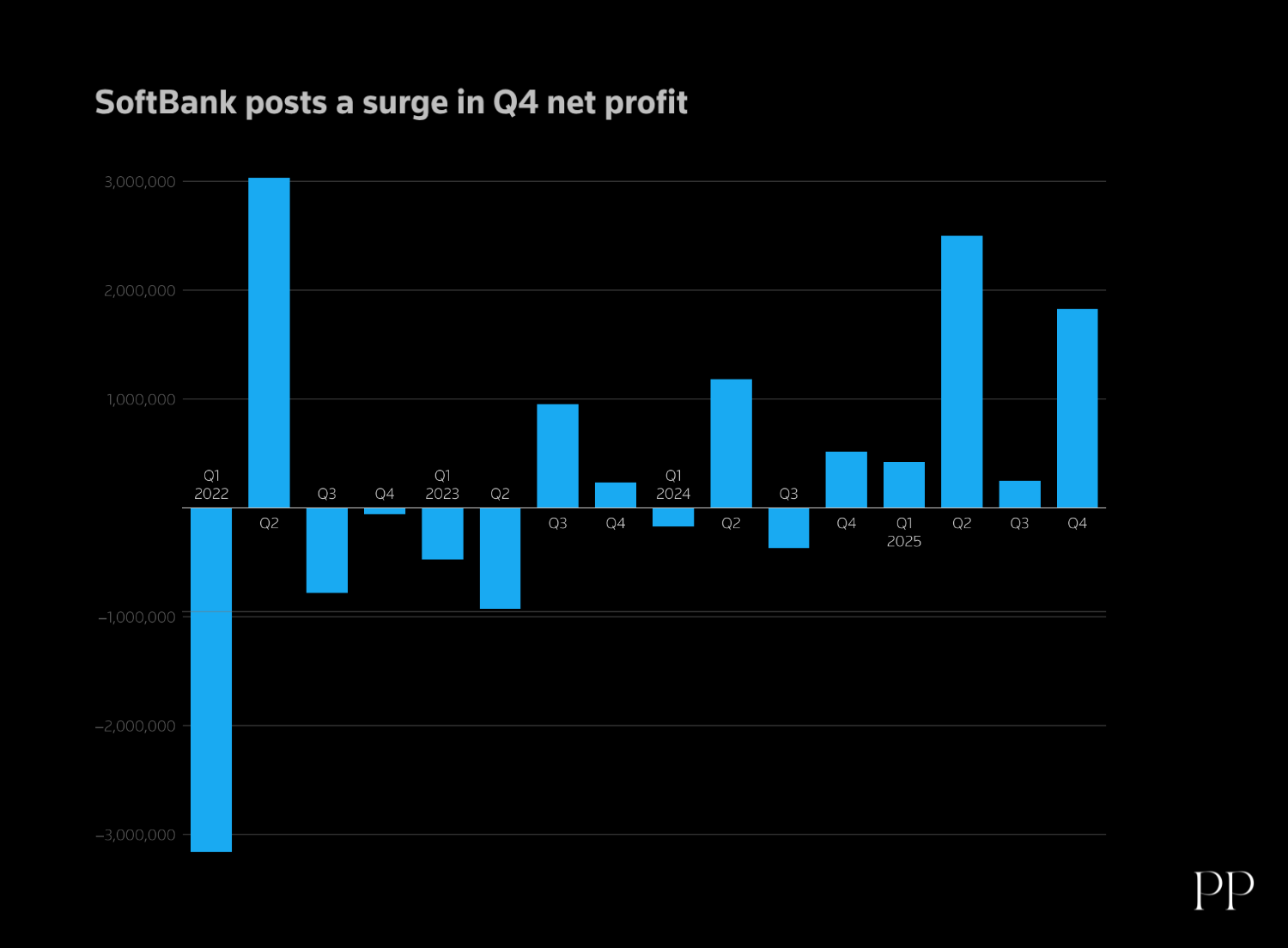
SoftBank Group on Wednesday reported that its net profit more than tripled to 1.83 trillion yen ($11.6 billion) in the January–March quarter, fueled largely by soaring gains tied to its investment in OpenAI, the creator of ChatGPT.
The result marked SoftBank’s fifth consecutive quarterly profit, with its Vision Fund investment arm booking a massive 3.1 trillion yen gain during the quarter, driven primarily by the rising valuation of OpenAI.
Chief Financial Officer Yoshimitsu Goto said the group’s annual profit of 5 trillion yen represented the highest yearly profit ever recorded by a Japanese company.
Founder and CEO Masayoshi Son has emerged as one of OpenAI’s most aggressive backers, with SoftBank stating that cumulative gains from the investment have now reached $45 billion.
However, the sheer scale of SoftBank’s OpenAI bet — the company’s largest spending push since the launch of the Vision Fund investment vehicles in 2017 and 2019 — has intensified concerns among analysts about the group’s financing risks and balance sheet pressure.
 Skeptics argue that OpenAI no longer holds a dominant position in the fast-evolving artificial intelligence market, as rivals including Alphabet’s Gemini and Anthropic’s Claude continue to gain market share. At the same time, the costs associated with training and operating advanced AI models continue to rise sharply across the industry.
“It’s a good thing for the industry that competitors are refining business models and providing new services to new users,” Goto said during an earnings briefing. “Overall, that increases the value of the industry.”
In March, S&P Global Ratings revised SoftBank’s credit outlook to negative, warning that OpenAI faces fierce competition and that the scale of SoftBank’s investment could weigh on the quality and liquidity of its portfolio.
To help finance its AI ambitions, SoftBank has sold stakes in major holdings including T-Mobile and Nvidia, while also issuing bonds and securing loans backed by its holdings in Arm Holdings and its domestic telecom subsidiary, SoftBank Corp.
The company also arranged a $40 billion bridge loan agreement in March. On Wednesday, SoftBank disclosed that $20 billion had already been drawn down in April, primarily to fund its OpenAI investment, while $2.5 billion has since been repaid.
SoftBank previously said it plans to invest an additional $30 billion into OpenAI through 2026, which would raise its cumulative investment to roughly $64.6 billion in exchange for a 13% stake in the AI company.
Goto declined to comment on speculation surrounding a potential OpenAI public listing, which some investors believe could happen as early as this year. Such a move could unlock capital for SoftBank while improving the credit quality of its investment portfolio.
However, Goto suggested SoftBank could leverage its valuable Arm stake to secure additional financing.
“It’s certainly possible we could use our OpenAI assets for financing in the form of a margin loan. How to make use of this 10 trillion yen asset is an exciting prospect,” Goto said.
Beyond artificial intelligence, SoftBank has also been expanding aggressively into robotics, an industry many analysts believe could become a major long-term profit driver.
Last year, the company agreed to acquire the robotics business of Swiss engineering giant ABB in a $5.4 billion deal and established a dedicated subsidiary to oversee its robotics-related investments.
Outside of OpenAI, SoftBank also booked a 278.6 billion yen gain from its investment in Intel, which is currently led by former SoftBank board member Lip-Bu Tan.
Skeptics argue that OpenAI no longer holds a dominant position in the fast-evolving artificial intelligence market, as rivals including Alphabet’s Gemini and Anthropic’s Claude continue to gain market share. At the same time, the costs associated with training and operating advanced AI models continue to rise sharply across the industry.
“It’s a good thing for the industry that competitors are refining business models and providing new services to new users,” Goto said during an earnings briefing. “Overall, that increases the value of the industry.”
In March, S&P Global Ratings revised SoftBank’s credit outlook to negative, warning that OpenAI faces fierce competition and that the scale of SoftBank’s investment could weigh on the quality and liquidity of its portfolio.
To help finance its AI ambitions, SoftBank has sold stakes in major holdings including T-Mobile and Nvidia, while also issuing bonds and securing loans backed by its holdings in Arm Holdings and its domestic telecom subsidiary, SoftBank Corp.
The company also arranged a $40 billion bridge loan agreement in March. On Wednesday, SoftBank disclosed that $20 billion had already been drawn down in April, primarily to fund its OpenAI investment, while $2.5 billion has since been repaid.
SoftBank previously said it plans to invest an additional $30 billion into OpenAI through 2026, which would raise its cumulative investment to roughly $64.6 billion in exchange for a 13% stake in the AI company.
Goto declined to comment on speculation surrounding a potential OpenAI public listing, which some investors believe could happen as early as this year. Such a move could unlock capital for SoftBank while improving the credit quality of its investment portfolio.
However, Goto suggested SoftBank could leverage its valuable Arm stake to secure additional financing.
“It’s certainly possible we could use our OpenAI assets for financing in the form of a margin loan. How to make use of this 10 trillion yen asset is an exciting prospect,” Goto said.
Beyond artificial intelligence, SoftBank has also been expanding aggressively into robotics, an industry many analysts believe could become a major long-term profit driver.
Last year, the company agreed to acquire the robotics business of Swiss engineering giant ABB in a $5.4 billion deal and established a dedicated subsidiary to oversee its robotics-related investments.
Outside of OpenAI, SoftBank also booked a 278.6 billion yen gain from its investment in Intel, which is currently led by former SoftBank board member Lip-Bu Tan.