Comcast will split into two publicly traded companies
Image Credit : Reuters
Source Credit : Portfolio Prints
Comcast announced that it will separate into two publicly traded companies through the spinoff of NBCUniversal and Sky, a move that will split its stable, cash-generating broadband and connectivity business from its media and entertainment operations, which continue to face mounting pressure from streaming competition and industry-wide consolidation.
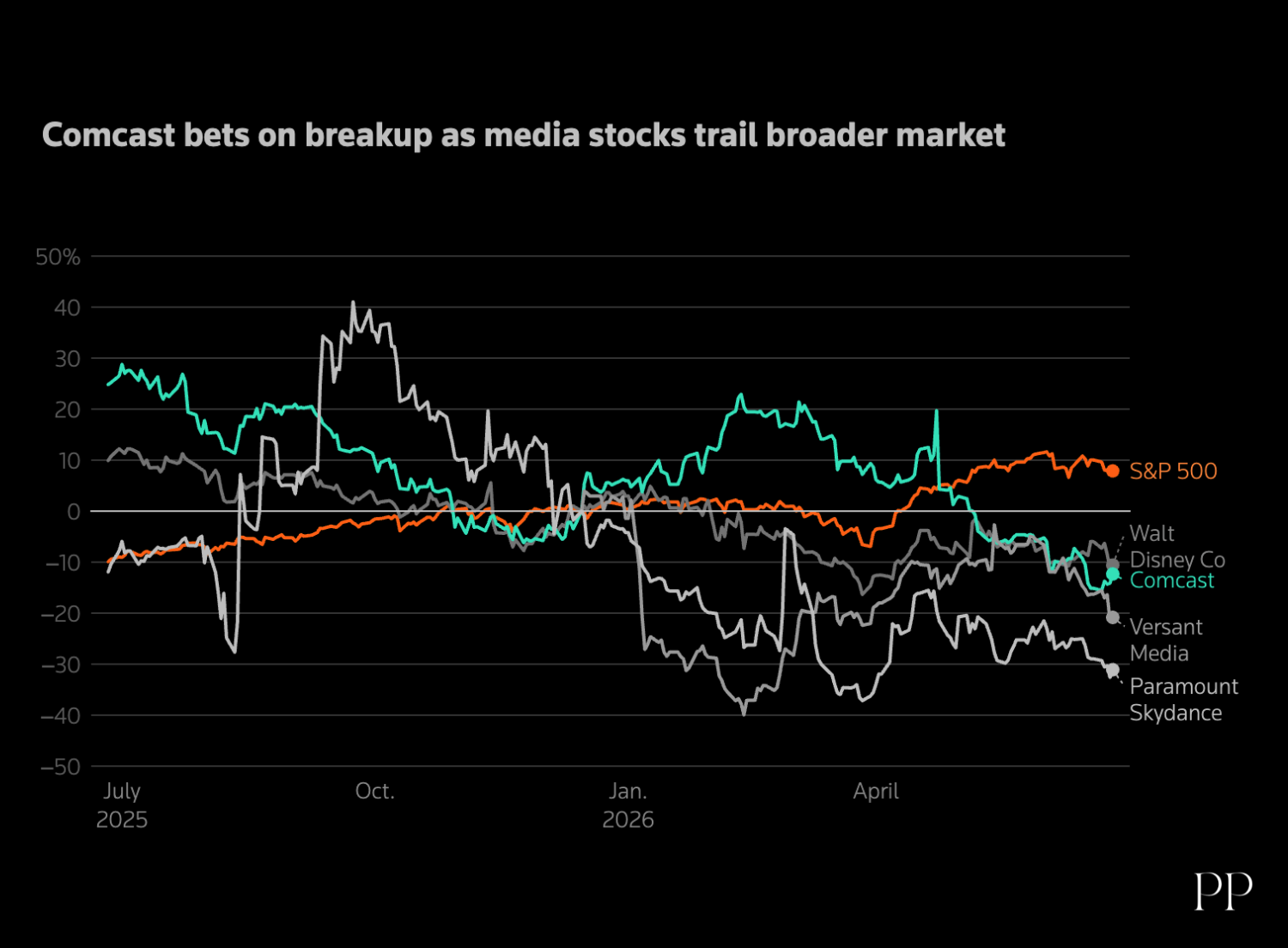
Investors welcomed the announcement, sending Comcast shares up approximately 22% in premarket trading on Monday. Prior to the news, the stock had declined more than 17% in 2026 through Friday's close, marking its third consecutive year of weak performance.
The separation effectively reverses more than 15 years of vertical integration that combined content creation with distribution. As both businesses have come under pressure from changing consumer viewing habits and the rapid expansion of streaming platforms, Comcast believes operating them independently will allow each company to pursue distinct growth strategies and strategic transactions.
The move reflects a broader transformation sweeping the media industry, where years of cord-cutting have steadily eroded the profitability of traditional cable television networks. Legacy media companies have increasingly turned to mergers, acquisitions, and restructurings in an effort to achieve greater scale and compete more effectively against streaming leaders such as Netflix.
The announcement follows another major industry development earlier this year, when Paramount won a bidding war for Warner Bros. Discovery with a proposed $110 billion acquisition, a deal that would create one of the world's largest media and entertainment companies.
 Beyond challenges in media, Comcast's core broadband business has also faced growing competition. The company has been losing internet subscribers to fixed wireless services offered by U.S. wireless carriers such as T-Mobile and Verizon, while fiber-optic providers continue to aggressively expand their high-speed broadband networks across the country.
"The transaction we are announcing will unlock a more entrepreneurial management approach and open up a multitude of new opportunities for each business," Comcast Chairman and Co-Chief Executive Officer Brian Roberts said.
The separation, which is expected to be completed within approximately one year, will create two distinct companies. One will focus on Comcast's cable, broadband, wireless, and business services operations, while the other will include Universal theme parks, Universal Pictures, NBC, Peacock, Sky, and the company's television production and media assets.
Comcast Co-Chief Executive Officer Mike Cavanagh will lead the newly independent NBCUniversal, while former Chief Financial Officer Michael Angelakis will return as Chief Executive Officer of Comcast after initially joining the company as a strategic adviser ahead of the separation.
Brian Roberts will remain actively involved in overseeing both companies following the split. Through Comcast's super-voting share structure, Roberts controls roughly one-third of the company's voting power. Comcast was founded by his father, Ralph Roberts, and NBCUniversal will retain the same dual-class share structure after becoming an independent company.
Following the completion of the transaction, Comcast shareholders will receive shares in both companies. Comcast also plans to retain an ownership stake of up to 19.9% in NBCUniversal for up to one year after the spinoff before gradually monetizing its remaining investment.
Industry analysts believe the restructuring could make NBCUniversal a more attractive acquisition target. Ross Benes, Senior Analyst at eMarketer, said the company's film studio could be particularly appealing to potential buyers, especially Netflix, which lost the bidding war for Warner Bros. Discovery.
Benes added that while Netflix could have strong interest in NBCUniversal's studio assets, it is unlikely to pursue the acquisition of the entire media company. He also noted that it remains uncertain whether NBCUniversal would consider another restructuring to separate its studio business from its broader media operations.
The announcement comes shortly after Comcast completed the spinoff of several cable television networks, including CNBC and USA Network, into Versant Media, which began trading on the Nasdaq earlier this year.
The latest restructuring represents one of the final unwinding efforts of the telecom-and-media integration strategy that dominated the industry throughout the 2010s, when companies sought to combine content ownership with distribution networks to strengthen their competitive positions.
Comcast helped drive that trend in 2011 by acquiring a controlling stake in NBCUniversal from General Electric before purchasing the remaining ownership in 2013 in a transaction valued at roughly $30 billion.
AT&T pursued a similar strategy, spending $49 billion to acquire DirecTV in 2015 and $85 billion to purchase Time Warner in 2018. However, the company later reversed course by spinning off WarnerMedia in 2022 and fully exiting DirecTV by 2025, highlighting the industry's shift away from vertically integrated media conglomerates.
PP Foresight analyst Paolo Pescatore said the separation reflects the changing dynamics of the communications and media industries, arguing that connectivity and media businesses are no longer evolving at the same pace. He described the move as a logical strategic decision but also as evidence of the increasing pressure on traditional media companies to simplify their operations, pursue consolidation, and clearly demonstrate where future growth will come from.
Beyond challenges in media, Comcast's core broadband business has also faced growing competition. The company has been losing internet subscribers to fixed wireless services offered by U.S. wireless carriers such as T-Mobile and Verizon, while fiber-optic providers continue to aggressively expand their high-speed broadband networks across the country.
"The transaction we are announcing will unlock a more entrepreneurial management approach and open up a multitude of new opportunities for each business," Comcast Chairman and Co-Chief Executive Officer Brian Roberts said.
The separation, which is expected to be completed within approximately one year, will create two distinct companies. One will focus on Comcast's cable, broadband, wireless, and business services operations, while the other will include Universal theme parks, Universal Pictures, NBC, Peacock, Sky, and the company's television production and media assets.
Comcast Co-Chief Executive Officer Mike Cavanagh will lead the newly independent NBCUniversal, while former Chief Financial Officer Michael Angelakis will return as Chief Executive Officer of Comcast after initially joining the company as a strategic adviser ahead of the separation.
Brian Roberts will remain actively involved in overseeing both companies following the split. Through Comcast's super-voting share structure, Roberts controls roughly one-third of the company's voting power. Comcast was founded by his father, Ralph Roberts, and NBCUniversal will retain the same dual-class share structure after becoming an independent company.
Following the completion of the transaction, Comcast shareholders will receive shares in both companies. Comcast also plans to retain an ownership stake of up to 19.9% in NBCUniversal for up to one year after the spinoff before gradually monetizing its remaining investment.
Industry analysts believe the restructuring could make NBCUniversal a more attractive acquisition target. Ross Benes, Senior Analyst at eMarketer, said the company's film studio could be particularly appealing to potential buyers, especially Netflix, which lost the bidding war for Warner Bros. Discovery.
Benes added that while Netflix could have strong interest in NBCUniversal's studio assets, it is unlikely to pursue the acquisition of the entire media company. He also noted that it remains uncertain whether NBCUniversal would consider another restructuring to separate its studio business from its broader media operations.
The announcement comes shortly after Comcast completed the spinoff of several cable television networks, including CNBC and USA Network, into Versant Media, which began trading on the Nasdaq earlier this year.
The latest restructuring represents one of the final unwinding efforts of the telecom-and-media integration strategy that dominated the industry throughout the 2010s, when companies sought to combine content ownership with distribution networks to strengthen their competitive positions.
Comcast helped drive that trend in 2011 by acquiring a controlling stake in NBCUniversal from General Electric before purchasing the remaining ownership in 2013 in a transaction valued at roughly $30 billion.
AT&T pursued a similar strategy, spending $49 billion to acquire DirecTV in 2015 and $85 billion to purchase Time Warner in 2018. However, the company later reversed course by spinning off WarnerMedia in 2022 and fully exiting DirecTV by 2025, highlighting the industry's shift away from vertically integrated media conglomerates.
PP Foresight analyst Paolo Pescatore said the separation reflects the changing dynamics of the communications and media industries, arguing that connectivity and media businesses are no longer evolving at the same pace. He described the move as a logical strategic decision but also as evidence of the increasing pressure on traditional media companies to simplify their operations, pursue consolidation, and clearly demonstrate where future growth will come from.