Apple overtakes Nvidia as world's most valuable company
Image Credit : Reuters
Source Credit : Portfolio Prints
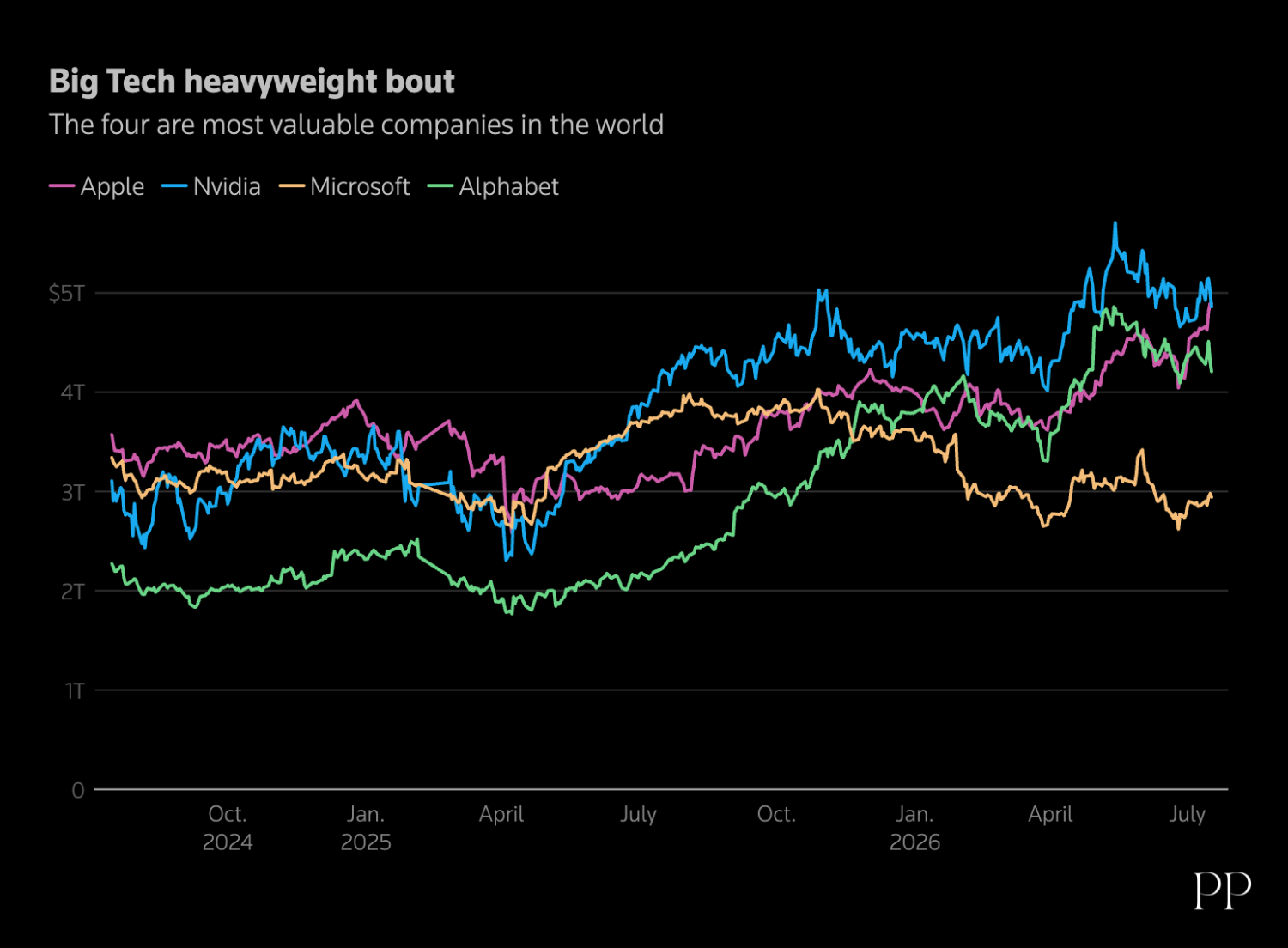
Apple reclaimed the title of the world’s most valuable company on Friday, surpassing Nvidia in a symbolic shift that highlights changing investor attitudes toward the artificial intelligence boom. Apple’s market capitalization stood at approximately $4.88 trillion, while Nvidia’s valuation slipped to around $4.86 trillion after its shares declined 3.5%. The milestone marks Apple’s return to the top position for the first time since April 2025 and signals a broader reassessment of how AI value will ultimately be created and captured.
The change in rankings reflects a growing belief among investors that the next phase of the AI revolution may reward companies that can successfully monetize artificial intelligence through products, services, and ecosystems rather than solely through the infrastructure powering it. For much of the past year, Nvidia dominated the market narrative as demand for its AI chips surged alongside unprecedented spending on data centers and AI infrastructure. However, attention is increasingly shifting toward companies capable of translating AI innovation into sustainable consumer and enterprise revenue streams.
“Apple was seen as a laggard in the AI race because it wasn’t spending aggressively to develop large-scale AI models, but investor sentiment has evolved,” said Toni Meadows, Head of Investment at BRI Wealth Management. According to Meadows, Apple’s appeal lies in its ability to monetize AI through its tightly integrated ecosystem, recurring services revenue, and hardware upgrades, making its earnings profile potentially more durable than businesses that depend heavily on continuous capital expenditure.
 For Apple, the achievement represents more than a market-cap milestone. The company has spent much of the generative AI era facing criticism for appearing slow to respond while rivals such as Microsoft, Google, OpenAI, and Meta accelerated their AI initiatives. Reclaiming the top spot suggests investors are becoming more confident that Apple can carve out a meaningful role in the AI landscape despite its relatively cautious approach.
The timing is particularly significant as Chief Executive Officer Tim Cook prepares to step down later this year after more than a decade leading the company. Cook is expected to hand leadership responsibilities to hardware chief John Ternus in September, making Apple’s renewed market leadership an important part of the legacy he leaves behind. Under Cook, Apple transformed from a hardware-focused company into a diversified technology giant built around devices, services, and ecosystem integration.
A key factor behind the renewed optimism has been Apple’s recent push into artificial intelligence. Last month, the company unveiled a long-awaited overhaul of Siri, introducing a more advanced and context-aware assistant designed to compete more effectively with AI-powered offerings from major technology companies and emerging startups. The upgraded Siri is viewed as a critical step in Apple’s effort to close the gap in one of the most strategically important technology races of the decade.
Many analysts believe Apple possesses a unique advantage in artificial intelligence due to the vast amount of personal data generated across its ecosystem of more than two billion active devices. Information related to user preferences, communication patterns, locations, schedules, and app activity could potentially enable highly personalized AI experiences. If leveraged effectively, this data could make Siri significantly more useful and differentiate Apple’s AI offerings from competitors.
At the same time, Apple faces a challenge that is largely unique to its business model. The company has built its brand around privacy and data protection, meaning much of this valuable information remains securely stored on users’ devices. Unlocking the full potential of AI while maintaining its privacy commitments will require Apple to strike a delicate balance between personalization and data security.
Nvidia’s fall to second place does not necessarily indicate a weakening of its long-term prospects. The company remains the dominant supplier of advanced AI processors, and its graphics processing units continue to power much of the world’s generative AI infrastructure. Nvidia became the first company to surpass a $5 trillion valuation earlier this year, reflecting the extraordinary demand generated by the AI boom.
Many investors view the change in rankings as largely symbolic rather than a fundamental shift in industry leadership. Nvidia remains at the center of global AI spending, and any acceleration in data-center investment or breakthrough AI applications could quickly propel the company back to the top of the market-cap leaderboard. The battle for the world’s most valuable company is likely to remain highly competitive as both firms continue benefiting from different aspects of the AI ecosystem.
Apple itself is not without risks. The company has recently implemented price increases across several product categories to offset rising costs and protect profit margins. While the strategy may support earnings growth, it also raises concerns about consumer demand, particularly in an environment where global economic growth remains uneven and competition in smartphones and consumer electronics continues to intensify.
“I don’t see any meaningful distinction between the two companies from a long-term perspective,” said Benjamin Hall, Vice President of Alpha Research at Segal Marco Advisors. “Nvidia is likely to remain a significant participant in whatever happens next in the AI economy.” His comments reflect a broader view among investors that both companies are positioned to benefit from different layers of the artificial intelligence value chain.
Meanwhile, AI enthusiasm has expanded beyond the familiar group of mega-cap technology stocks. Investors have increasingly turned their attention to memory-chip manufacturers, whose products have become essential components of AI infrastructure. Micron Technology surpassed a $1 trillion market valuation earlier this year as demand for high-bandwidth memory surged, highlighting how the benefits of AI spending are spreading across the semiconductor industry.
South Korean chipmaker SK Hynix has also attracted growing investor interest following its recent Nasdaq listing. As one of the world’s leading producers of advanced memory chips, the company is well positioned to capitalize on rising AI-related demand and represents another example of how the AI investment story is broadening beyond a handful of dominant names.
According to market analysts, the arrival of new AI-related investment opportunities could gradually shift attention away from the traditional “Magnificent Seven” technology stocks and toward a wider range of companies participating in the AI ecosystem. This evolution suggests that investors are becoming more selective, focusing not only on AI leaders but also on the broader network of suppliers and beneficiaries supporting the industry’s growth.
The semiconductor sector’s remarkable rally has nevertheless encountered turbulence in recent months. Concerns about valuations, spending sustainability, and the pace of AI adoption triggered a sharp correction, with the Philadelphia Semiconductor Index falling nearly 19% from its record highs in July. The pullback reflects growing debate over whether the industry’s rapid gains have fully accounted for future growth expectations.
Despite the recent volatility, semiconductor stocks remain among the market’s strongest performers. The sector continues to benefit from long-term structural trends including artificial intelligence, cloud computing, advanced manufacturing, and digital transformation. While leadership positions may change from time to time, the competition between Apple and Nvidia underscores a broader reality: investors increasingly view AI as a foundational technology that will create value across multiple industries rather than concentrating gains in a single company.
For Apple, the achievement represents more than a market-cap milestone. The company has spent much of the generative AI era facing criticism for appearing slow to respond while rivals such as Microsoft, Google, OpenAI, and Meta accelerated their AI initiatives. Reclaiming the top spot suggests investors are becoming more confident that Apple can carve out a meaningful role in the AI landscape despite its relatively cautious approach.
The timing is particularly significant as Chief Executive Officer Tim Cook prepares to step down later this year after more than a decade leading the company. Cook is expected to hand leadership responsibilities to hardware chief John Ternus in September, making Apple’s renewed market leadership an important part of the legacy he leaves behind. Under Cook, Apple transformed from a hardware-focused company into a diversified technology giant built around devices, services, and ecosystem integration.
A key factor behind the renewed optimism has been Apple’s recent push into artificial intelligence. Last month, the company unveiled a long-awaited overhaul of Siri, introducing a more advanced and context-aware assistant designed to compete more effectively with AI-powered offerings from major technology companies and emerging startups. The upgraded Siri is viewed as a critical step in Apple’s effort to close the gap in one of the most strategically important technology races of the decade.
Many analysts believe Apple possesses a unique advantage in artificial intelligence due to the vast amount of personal data generated across its ecosystem of more than two billion active devices. Information related to user preferences, communication patterns, locations, schedules, and app activity could potentially enable highly personalized AI experiences. If leveraged effectively, this data could make Siri significantly more useful and differentiate Apple’s AI offerings from competitors.
At the same time, Apple faces a challenge that is largely unique to its business model. The company has built its brand around privacy and data protection, meaning much of this valuable information remains securely stored on users’ devices. Unlocking the full potential of AI while maintaining its privacy commitments will require Apple to strike a delicate balance between personalization and data security.
Nvidia’s fall to second place does not necessarily indicate a weakening of its long-term prospects. The company remains the dominant supplier of advanced AI processors, and its graphics processing units continue to power much of the world’s generative AI infrastructure. Nvidia became the first company to surpass a $5 trillion valuation earlier this year, reflecting the extraordinary demand generated by the AI boom.
Many investors view the change in rankings as largely symbolic rather than a fundamental shift in industry leadership. Nvidia remains at the center of global AI spending, and any acceleration in data-center investment or breakthrough AI applications could quickly propel the company back to the top of the market-cap leaderboard. The battle for the world’s most valuable company is likely to remain highly competitive as both firms continue benefiting from different aspects of the AI ecosystem.
Apple itself is not without risks. The company has recently implemented price increases across several product categories to offset rising costs and protect profit margins. While the strategy may support earnings growth, it also raises concerns about consumer demand, particularly in an environment where global economic growth remains uneven and competition in smartphones and consumer electronics continues to intensify.
“I don’t see any meaningful distinction between the two companies from a long-term perspective,” said Benjamin Hall, Vice President of Alpha Research at Segal Marco Advisors. “Nvidia is likely to remain a significant participant in whatever happens next in the AI economy.” His comments reflect a broader view among investors that both companies are positioned to benefit from different layers of the artificial intelligence value chain.
Meanwhile, AI enthusiasm has expanded beyond the familiar group of mega-cap technology stocks. Investors have increasingly turned their attention to memory-chip manufacturers, whose products have become essential components of AI infrastructure. Micron Technology surpassed a $1 trillion market valuation earlier this year as demand for high-bandwidth memory surged, highlighting how the benefits of AI spending are spreading across the semiconductor industry.
South Korean chipmaker SK Hynix has also attracted growing investor interest following its recent Nasdaq listing. As one of the world’s leading producers of advanced memory chips, the company is well positioned to capitalize on rising AI-related demand and represents another example of how the AI investment story is broadening beyond a handful of dominant names.
According to market analysts, the arrival of new AI-related investment opportunities could gradually shift attention away from the traditional “Magnificent Seven” technology stocks and toward a wider range of companies participating in the AI ecosystem. This evolution suggests that investors are becoming more selective, focusing not only on AI leaders but also on the broader network of suppliers and beneficiaries supporting the industry’s growth.
The semiconductor sector’s remarkable rally has nevertheless encountered turbulence in recent months. Concerns about valuations, spending sustainability, and the pace of AI adoption triggered a sharp correction, with the Philadelphia Semiconductor Index falling nearly 19% from its record highs in July. The pullback reflects growing debate over whether the industry’s rapid gains have fully accounted for future growth expectations.
Despite the recent volatility, semiconductor stocks remain among the market’s strongest performers. The sector continues to benefit from long-term structural trends including artificial intelligence, cloud computing, advanced manufacturing, and digital transformation. While leadership positions may change from time to time, the competition between Apple and Nvidia underscores a broader reality: investors increasingly view AI as a foundational technology that will create value across multiple industries rather than concentrating gains in a single company.