The AI Capital Expenditure: Productivity or Bubble?
Image Credit : The New York Times
Source Credit : Portfolio Prints
Introduction
Throughout economic history, transformative technologies have required substantial upfront investment before delivering measurable productivity improvements. Railroads in the nineteenth century, electrification in the early twentieth century, and the internet during the late twentieth century all experienced periods of intense capital expenditure, speculative enthusiasm, and uncertainty regarding returns.
Artificial intelligence appears to be following a similar trajectory. Major technology firms including Microsoft, Alphabet, Amazon, and Meta have dramatically increased spending on AI infrastructure. Data center construction, GPU procurement, cloud capacity expansion, and AI model development have become central strategic priorities. Analysts estimate that hyperscaler AI investments could reach between $650 billion and $765 billion annually in 2026, with further acceleration expected throughout the decade.
The central question is whether these investments will generate sufficient economic value to justify their cost. If AI substantially increases labor productivity, creates new industries, and transforms business processes, current expenditures may appear modest in hindsight. Conversely, if adoption slows or revenue growth fails to match infrastructure spending, investors may face significant losses reminiscent of previous technology bubbles.
Understanding AI Capital Expenditure
Capital expenditure refers to investments in long-term assets that enhance productive capacity. In the context of AI, CapEx primarily includes spending on advanced semiconductors, data centers, networking equipment, power infrastructure, and cloud computing facilities.
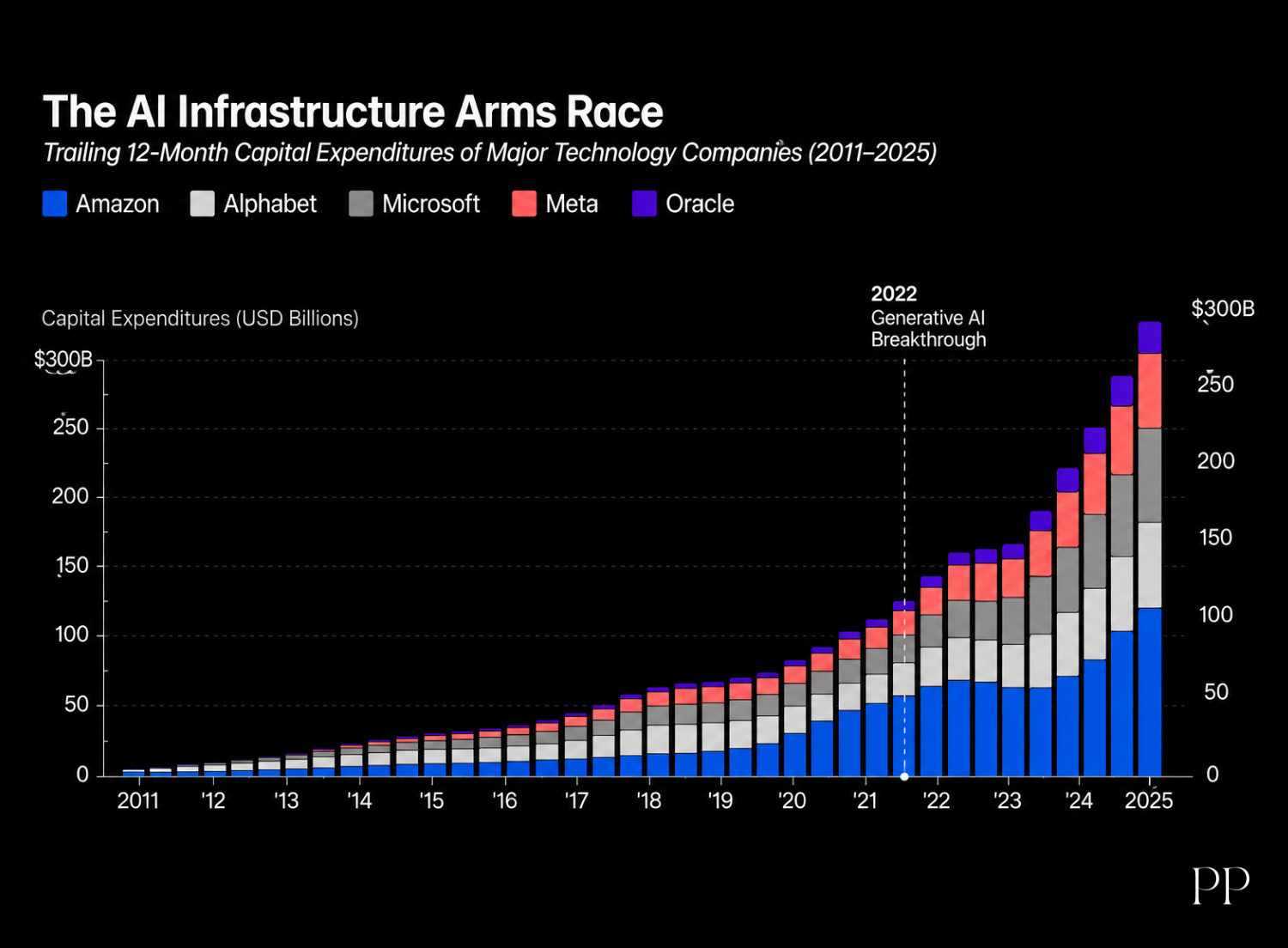 Unlike traditional software, modern generative AI systems require enormous computational resources. Training frontier AI models involves processing trillions of data points using thousands of high-performance GPUs. Operating these models at scale requires extensive infrastructure capable of serving millions of users simultaneously.
The scale of investment is extraordinary. Goldman Sachs projects annual AI-related capital expenditure reaching approximately $765 billion in 2026 and potentially exceeding $1.6 trillion annually by 2031.
Unlike traditional software, modern generative AI systems require enormous computational resources. Training frontier AI models involves processing trillions of data points using thousands of high-performance GPUs. Operating these models at scale requires extensive infrastructure capable of serving millions of users simultaneously.
The scale of investment is extraordinary. Goldman Sachs projects annual AI-related capital expenditure reaching approximately $765 billion in 2026 and potentially exceeding $1.6 trillion annually by 2031.
| Year |
Estimated AI CapEx (USD Billion) |
Key Drivers |
| 2023 |
150–200 |
Initial generative AI adoption |
| 2024 |
250–300 |
Expansion of cloud AI services |
| 2025 |
350–405 |
Large-scale hyperscaler investments |
| 2026 |
650–765 |
Data center and GPU expansion |
| 2030+ |
1,000+ |
Enterprise-wide AI integration |
This scale of spending has few historical precedents outside wartime industrial mobilization, national infrastructure programs, or the internet boom of the late 1990s.
The Case for a Productivity Revolution
Supporters of current AI investment argue that the world is witnessing the emergence of a general-purpose technology. Such technologies affect nearly every industry and create productivity improvements across entire economies.
Research increasingly demonstrates that AI can significantly improve worker performance. In software development, AI coding assistants reduce development time and improve efficiency. In customer service, AI agents handle routine inquiries at a fraction of traditional costs. In finance, healthcare, legal services, manufacturing, and education, AI is automating knowledge-intensive tasks previously considered resistant to technological disruption.
Economic theory suggests that productivity gains occur when workers can produce more output using the same amount of labor. AI has the potential to enhance productivity in three primary ways.
First, AI automates repetitive cognitive tasks. Unlike previous waves of automation that primarily affected manual labor, AI targets information processing and decision-making activities.
Second, AI augments human capabilities. Workers equipped with AI tools often complete tasks faster and with greater accuracy than those working without assistance.
Third, AI enables entirely new products and services. Generative AI applications, autonomous agents, scientific discovery platforms, and personalized digital assistants represent new economic categories that did not previously exist.
Historical evidence supports this perspective. Electrification required decades of investment before productivity statistics reflected its benefits. Similarly, internet infrastructure investments during the 1990s appeared excessive until e-commerce, cloud computing, and digital platforms transformed global business.
Many economists believe AI may follow a comparable path, with current investments serving as foundational infrastructure for future economic growth.
The Case for an AI Bubble
Critics argue that current spending levels reflect speculative excess rather than rational economic calculation.
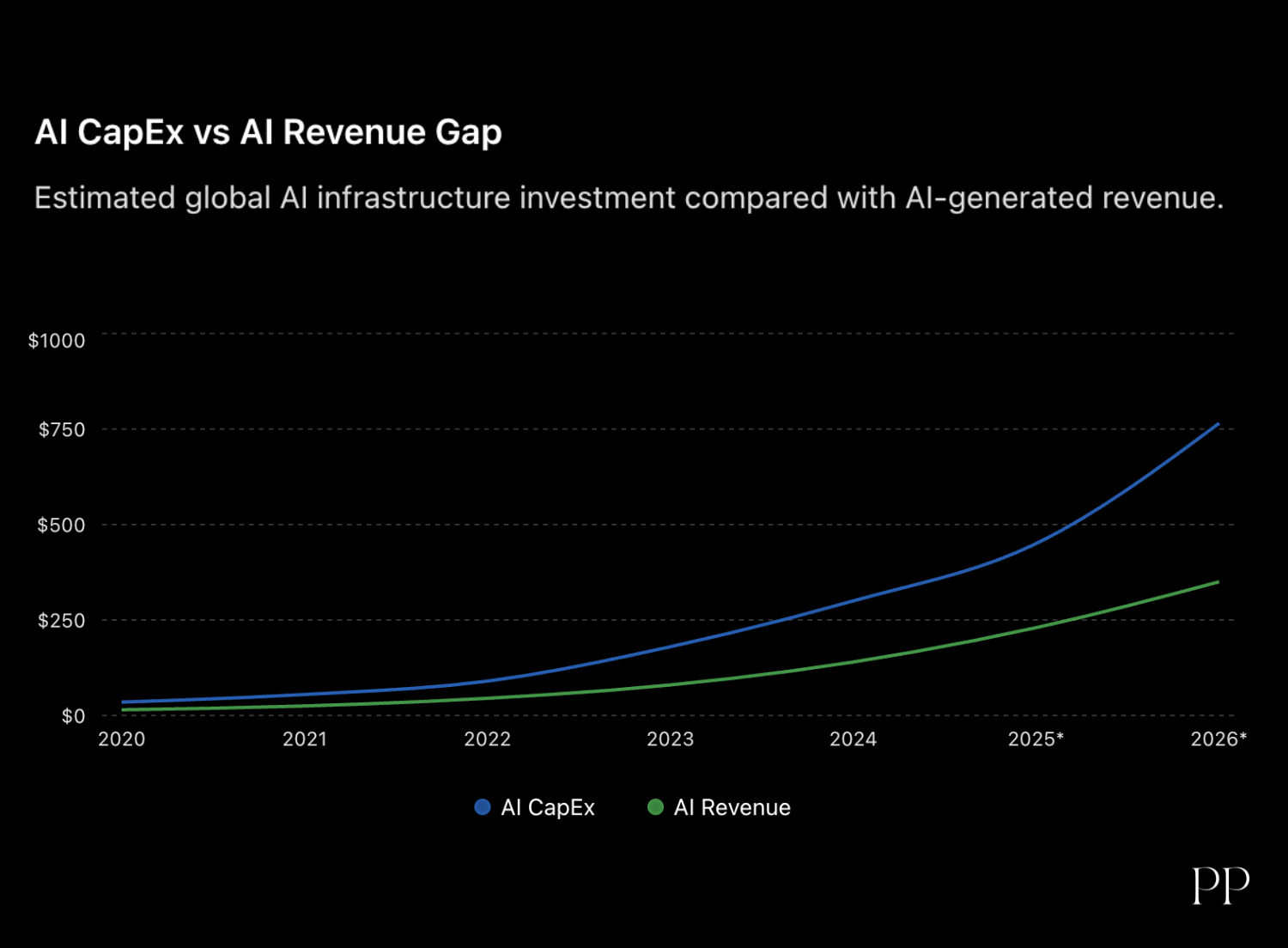
A key concern is the growing gap between AI spending and AI-generated revenue. While infrastructure investments have accelerated dramatically, monetization remains uncertain. Some analysts estimate that AI ecosystem revenues remain substantially below the level required to justify current infrastructure expenditures.
Investors increasingly value companies based on future AI potential rather than current earnings. Technology firms are issuing large amounts of debt and committing to long-term infrastructure projects despite uncertain demand forecasts. Several central banks and financial regulators have warned about elevated valuations and potential market vulnerabilities associated with AI enthusiasm.
Another concern involves declining marginal returns. As more firms build similar infrastructure, competitive advantages may erode. If AI services become commoditized, profit margins could compress significantly.
Skeptics also note that technological progress does not automatically translate into productivity gains. Organizations must redesign workflows, train employees, and adapt business processes to fully realize AI's benefits. Without complementary investments in human capital and organizational change, expensive AI systems may fail to generate meaningful returns.
Lessons from Historical Technology Bubbles
| Technology Cycle |
Period |
Initial Market View |
| Railroads |
1840s–1870s |
Transformative growth |
| Electrification |
1880s–1920s |
Excessive spending concerns |
| Internet |
1995–2000 |
New economy optimism |
| Mobile Technology |
2007–2015 |
Rapid adoption |
| Artificial Intelligence |
2023–Present |
Productivity revolution vs bubble |
The dot-com bubble provides perhaps the most relevant comparison. During the late 1990s, excessive speculation led to widespread overvaluation and eventual market collapse. Yet the underlying technology proved genuinely transformative. Companies such as Amazon survived the crash and became dominant global enterprises.
This historical pattern suggests that bubbles and technological revolutions are not mutually exclusive. Excessive investment can coexist with genuine innovation.
A Hybrid Scenario: Both Productivity and Bubble
The most realistic interpretation may be that AI represents both a productivity revolution and a speculative bubble simultaneously.
Financial markets often overestimate short-term technological impacts while underestimating long-term consequences. During the early stages of transformative technologies, investors tend to extrapolate optimistic scenarios, resulting in excessive valuations and capital allocation. Eventually, expectations moderate, weaker firms fail, and sustainable business models emerge.
AI may currently be experiencing this phase. Infrastructure spending appears excessive relative to present revenues, yet the technology's long-term potential remains substantial.
In this scenario, some companies will likely overinvest and suffer financial losses. Certain AI applications may fail to achieve commercial viability. Market corrections may occur as investors reassess expectations. However, the broader technological transformation is likely to continue, producing meaningful productivity gains over time.
Conclusion
The debate surrounding AI capital expenditure reflects a broader tension between technological optimism and financial realism. On one side, unprecedented investments in AI infrastructure suggest confidence that artificial intelligence will become a foundational technology of the twenty-first century. On the other side, the scale of spending, uncertain monetization, and elevated valuations raise legitimate concerns about speculative excess.
Historical evidence indicates that transformative technologies often experience periods of overinvestment before delivering their full economic benefits. Railroads, electricity, and the internet all followed similar patterns. AI appears to be no exception.
Therefore, framing the issue as a choice between productivity revolution and asset bubble may be misleading. The current AI boom likely contains elements of both. Short-term market excesses may coexist with long-term productivity gains. The ultimate outcome will depend on whether businesses can translate technological capabilities into sustainable economic value.
The trillion-dollar question is not whether AI will transform the economy—it almost certainly will. The real question is whether today's investors are accurately pricing the timing, scale, and distribution of those future benefits.