U.S. consumer inflation slowed more than expected
Image Credit : Reuters
Source Credit : Portfolio Prints
U.S. inflation cooled more sharply than expected in June, providing a welcome reprieve for policymakers after months of stubborn price pressures. Falling energy costs helped drive the slowdown, but the improvement was not sufficient to convince investors that the Federal Reserve has finished tightening monetary policy. Renewed geopolitical tensions in the Middle East and the resulting rebound in oil prices continue to cloud the inflation outlook, keeping the possibility of another interest-rate increase firmly on the table.
The latest Consumer Price Index (CPI) report, released by the U.S. Labor Department on Tuesday, showed that both headline and underlying inflation eased during June. Economists said the data gives Federal Reserve officials additional flexibility ahead of their upcoming policy meeting. However, they cautioned that the report largely reflects conditions before the recent escalation in hostilities between the United States and Iran, which has already begun to push energy prices higher again.
Federal Reserve Chair Kevin Warsh reinforced the central bank’s commitment to restoring price stability, telling lawmakers that policymakers have “no tolerance for persistently elevated inflation.” While the June figures were encouraging, he signaled that the Fed remains cautious and is not yet prepared to declare victory over inflation.
“Energy prices plunged on the Iran cease-fire and memorandum of understanding,” said Scott Anderson, Chief U.S. Economist at BMO Capital Markets. “But with fighting back on in the Gulf, the agreement effectively collapsing, and energy prices moving higher again in July, the balance of risks remains tilted toward another rate hike later this year.”
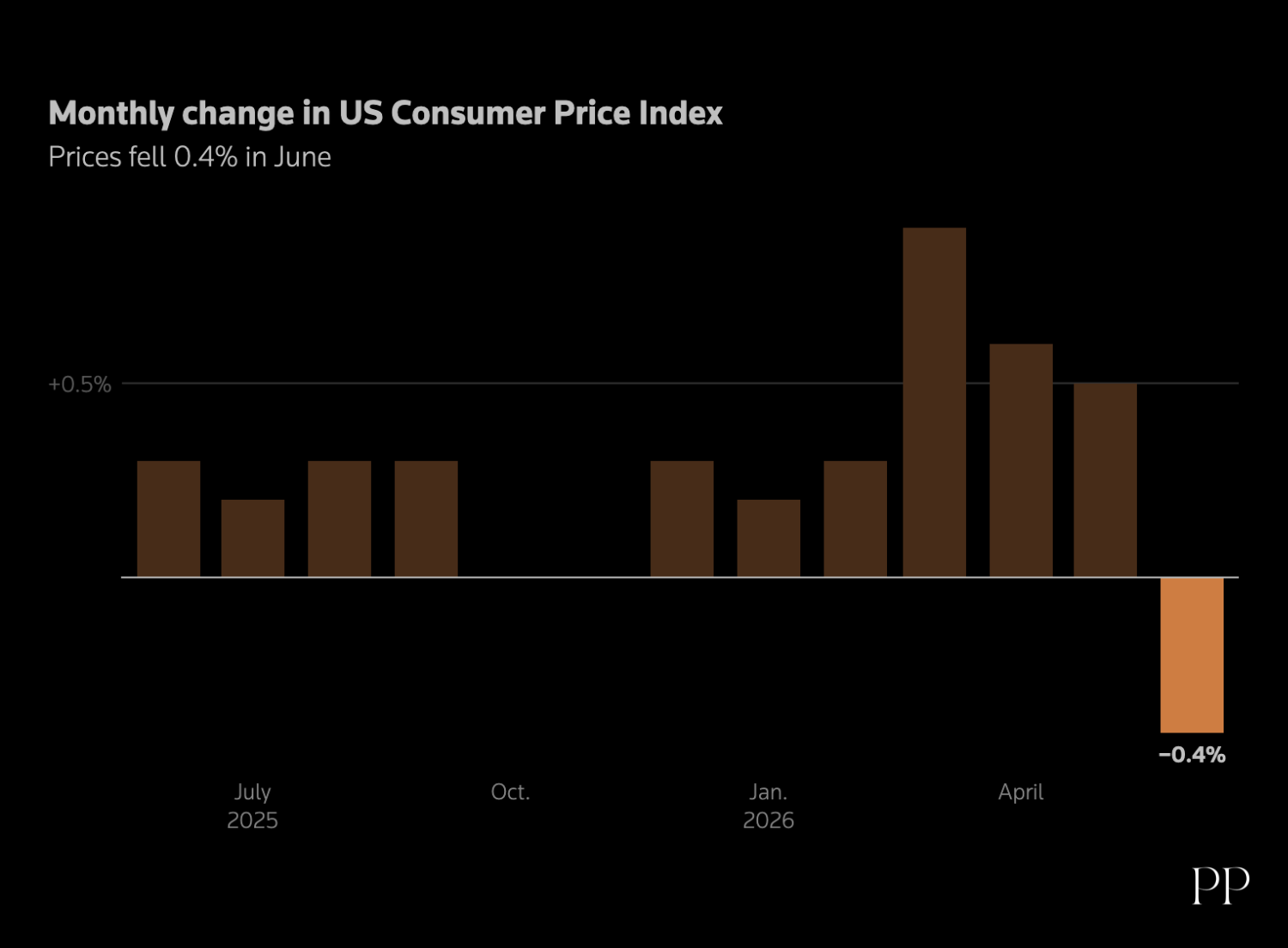
Annual consumer inflation slowed to 3.5% in June from 4.2% in May, according to data from the Bureau of Labor Statistics. Although still well above the Federal Reserve’s 2% target, the decline was larger than economists had anticipated. On a monthly basis, consumer prices fell 0.4%, marking the first monthly decline since April 2020 and a significant reversal from the 0.5% increase recorded in May. Economists surveyed by Reuters had expected annual inflation of 3.8% and only a modest 0.1% monthly decline.
 The moderation in inflation was driven primarily by a sharp decline in energy costs. Energy prices fell 5.7% during the month, their largest drop since April 2020, reversing much of May’s increase. Gasoline prices plunged 9.7% in June, though they remained 26.7% higher than a year earlier. The decline followed a temporary ceasefire in the Middle East that eased concerns over global oil supplies. However, that relief proved short-lived as the truce collapsed after commercial vessels came under attack in the Strait of Hormuz, triggering renewed military exchanges between the United States and Iran.
The resurgence in regional tensions has already begun to affect fuel markets. According to data from AAA, the national average gasoline price rose to $3.86 per gallon on Tuesday, up from $3.79 a week earlier. Analysts expect further increases after oil prices climbed to a four-week high following Washington’s decision to reimpose a naval blockade on Iran.
“The outlook for inflation in July is considerably less encouraging,” said Bill Adams, Chief U.S. Economist at Fifth Third Commercial Bank. “Energy prices are moving in the wrong direction again, and that creates significant upside risks for future inflation readings.”
Food inflation remained relatively stable during the month. Food prices increased 0.2%, matching May’s gain, while annual food inflation stood at 3.0%. Grocery prices also rose 0.2%, driven by a 4.3% increase in egg prices and a 1.2% rise in dairy products. Offsetting some of those increases, nonalcoholic beverage prices fell 1.5%, including a 2.0% decline in coffee prices. Fruit and vegetable prices decreased 0.2% during the month but remained 5.3% higher than a year earlier.
Excluding the volatile food and energy categories, core CPI inflation eased to 2.6% annually from 2.9% in May. On a monthly basis, core prices were unchanged after increasing 0.2% in the previous month. The decline suggests that underlying inflationary pressures may be moderating, though economists remain divided on whether the improvement represents a lasting trend or a temporary fluctuation.
Financial markets interpreted the report as supportive but not decisive. Investors widely expect the Federal Reserve to leave its benchmark interest rate unchanged in the 3.50%–3.75% range at its upcoming meeting. However, futures markets continue to price in a meaningful probability of an additional rate increase later in the year, reflecting concerns that inflation could reaccelerate if energy prices continue to rise.
Following the release of the report, Wall Street stocks moved higher, Treasury yields declined, and the U.S. dollar weakened against a basket of major currencies as investors welcomed signs of easing price pressures.
Several categories helped restrain core inflation during June. Motor vehicle insurance costs fell 2.0% after declining 1.7% in May. Communication services prices dropped 1.5%, while shelter inflation rose just 0.1%, its smallest monthly increase since January 2021. Owners’ equivalent rent, a key housing-cost measure, increased only 0.2%, while hotel and motel prices declined 2.3%, likely reflecting softer travel demand after the economic boost associated with the FIFA World Cup faded.
Healthcare costs also edged lower, declining 0.1% during the month, while health insurance prices fell 0.5%. These decreases contributed to the broader moderation in services inflation, which was unchanged overall in June.
Not all categories showed signs of cooling. Recreation costs increased 0.5%, and airline fares rose 0.2%, highlighting pockets of resilience in consumer demand. Meanwhile, core goods prices declined 0.1% for a second consecutive month. Apparel prices fell 0.6%, suggesting that tariff-related price pressures may be fading. Used vehicle prices declined 0.2%, prescription drug prices slipped 0.1%, and tobacco products recorded their largest monthly decline since 2014.
Some categories, however, moved in the opposite direction. Household furnishings and operational costs rose 0.2%, indicating that inflationary pressures remain uneven across the economy.
Economists remain cautious about interpreting June’s softer inflation reading as a definitive turning point. Several analysts argued that unusually large declines in categories such as insurance, healthcare, and tobacco products may prove temporary and could reverse in coming months.
“There are a number of one-off factors in this report, but there are also several genuinely encouraging readings that may point to broader disinflation,” said Stephen Stanley, Chief U.S. Economist at Santander U.S. Capital Markets. “Still, I remain skeptical that inflation has suddenly rolled over.”
Based on the CPI report, economists estimate that the Federal Reserve’s preferred inflation measure—the core Personal Consumption Expenditures (PCE) Price Index—rose 3.3% year-over-year in June, down from 3.4% in May. Monthly core PCE inflation is expected to increase 0.2%, compared with 0.3% in the previous month. Those estimates could change following the release of the Producer Price Index data.
For policymakers, the June inflation report offers reassurance that progress toward lower inflation has resumed, but it does not eliminate the challenges ahead. Rising energy costs, persistent geopolitical uncertainty, and the risk of secondary price effects continue to threaten the disinflation process.
“For the Fed, this report is a relief, but not a reason to relax,” said Carl Weinberg, Chief Economist at High Frequency Economics. “We expect inflation to accelerate again in the coming months as higher energy costs filter through transportation networks and eventually spill over into broader consumer prices.”
The moderation in inflation was driven primarily by a sharp decline in energy costs. Energy prices fell 5.7% during the month, their largest drop since April 2020, reversing much of May’s increase. Gasoline prices plunged 9.7% in June, though they remained 26.7% higher than a year earlier. The decline followed a temporary ceasefire in the Middle East that eased concerns over global oil supplies. However, that relief proved short-lived as the truce collapsed after commercial vessels came under attack in the Strait of Hormuz, triggering renewed military exchanges between the United States and Iran.
The resurgence in regional tensions has already begun to affect fuel markets. According to data from AAA, the national average gasoline price rose to $3.86 per gallon on Tuesday, up from $3.79 a week earlier. Analysts expect further increases after oil prices climbed to a four-week high following Washington’s decision to reimpose a naval blockade on Iran.
“The outlook for inflation in July is considerably less encouraging,” said Bill Adams, Chief U.S. Economist at Fifth Third Commercial Bank. “Energy prices are moving in the wrong direction again, and that creates significant upside risks for future inflation readings.”
Food inflation remained relatively stable during the month. Food prices increased 0.2%, matching May’s gain, while annual food inflation stood at 3.0%. Grocery prices also rose 0.2%, driven by a 4.3% increase in egg prices and a 1.2% rise in dairy products. Offsetting some of those increases, nonalcoholic beverage prices fell 1.5%, including a 2.0% decline in coffee prices. Fruit and vegetable prices decreased 0.2% during the month but remained 5.3% higher than a year earlier.
Excluding the volatile food and energy categories, core CPI inflation eased to 2.6% annually from 2.9% in May. On a monthly basis, core prices were unchanged after increasing 0.2% in the previous month. The decline suggests that underlying inflationary pressures may be moderating, though economists remain divided on whether the improvement represents a lasting trend or a temporary fluctuation.
Financial markets interpreted the report as supportive but not decisive. Investors widely expect the Federal Reserve to leave its benchmark interest rate unchanged in the 3.50%–3.75% range at its upcoming meeting. However, futures markets continue to price in a meaningful probability of an additional rate increase later in the year, reflecting concerns that inflation could reaccelerate if energy prices continue to rise.
Following the release of the report, Wall Street stocks moved higher, Treasury yields declined, and the U.S. dollar weakened against a basket of major currencies as investors welcomed signs of easing price pressures.
Several categories helped restrain core inflation during June. Motor vehicle insurance costs fell 2.0% after declining 1.7% in May. Communication services prices dropped 1.5%, while shelter inflation rose just 0.1%, its smallest monthly increase since January 2021. Owners’ equivalent rent, a key housing-cost measure, increased only 0.2%, while hotel and motel prices declined 2.3%, likely reflecting softer travel demand after the economic boost associated with the FIFA World Cup faded.
Healthcare costs also edged lower, declining 0.1% during the month, while health insurance prices fell 0.5%. These decreases contributed to the broader moderation in services inflation, which was unchanged overall in June.
Not all categories showed signs of cooling. Recreation costs increased 0.5%, and airline fares rose 0.2%, highlighting pockets of resilience in consumer demand. Meanwhile, core goods prices declined 0.1% for a second consecutive month. Apparel prices fell 0.6%, suggesting that tariff-related price pressures may be fading. Used vehicle prices declined 0.2%, prescription drug prices slipped 0.1%, and tobacco products recorded their largest monthly decline since 2014.
Some categories, however, moved in the opposite direction. Household furnishings and operational costs rose 0.2%, indicating that inflationary pressures remain uneven across the economy.
Economists remain cautious about interpreting June’s softer inflation reading as a definitive turning point. Several analysts argued that unusually large declines in categories such as insurance, healthcare, and tobacco products may prove temporary and could reverse in coming months.
“There are a number of one-off factors in this report, but there are also several genuinely encouraging readings that may point to broader disinflation,” said Stephen Stanley, Chief U.S. Economist at Santander U.S. Capital Markets. “Still, I remain skeptical that inflation has suddenly rolled over.”
Based on the CPI report, economists estimate that the Federal Reserve’s preferred inflation measure—the core Personal Consumption Expenditures (PCE) Price Index—rose 3.3% year-over-year in June, down from 3.4% in May. Monthly core PCE inflation is expected to increase 0.2%, compared with 0.3% in the previous month. Those estimates could change following the release of the Producer Price Index data.
For policymakers, the June inflation report offers reassurance that progress toward lower inflation has resumed, but it does not eliminate the challenges ahead. Rising energy costs, persistent geopolitical uncertainty, and the risk of secondary price effects continue to threaten the disinflation process.
“For the Fed, this report is a relief, but not a reason to relax,” said Carl Weinberg, Chief Economist at High Frequency Economics. “We expect inflation to accelerate again in the coming months as higher energy costs filter through transportation networks and eventually spill over into broader consumer prices.”