China’s economy slows further in July
Image Credit : Reuters
Source Credit : Portfolio Prints
China’s economy lost momentum at the start of the second half of 2026, with industrial production and retail sales slowing sharply as extreme weather disrupted economic activity and weak domestic demand continued to weigh on growth. The latest data are likely to renew pressure on policymakers to introduce stronger measures to support consumption, investment and overall economic activity.
The disappointing figures come after China’s economic growth slowed to a three-and-a-half-year low in the second quarter, underscoring the structural challenges facing the world’s second-largest economy. China continues to rely heavily on exports to compensate for sluggish household consumption and weak private investment, even as U.S. tariffs, geopolitical tensions and the conflict in the Middle East create additional risks for its external sector.
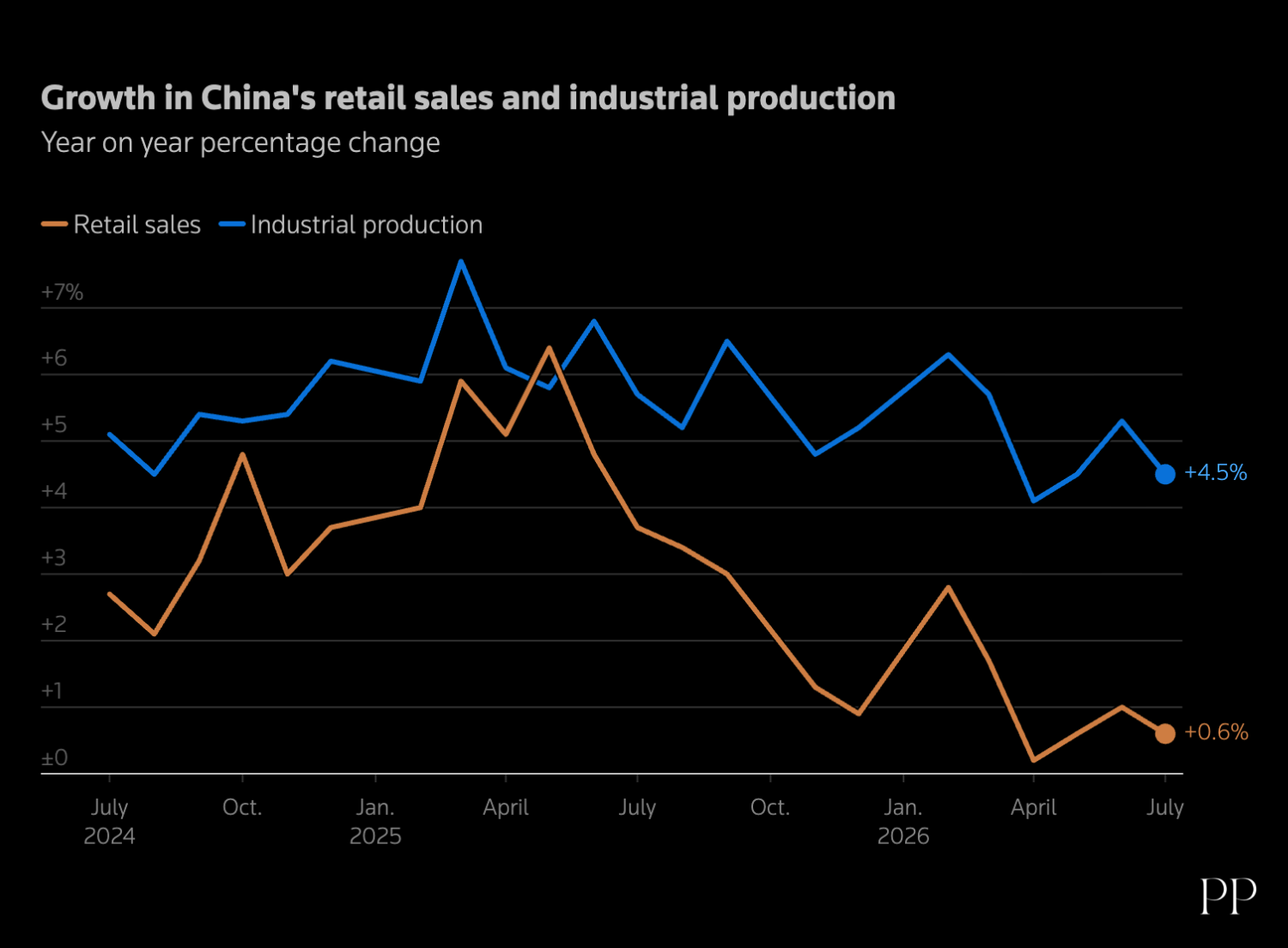
Industrial output increased 4.5% year on year in July, slowing from 5.3% growth in June and falling short of the 4.8% increase expected by economists in a Reuters poll, according to data released Monday by China’s National Bureau of Statistics. The slowdown indicates that manufacturers are facing weaker domestic demand despite continued strength in some export-oriented industries.
 Economists have argued that the weakness is partly linked to the limited impact of existing policy measures. Xu Tianchen, senior economist at the Economist Intelligence Unit, said fiscal spending has lagged behind expectations and argued that policymakers need to make more aggressive use of the tools already available to support the economy.
Investment has emerged as one of the biggest areas of concern. Fixed-asset investment fell 6.7% during the first seven months of 2026, compared with expectations for a 6% decline. The decline accelerated from a 5.7% contraction during the January-June period, highlighting the continued weakness in construction, property and other investment-intensive sectors.
Fu Linghui, a spokesperson for the National Bureau of Statistics, said policymakers would strengthen counter-cyclical adjustments and take additional steps to boost domestic demand. However, reviving consumer spending is likely to remain difficult while households continue to face uncertainty over employment, income and property values.
China’s prolonged property downturn remains one of the biggest obstacles to a stronger domestic recovery. New home prices fell 3.2% from a year earlier in July and declined another 0.1% from June. With a significant portion of household wealth tied to real estate, falling property values have weakened consumer confidence and reduced households’ willingness to spend.
Retail sales, a key measure of consumer demand, increased just 0.6% in July, down from 1% growth in June and well below economists’ forecast of 1.5%. The slowdown came despite increased summer tourism and seasonal spending, suggesting that government efforts to encourage consumption have yet to generate a broad-based recovery in household demand.
Julian Evans-Pritchard, head of China economics at Capital Economics, attributed part of the weakness to a reversal of the boost created by the government’s consumer goods trade-in programme. The scheme brought forward some purchases during the previous year, meaning that the resulting high comparison base has made current sales growth appear weaker.
Citi economists also pointed to a slowdown in government subsidy distribution. Daily average sales supported by the programme fell to around 6.3 billion yuan in July from approximately 9 billion yuan in June, suggesting that the fading impact of subsidies could further weaken consumer spending in the coming months.
Policymakers are also facing challenges beyond their direct control. Unusually severe weather disrupted economic activity in July, with three typhoons making landfall and millions of people relocated across manufacturing centres in eastern and southern China. The disruptions affected factories, transportation networks and retail activity at a particularly important point in the economic calendar.
The automotive sector provided another sign of weak domestic demand. Auto sales declined for the tenth consecutive month in July, although the pace of contraction moderated. The weakness at home stands in contrast to strong external demand, encouraging Chinese automakers to accelerate overseas expansion as they search for new sources of growth.
Other economic indicators have also pointed to a weak start to the third quarter. China’s official manufacturing purchasing managers’ index unexpectedly slipped into contraction, while both export and import growth moderated from June. Although trade growth remained in double-digit territory, the loss of momentum suggests that external demand may not be strong enough to fully compensate for weakness at home.
Despite the disappointing data, Fu remained confident that the recent weather disruptions would not derail China’s growth ambitions. Beijing is targeting economic growth of between 4.5% and 5% for 2026, and officials continue to argue that the underlying foundations of the economy remain solid.
Exports remain one of the strongest parts of the Chinese economy. Robust overseas demand, particularly from industries connected to the global artificial intelligence infrastructure boom, has helped keep factories busy despite weak domestic consumption. However, this dependence on external demand also leaves China increasingly exposed to trade restrictions, tariffs and geopolitical tensions.
China recorded another monthly trade surplus of more than $100 billion in July, putting the country on course to exceed a $1 trillion annual trade surplus for a second consecutive year. While the enormous surplus reflects the competitiveness of Chinese manufacturers, it is also intensifying trade tensions with major economic partners.
The European Union is considering tougher measures to address its growing trade deficit with China, while the United States has introduced additional tariffs on Chinese goods. Increasing trade barriers could make it more difficult for Chinese manufacturers to rely on exports as a substitute for weak domestic demand.
China’s leadership has pledged to support the economy by accelerating fiscal spending and introducing additional policies in a timely manner. However, policymakers have so far stopped short of announcing a major new stimulus package, suggesting that Beijing remains cautious about relying on aggressive fiscal intervention.
Yuhan Zhang, principal economist at The Conference Board’s China Center, described the current environment as one of “selective strength amid broad softness.” The assessment captures the uneven nature of China’s recovery: exports and selected manufacturing industries remain resilient, while household consumption, property and private investment continue to struggle.
The central challenge for Beijing is therefore not simply maintaining headline economic growth, but transforming pockets of policy-supported and export-driven strength into a broader domestic recovery. Unless consumer confidence improves and private investment begins to recover, China’s economy will remain vulnerable to external shocks, extreme weather, trade restrictions and fluctuations in global demand.
For policymakers, the latest figures increase the urgency of supporting domestic demand without creating excessive dependence on short-term stimulus. A sustained recovery will ultimately require stronger household consumption, a stabilization of the property market and renewed confidence among private businesses and investors. Until those conditions improve, China’s reliance on exports is likely to remain a defining feature—and a significant vulnerability—of its economic growth model.
Economists have argued that the weakness is partly linked to the limited impact of existing policy measures. Xu Tianchen, senior economist at the Economist Intelligence Unit, said fiscal spending has lagged behind expectations and argued that policymakers need to make more aggressive use of the tools already available to support the economy.
Investment has emerged as one of the biggest areas of concern. Fixed-asset investment fell 6.7% during the first seven months of 2026, compared with expectations for a 6% decline. The decline accelerated from a 5.7% contraction during the January-June period, highlighting the continued weakness in construction, property and other investment-intensive sectors.
Fu Linghui, a spokesperson for the National Bureau of Statistics, said policymakers would strengthen counter-cyclical adjustments and take additional steps to boost domestic demand. However, reviving consumer spending is likely to remain difficult while households continue to face uncertainty over employment, income and property values.
China’s prolonged property downturn remains one of the biggest obstacles to a stronger domestic recovery. New home prices fell 3.2% from a year earlier in July and declined another 0.1% from June. With a significant portion of household wealth tied to real estate, falling property values have weakened consumer confidence and reduced households’ willingness to spend.
Retail sales, a key measure of consumer demand, increased just 0.6% in July, down from 1% growth in June and well below economists’ forecast of 1.5%. The slowdown came despite increased summer tourism and seasonal spending, suggesting that government efforts to encourage consumption have yet to generate a broad-based recovery in household demand.
Julian Evans-Pritchard, head of China economics at Capital Economics, attributed part of the weakness to a reversal of the boost created by the government’s consumer goods trade-in programme. The scheme brought forward some purchases during the previous year, meaning that the resulting high comparison base has made current sales growth appear weaker.
Citi economists also pointed to a slowdown in government subsidy distribution. Daily average sales supported by the programme fell to around 6.3 billion yuan in July from approximately 9 billion yuan in June, suggesting that the fading impact of subsidies could further weaken consumer spending in the coming months.
Policymakers are also facing challenges beyond their direct control. Unusually severe weather disrupted economic activity in July, with three typhoons making landfall and millions of people relocated across manufacturing centres in eastern and southern China. The disruptions affected factories, transportation networks and retail activity at a particularly important point in the economic calendar.
The automotive sector provided another sign of weak domestic demand. Auto sales declined for the tenth consecutive month in July, although the pace of contraction moderated. The weakness at home stands in contrast to strong external demand, encouraging Chinese automakers to accelerate overseas expansion as they search for new sources of growth.
Other economic indicators have also pointed to a weak start to the third quarter. China’s official manufacturing purchasing managers’ index unexpectedly slipped into contraction, while both export and import growth moderated from June. Although trade growth remained in double-digit territory, the loss of momentum suggests that external demand may not be strong enough to fully compensate for weakness at home.
Despite the disappointing data, Fu remained confident that the recent weather disruptions would not derail China’s growth ambitions. Beijing is targeting economic growth of between 4.5% and 5% for 2026, and officials continue to argue that the underlying foundations of the economy remain solid.
Exports remain one of the strongest parts of the Chinese economy. Robust overseas demand, particularly from industries connected to the global artificial intelligence infrastructure boom, has helped keep factories busy despite weak domestic consumption. However, this dependence on external demand also leaves China increasingly exposed to trade restrictions, tariffs and geopolitical tensions.
China recorded another monthly trade surplus of more than $100 billion in July, putting the country on course to exceed a $1 trillion annual trade surplus for a second consecutive year. While the enormous surplus reflects the competitiveness of Chinese manufacturers, it is also intensifying trade tensions with major economic partners.
The European Union is considering tougher measures to address its growing trade deficit with China, while the United States has introduced additional tariffs on Chinese goods. Increasing trade barriers could make it more difficult for Chinese manufacturers to rely on exports as a substitute for weak domestic demand.
China’s leadership has pledged to support the economy by accelerating fiscal spending and introducing additional policies in a timely manner. However, policymakers have so far stopped short of announcing a major new stimulus package, suggesting that Beijing remains cautious about relying on aggressive fiscal intervention.
Yuhan Zhang, principal economist at The Conference Board’s China Center, described the current environment as one of “selective strength amid broad softness.” The assessment captures the uneven nature of China’s recovery: exports and selected manufacturing industries remain resilient, while household consumption, property and private investment continue to struggle.
The central challenge for Beijing is therefore not simply maintaining headline economic growth, but transforming pockets of policy-supported and export-driven strength into a broader domestic recovery. Unless consumer confidence improves and private investment begins to recover, China’s economy will remain vulnerable to external shocks, extreme weather, trade restrictions and fluctuations in global demand.
For policymakers, the latest figures increase the urgency of supporting domestic demand without creating excessive dependence on short-term stimulus. A sustained recovery will ultimately require stronger household consumption, a stabilization of the property market and renewed confidence among private businesses and investors. Until those conditions improve, China’s reliance on exports is likely to remain a defining feature—and a significant vulnerability—of its economic growth model.